A comprehensive educational guide to fine blanking technology — the triple-force shearing process that produces fully smooth, burr-free edges in a single stroke.
Fine blanking is a precision metal-forming process that produces fully sheared, burr-free edges in a single stroke. Unlike conventional stamping, which produces a part edge with approximately one-third smooth shear zone and two-thirds torn fracture surface, fine blanking generates a 100% smooth shear edge with dimensional accuracy at IT6–IT9 tolerance grade and surface roughness Ra ≤ 0.4 μm. The process achieves this through a fundamentally different force architecture: three independently controlled hydraulic forces act simultaneously on the material — V-ring impingement force, counter-pressure force and blanking force — creating conditions where the material shears cleanly rather than tearing.
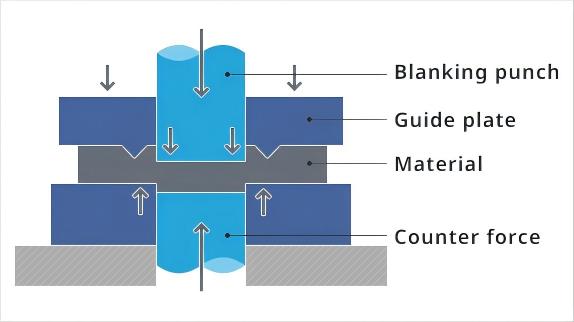
The key distinction is this: in conventional stamping, the punch pushes material through the die with a single ram force. The material first shears for approximately one-third of its thickness, then fractures (tears) for the remaining two-thirds. The result is a ragged, dimensionally inconsistent edge that often requires secondary machining, deburring or grinding. In fine blanking, the V-ring holds the material flat and constrained around the cutting line, and the counter-pressure opposes the blanking force from below, preventing the material from bulging or cracking. The material shears cleanly through 100% of its thickness — no fracture zone, no tear, no burr.


The fine blanking process was invented by Fritz Schiess in Switzerland in the 1920s. Schiess recognized that conventional stamping produced inconsistent edge quality because the material was unconstrained during shearing — it could bulge, bend and fracture freely. His insight was that constraining the material with a V-shaped ring indenter (the V-ring or "stinging ring") around the cutting line, combined with opposing counter-pressure from below, would force the material to shear cleanly rather than tear.
The technology was industrialized and commercialized by Feintool AG, founded in Switzerland in 1959, which became the dominant fine blanking press manufacturer worldwide. Feintool's HFA-series hydraulic presses and earlier mechanical fine blanking presses established the industry standard for triple-force fine blanking. Other manufacturers — Mori (Japan), Schuler (Germany), Hydrel (Switzerland), Osterwalder (Switzerland), Asahi-Seiki (Japan) and Nagano Seiko (Japan) — subsequently developed their own fine blanking press lines, all based on the same fundamental triple-force principle.
HS-FINEB was established in Huangshi, Hubei Province — a city with a deep steel-making and heavy-industry heritage — and has spent nearly 40 years focused exclusively on fine blanking press manufacturing. The HF-series represents accumulated engineering experience in triple-force hydraulic press design, built to the same process fundamentals that define fine blanking worldwide. We also provide refurbishment and repair services for Feintool, Mori and other major brands, giving our engineers cross-brand expertise.
The V-ring (also called ring gear or stinging ring) is a sharp, V-shaped protrusion on the stripper plate that indents the material around the cutting line before the punch contacts the material. The V-ring penetrates 20–30% of material thickness into the strip, creating a constraining groove that prevents lateral material flow during shearing. Without the V-ring, the material would bulge outward as the punch pushes through, causing the shear zone to transition to fracture prematurely. The V-ring force is typically 20–40% of the blanking force, applied through an independent hydraulic circuit (ring gear cylinder).
The counter-pressure (also called ejector force or counter-hold force) is applied from below the material, opposing the blanking punch. The counter-pressure plate pushes upward against the material with 10–20% of the blanking force. This opposing pressure prevents the material from bulging downward (which would occur if only the punch pushed from above), keeps the material flat during shearing, and suppresses crack initiation at the cutting edge. The result is that the shear zone extends through 100% of the material thickness instead of transitioning to fracture at the one-third point.
The blanking force (main ram force) is the primary cutting force that pushes the punch through the material. It is calculated as: Force = Perimeter × Material Thickness × Shear Strength × Safety Factor. The blanking force must overcome the material's shear strength cleanly — with the V-ring and counter-pressure holding the material constrained, the blanking force produces a smooth shear rather than a tear. The blanking speed is controlled by proportional hydraulic valves, typically 5–15 mm/s during the cutting phase, slow enough to maintain clean shearing but fast enough for production economics.
The three forces act simultaneously, not sequentially. The V-ring engages first (indenting the material before the punch contacts), then the blanking force and counter-pressure build together during the cut. The CNC controller synchronizes all three force profiles — the operator sets V-ring force, counter-pressure and blanking speed as a coordinated program, not as independent setpoints. This synchronization is what distinguishes a fine blanking press from a conventional stamping press with added cylinders: the force profiles are engineered as one system.

The difference between fine blanking and conventional stamping is fundamental — it is a difference in process physics, not merely a difference in precision:
For a detailed comparison with selection guidance, see our fine blanking vs conventional stamping comparison page.
Fine blanking works on a wide range of sheet metals from 1 mm to 25 mm thickness, including:
The key material requirement is ductility — the material must shear cleanly rather than fracturing. Very hard or brittle materials (e.g., hardened tool steel, some cast metals) are not suitable for fine blanking.
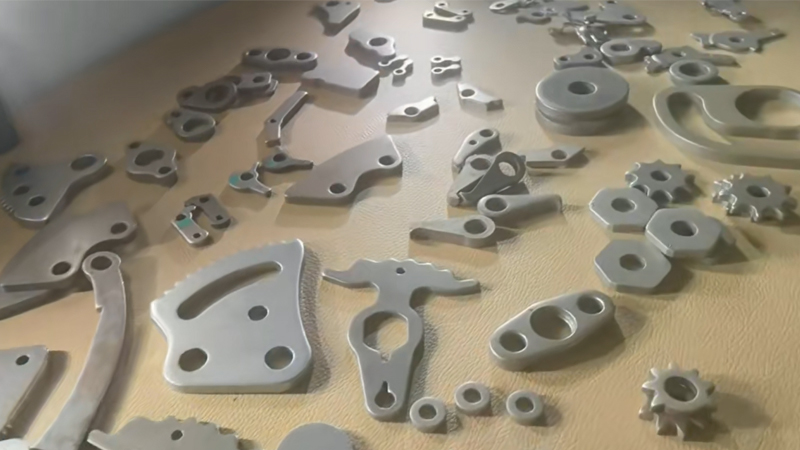
Fine-blanked parts are found across virtually every industry that uses precision sheet metal components:
Send us your part drawings and material specifications. Our engineers will assess fine blanking feasibility, recommend the appropriate press model and configure the force parameters for your application.