💬 WhatsApp Chat

Fine Blanking for Locks & Security Hardware

Lock cylinder keyway profiles, bolt teeth, and tumbler plates demand micron-level precision — fine blanking produces complex security profiles in a single stroke.

High-Volume Precision

Every Lock You Turn Has 6-14 Fine-Blanked Components Inside

Open any door lock, padlock or automotive ignition lock and you will find a system of fine-blanked components working in concert: the cylinder plug with its complex keyway profile, the tumbler pins and driver pins, the bolt mechanism with its rack teeth, the cam that converts rotational key movement into linear bolt travel, and the retaining plates that hold the pin stack in alignment. Each of these components demands micron-level precision because the lock's security rating depends on the geometric relationship between tumblers, keyway and bolt.

Fine blanking is the dominant production method for lock hardware because it achieves what no other stamping process can: complex internal profiles — keyway channels, pin holes, rack teeth — cut to 0.01 mm tolerance in a single press stroke from coil or strip stock. The 100% shear zone on every cut surface eliminates the burr, fracture and taper that would cause pin sticking, key binding or bolt rattle. And the high production rates — 40-60 strokes per minute on brass and zinc alloys — make fine blanking the only economically viable method for the multi-million-unit volumes that lock hardware demands.

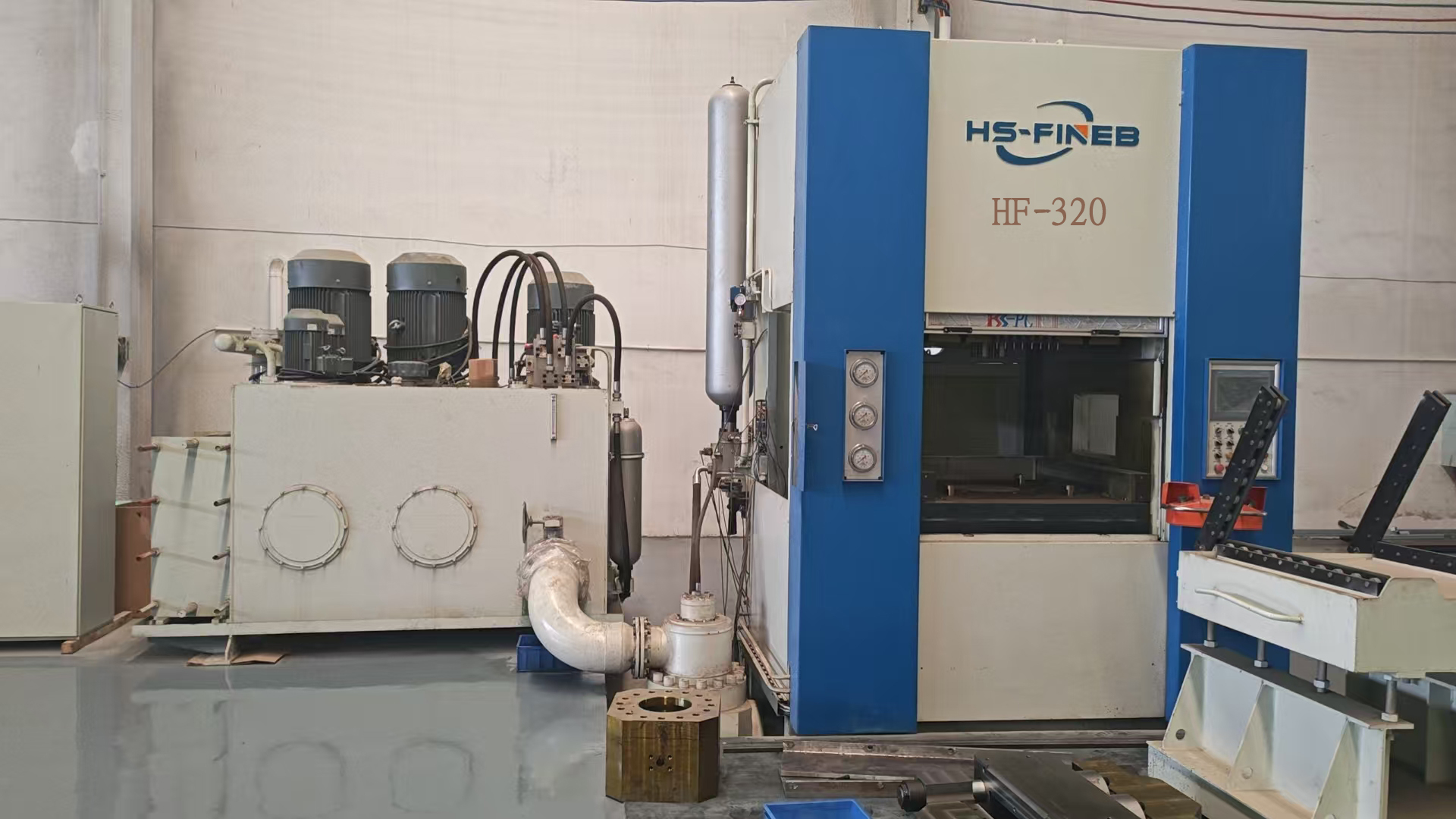
HS-FINEB presses — the HF-200, HF-320 and HF-400 — cover the full range of lock hardware production, from 200-ton brass tumbler plates to 400-ton multi-station progressive dies for complete lock component families.

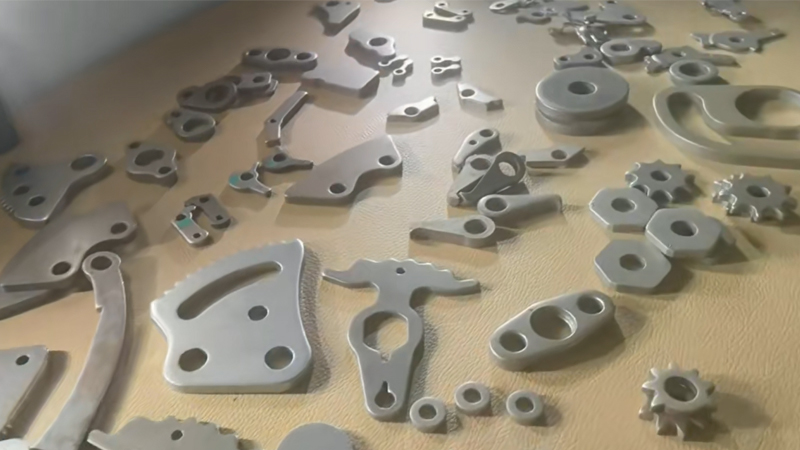
Fine-blanked lock cylinder and security hardware components
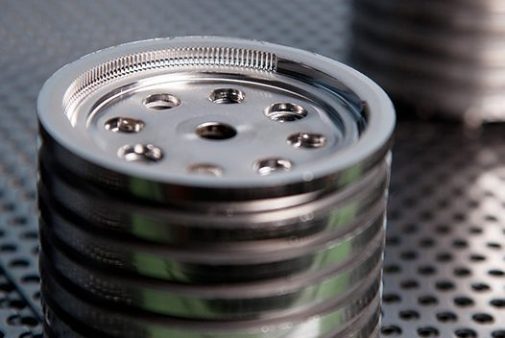
Lock cylinder plug with complex keyway profile produced by fine blanking
Keyway Geometry

Lock Cylinder Keyway Profiles: Complex Geometry in a Single Stroke

The keyway is the channel that admits the key into the lock cylinder. Its cross-section is anything but simple: a standard pin tumbler keyway has 4-12 ward cuts along its length, each angled at different positions around the cylinder bore to create unique key combinations. The keyway profile must be reproducible across millions of cylinders to within 0.01 mm, because any variation affects how the key enters, how the tumblers lift, and ultimately whether the lock opens.

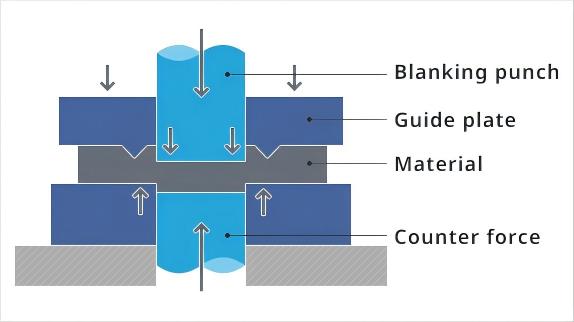
Conventional production of lock cylinder plugs requires bar stock, turning, drilling, milling the keyway on a specialized milling machine, and deburring — five operations with significant material waste and cycle time of 30-60 seconds per part. Fine blanking from coil stock produces the same keyway geometry in a single stroke: the die cavity contains the complete keyway cross-section, including all ward cuts, chamfers and the cylinder bore, ground into the carbide die plate by wire-EDM. The V-ring compresses brass or zinc material into the keyway cavity, producing 100% shear zone on all ward surfaces — no burr to interfere with key insertion, no taper to cause binding.

For brass C26000 cylinder plugs at 3-4 mm wall thickness, fine blanking on the HF-320 achieves 40-60 SPM with carbide die life exceeding 500,000 strokes — a dramatic cost reduction compared to the multi-operation machining approach. The 0.01 mm keyway dimensional accuracy holds across the full die life because carbide wears at less than 0.001 mm per 10,000 strokes on brass.

Rack Tooth Precision

Bolt Mechanism Teeth: 0.01 mm Pitch Tolerance on Rack Geometry

The lock bolt — the component that physically extends from the lock face to engage the strike plate — is driven by a cam or gear that converts the key's rotational movement into linear bolt travel. Many bolt designs use rack teeth cut along the bolt body, engaging a pinion gear on the cylinder plug. The rack tooth pitch must hold to 0.01 mm tolerance to ensure smooth bolt travel without backlash, and the tooth profile must have 100% shear zone to prevent wear that would create play between the rack and pinion over the lock's 100,000+ operating cycles.

Fine blanking produces the rack teeth with the complete involute or trapezoidal profile ground into the carbide die cavity. The V-ring surrounds each tooth cavity, compressing material into the tooth root and flank to achieve 100% shear zone on all functional surfaces. The 0.01 mm pitch tolerance is maintained by the wire-EDM accuracy of the die cavity — ±0.005 mm — which determines tooth-to-tooth spacing at the die level, not through secondary machining or measurement.

Bolt mechanism components are typically produced in stainless steel 304 for exterior door locks (corrosion resistance) or zinc ZN4 alloy for interior locks (cost efficiency). The HF-200 handles single-cavity bolt production in zinc at 2-3 mm thickness, while the HF-400 supports multi-cavity progressive dies for stainless steel bolts at 4-5 mm thickness with simultaneous piercing of the pinion gear hole.

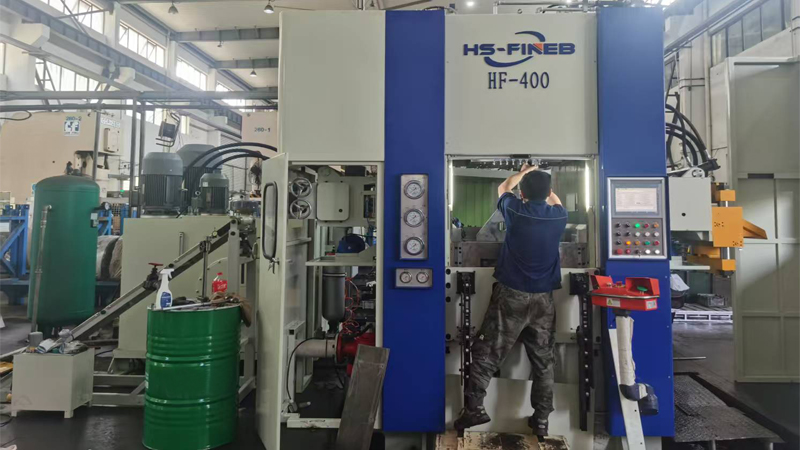
HF-400 fine blanking press for lock bolt production
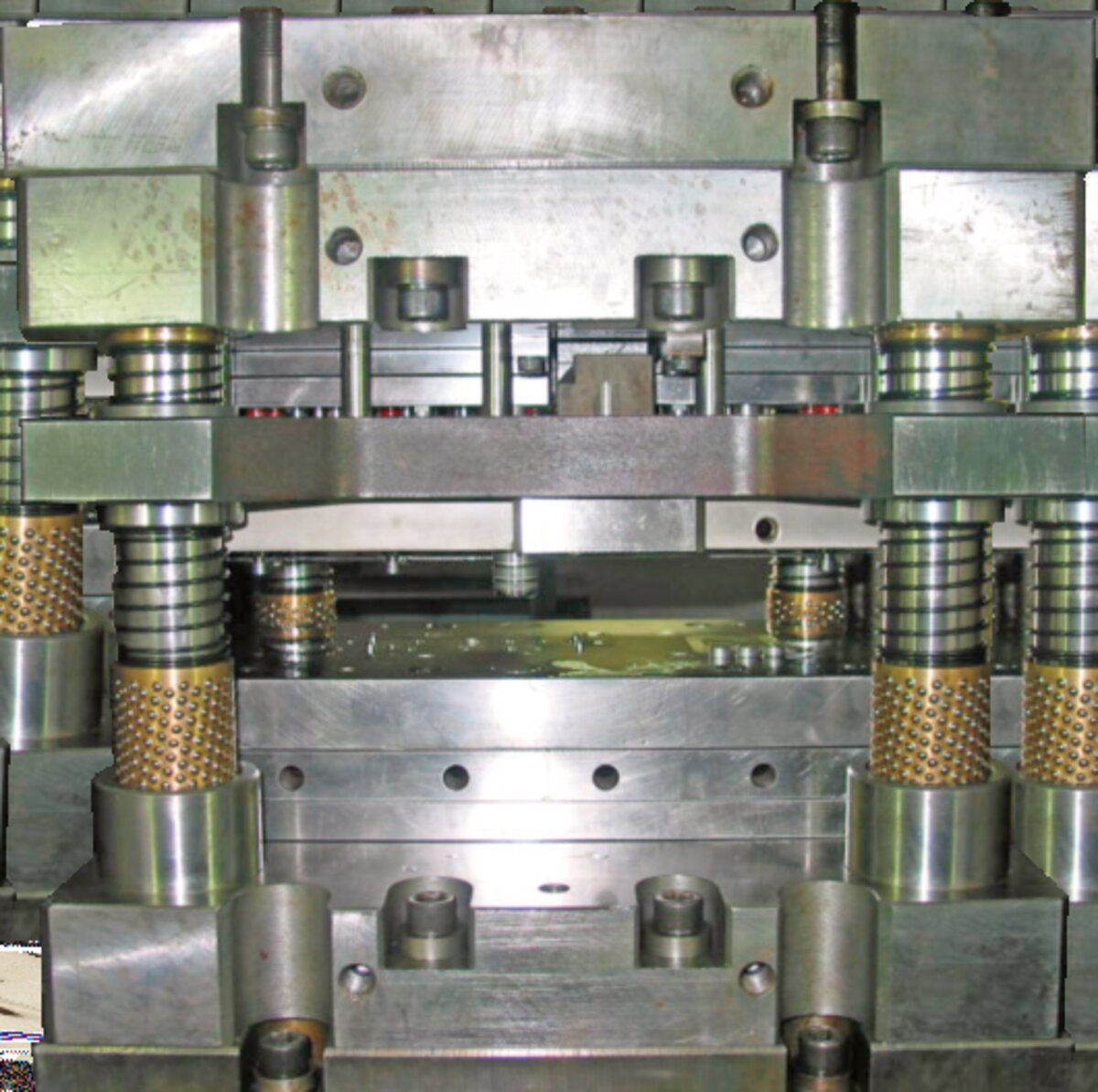
Fine blanking die detail for tumbler plate production
Pin Stack Alignment

Tumbler Plate Stacks: 0.03 mm Flatness for Smooth Pin Stacking

Pin tumbler locks operate on a stack of pins — key pin, driver pin and spring — that must align precisely at the shear line when the correct key is inserted. The tumbler plate (or cylinder shell) holds these pin stacks in drilled or blanked holes, and the plate flatness directly determines whether all pin stacks align simultaneously at the shear line. If the plate warps by more than 0.03 mm, some pin stacks will bind at the shear line even with the correct key, causing the lock to stick or fail.

Fine blanking produces tumbler plates with 0.03 mm flatness across the full plate surface because the counter-pressure pad applies uniform holding force across the entire blank during the cutting stroke. This prevents the material relaxation and warping that occurs in conventional stamping, where the unsupported blank distorts as each hole is pierced. Additionally, the 100% shear zone on the pin hole walls eliminates the burr that would interfere with pin insertion and the taper that would cause pin tilt within the hole.

For multi-hole tumbler plates in brass C26000 at 3-4 mm thickness, the HF-200 with 2000 kN total force and 500×500 mm working table provides sufficient capacity for 8-12 hole patterns. The progressive die configuration pierces all pin holes, blanks the outer profile and shears the plate from the coil in a single feed pitch, achieving 50-60 SPM production rates with die life exceeding 500,000 strokes on brass.

Material Selection

Materials for Lock & Security Hardware Fine Blanking

Brass C26000

The industry standard for lock cylinder plugs, tumbler plates and pin components. 70/30 copper-zinc alloy with excellent corrosion resistance, machinability and fine blanking response. Hardness 55-70 HV in the annealed condition, work-hardening to 120-140 HV in the shear zone. Carbide die life on brass exceeds 500,000 strokes due to the material's low abrasiveness and galling resistance.

Zinc ZN4 (Zamak 4)

Cost-efficient zinc die-casting alloy for interior lock components, bolt bodies and cam followers. Fine blanking from rolled zinc strip achieves 100% shear zone with very low die-roll (below 5% of material thickness) due to the material's low shear strength. Die life on zinc exceeds 600,000 strokes, but press force requirements are 30-40% lower than brass, enabling higher SPM rates.

Stainless 304

For exterior and marine lock hardware requiring corrosion resistance. The work-hardening behavior of austenitic 304 stainless requires 40-50% higher V-ring force than brass to maintain full shear zone depth, and carbide die life is shorter (200,000-300,000 strokes). The 100% shear zone provides a hardened, corrosion-free edge that resists pitting and crevice corrosion in salt spray environments.

View full material processing guide →

Production Parameters

High-Volume Production Data for Lock Components

Lock ComponentTypical ForceMaterialThicknessSPMDie Life (strokes)
Cylinder plug (keyway)200-320TC26000 brass3-4 mm40-60500,000+
Tumbler plate200TC26000 brass3-4 mm50-60500,000+
Bolt body (rack teeth)200-400TSUS304 / ZN43-5 mm40-55200,000-600,000
Cam follower200-320TC26000 / ZN43-4 mm50-60400,000-600,000
Retaining plate200TC26000 brass2-3 mm55-60500,000+
Note: SPM (strokes per minute) and die life figures assume carbide tooling, coil-fed progressive die configuration, and per-material blanking speed optimization. Lock hardware production often uses multi-cavity dies to maximize throughput — a 4-cavity tumbler plate die on the HF-320 delivers 200-240 effective parts per minute. Security ratings: lock components produced on HS-FINEB presses meet EN 1303 (cylinder locks) and DIN 18252 (mortice locks) dimensional requirements when configured with appropriate material grade and heat treatment.
Recommended Presses

HS-FINEB Models for Lock Hardware Production

HF-200HF-200 fine blanking press for brass tumbler plates

HF-200 (200T)

Entry platform for brass tumbler plates, retaining plates and zinc bolt bodies. 2000 kN total force, 500×500 mm table, 70 SPM. Ideal for multi-cavity brass lock dies.

HF-320HF-320 fine blanking press for lock cylinder plugs

HF-320 (320T)

Production standard for cylinder plugs with complex keyway profiles. 3200 kN force, 65 SPM. Carbide die life 500,000+ strokes on C26000 brass.

HF-400HF-400 fine blanking press for stainless steel bolt mechanisms

HF-400 (400T)

Stainless steel bolt mechanisms and multi-station progressive dies for complete lock component families. 650×650 mm table for compound die layouts.

Progressive Die Configurations

Multi-Profile Progressive Dies for Lock Component Families

Lock manufacturers typically produce a family of components — cylinder plugs, tumblers, bolts, cams — from the same material grade and coil width. A multi-station progressive die configured on the HF-400 can produce two or three different component types per feed pitch by arranging different die cavities across the strip. This approach maximizes material utilization and reduces the number of die changes required when switching between component types in the same production run.

HS-FINEB engineers progressive dies with modular carbide inserts for each cavity, allowing individual cavity replacement without re-grinding the entire die plate. The V-ring geometry is configured per cavity to match the specific component's material flow requirements — deeper V-ring for keyway profiles, standard V-ring for tumbler holes, angled V-ring for rack teeth. Learn about our die design process →

Fine blanking process for lock component progressive die production

Have a Lock Component to Evaluate for Fine Blanking?

Send your part drawing, material grade and target volume. Our engineers will assess the keyway or rack tooth profile feasibility, calculate the required press force for your material, and recommend the right HF-series platform for your lock hardware production — with carbide die life projections per material grade.

💬