💬 WhatsApp Chat

Case Study: Mori FB Series Hydraulic System Repair

A field service engagement restoring counter-pressure stability on a 650-ton Mori fine blanking press at a Japanese automotive parts manufacturer in India — from diagnostic methodology through seal replacement, valve upgrade and system commissioning.

Field Service Case Study

Customer Background and Challenge

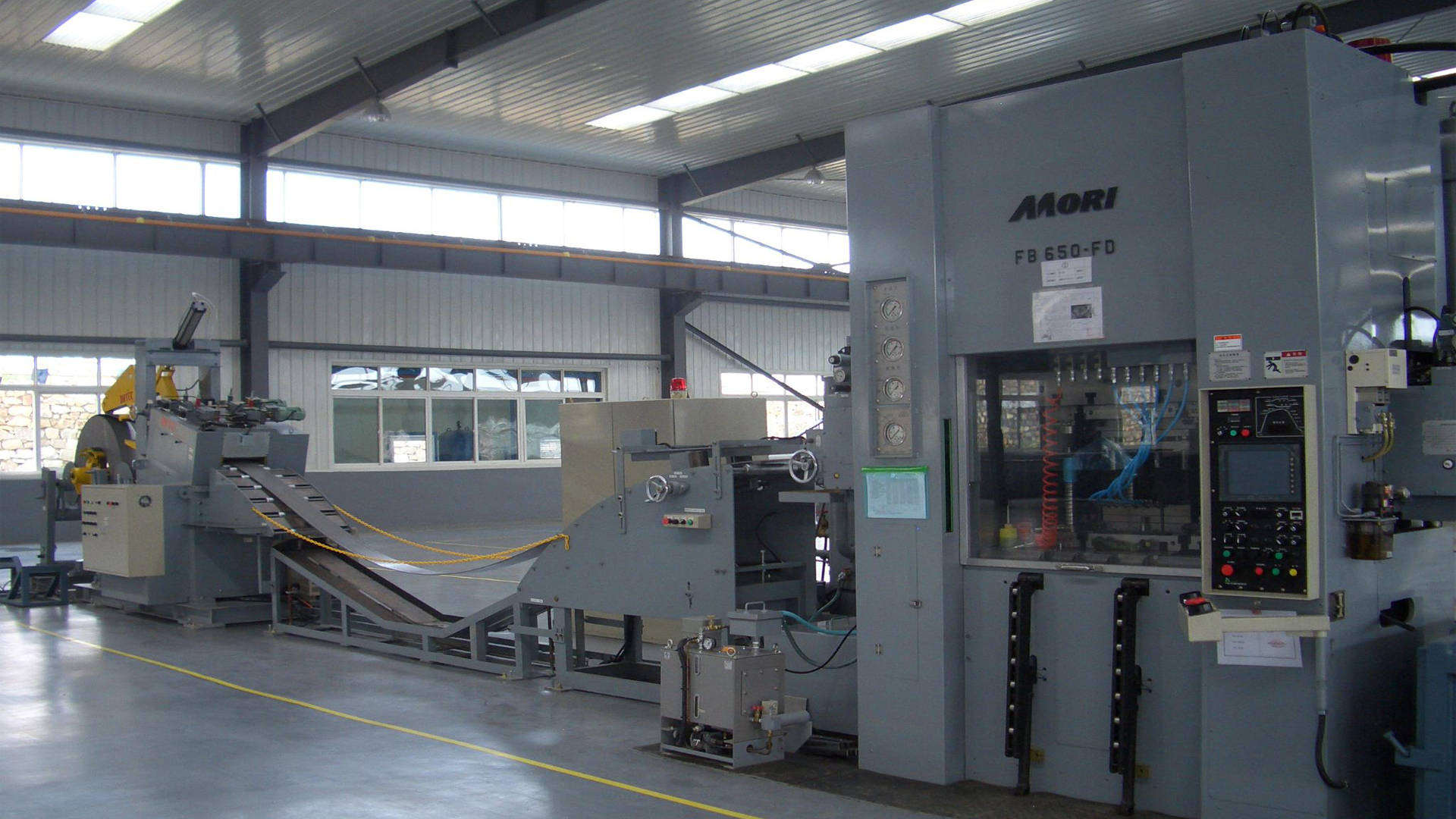
The customer is a Japanese automotive parts manufacturer operating a production facility in Pune, India. The plant runs a Mori FB650-FDE-B triple-action fine blanking press rated at 650 tons (6500 kN), producing seat recliner components and transmission gear blanks from 4–6 mm C45 and 16MnCr5 steel. The press had accumulated approximately 38,000 operating hours since its last major hydraulic service and was exhibiting a progressive deterioration in counter-pressure stability that was beginning to affect part quality.

The production engineering team reported that the counter-pressure was fluctuating ±15% around the setpoint during the blanking stroke, causing inconsistent die-roll across the part batch. Parts at the beginning of a coil run showed acceptable die-roll (approximately 8% of material thickness), but by mid-coil the die-roll was reaching 18–22%, exceeding the 15% specification for automotive seat recliner components. The reject rate had climbed to 4.7% over the preceding six weeks, compared to the historical baseline of 0.8%.

HS-FINEB was contracted to perform an on-site diagnostic assessment and hydraulic system repair. Our field service team mobilized to the Pune facility with portable hydraulic test equipment, spare seal kits, and replacement valves pre-selected based on the Mori FB650 hydraulic circuit diagrams reviewed remotely before dispatch.

Mori fine blanking press hydraulic system repair and diagnostic assessment by HS-FINEB field service engineers
Root Cause Analysis

Diagnostic Findings

The diagnostic assessment was conducted over two shifts, during which our engineers instrumented the counter-pressure circuit with portable pressure transducers (0.1% accuracy class) and a 10 kHz data acquisition system to capture pressure-time profiles during actual blanking strokes. Four root causes were identified:

Counter-Pressure Cylinder Internal Leakage

The counter-pressure cylinder showed internal leakage across the piston. A pressurized leak-down test was performed: the rod end was pressurized to 200 bar and isolated, and pressure decay was logged. The cylinder lost 45 bar in 60 seconds — far exceeding the 5 bar/60s specification. Disassembly confirmed the piston seal was extruded, allowing pressure bypass between the rod-end and cap-end chambers. The extrusion pattern indicated a combination of thermal degradation and pressure spikes exceeding the seal’s extrusion limit during rapid decompression cycles.

Proportional Valve Slow Response

The proportional pressure valve on the counter-pressure circuit exhibited a 200 ms rise time — four times slower than the 50 ms specification for this valve model. This sluggish response meant the counter-pressure could not stabilize before the blanking force engaged the material, producing the initial pressure dip that led to excessive die-roll at the start of each stroke. The valve’s solenoid resistance was within specification, but the valve spool showed wear deposits and varnish buildup consistent with degraded hydraulic oil.

🔎

Pressure Transducer Drift

The counter-pressure transducer had drifted 8% high at the 200 bar operating point. The CNC controller was compensating based on this erroneous reading, so the actual counter-pressure was 8% below the displayed setpoint — a systematic error that explained the generally higher-than-expected die-roll even before the fluctuation issue worsened. Recalibration against a dead-weight tester confirmed the offset was linear across the range, indicating zero-point drift rather than span error.

💧

Hydraulic Oil Degradation

Oil analysis revealed two critical findings: elevated copper content (320 ppm, against a 50 ppm alarm threshold) indicating accelerated bushing wear, and water content of 0.15% — three times the 0.05% maximum specified for this hydraulic system. The water contamination was traced to a failing heat exchanger seal allowing cooling water ingress. The elevated copper was consistent with the spool wear observed in the proportional valve, creating a feedback loop: worn bushings shed copper into the oil, which accelerates valve spool wear, which degrades pressure control.

Repair Execution

Systematic Repair Scope

The repair was executed over four working days during a scheduled production shutdown. Our team worked in a structured sequence to avoid re-contaminating completed circuits:

1. Counter-Pressure Cylinder Rebuild: The cylinder was fully stripped on-site. The piston seal, rod seal, wiper seal, and wear rings were replaced with a new seal kit matched to the Mori FB650 bore and rod dimensions. The cylinder bore was inspected with a bore gauge — measurements showed taper wear of 0.03 mm over the 450 mm stroke length, within acceptable limits. The bore was honed to restore surface finish (Ra 0.2–0.4 μm) and eliminate the glazing that was contributing to seal wear. New wear rings were sized with the correct interference fit to restore piston-to-bore clearance to specification.

2. Proportional Valve Replacement: The degraded proportional valve was replaced with a current-generation Bosch Rexroth 4WRPE6 valve, selected for its 30 ms response time and integrated position feedback. The new valve was specified to match the Mori hydraulic circuit’s flow requirements (12 L/min at 200 bar) and electrical interface (0–10 V command signal). The replacement required an adapter plate to match the original mounting pattern, which was machined on-site.

3. Pressure Transducer Replacement: The drifted transducer was replaced with a factory-calibrated unit of equivalent range (0–400 bar) and accuracy class (0.1%). The new transducer was bench-calibrated against a dead-weight tester before installation, and a three-point verification (50, 200, 350 bar) was performed after installation to confirm accuracy within the system.

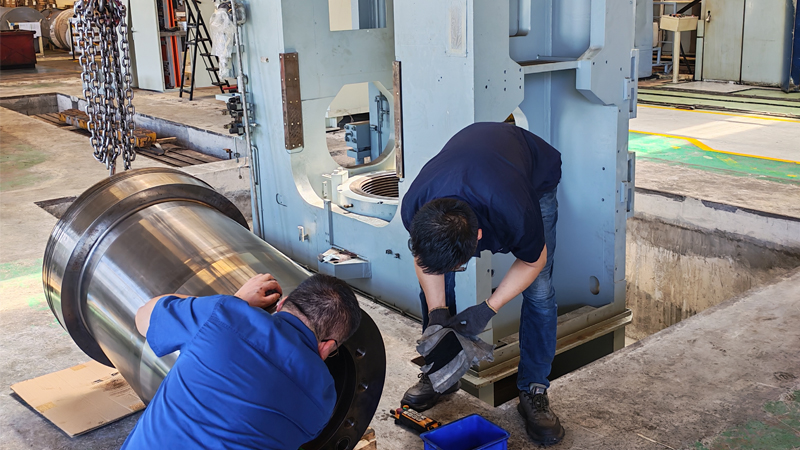
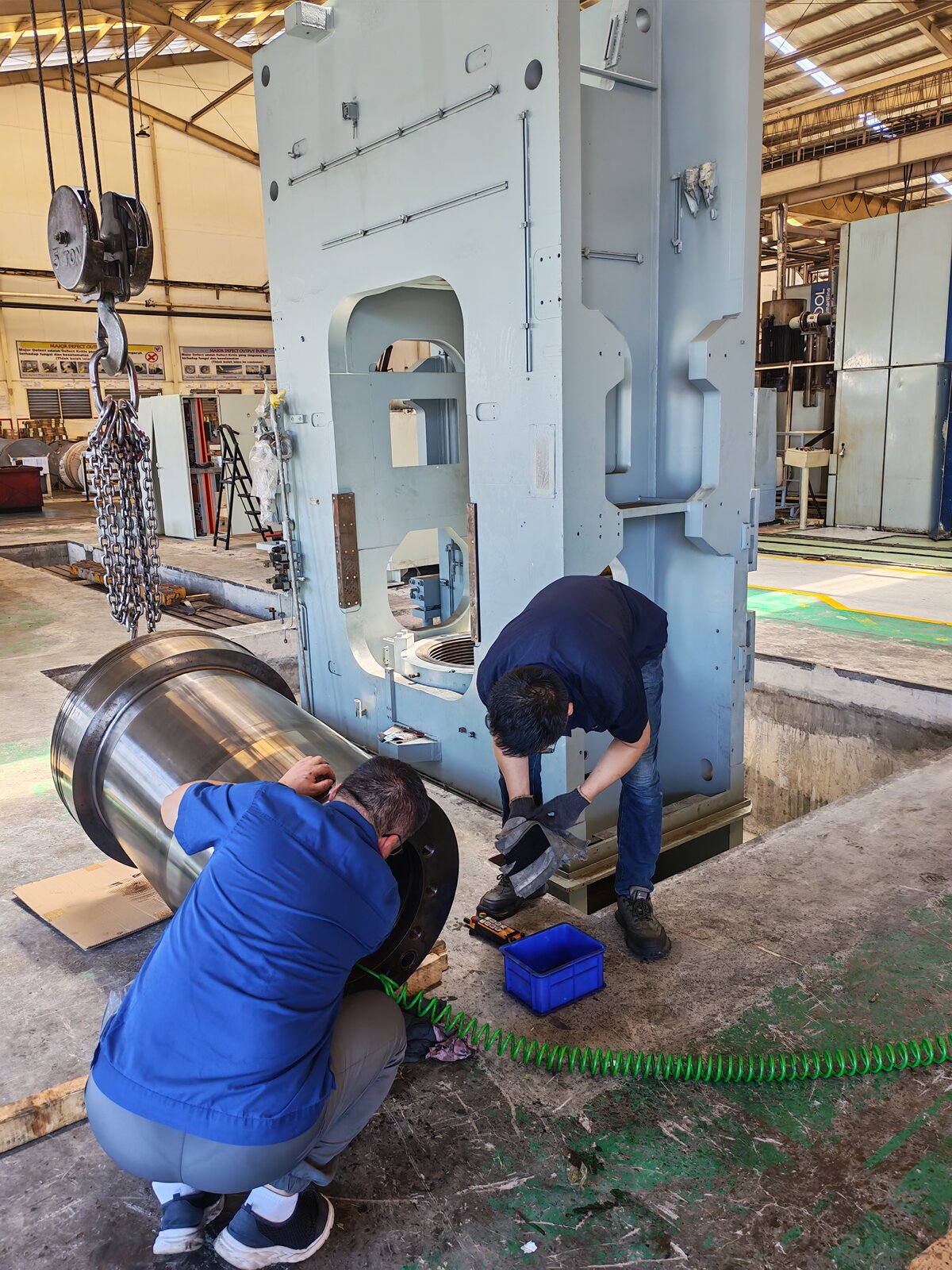
HS-FINEB field service engineers performing hydraulic cylinder rebuild and valve replacement on Mori fine blanking press
System Commissioning

Verification and Results

Hydraulic cylinder rebuild with new seal kit and honed bore for Mori fine blanking press counter-pressure system

4. Complete Oil Flush and Replacement: The entire hydraulic system (approximately 450 liters) was drained. The reservoir was cleaned manually, and the system was flushed with flushing oil for 4 hours at 40°C to dislodge contaminants from lines and valve blocks. The system was then charged with fresh ISO VG68 hydraulic oil meeting the DIN 51524-2 specification. The failing heat exchanger seal was also replaced to eliminate the water ingress source.

5. Filter Element Replacement: Both the return-line filter (10 μm absolute) and pressure-line filter (3 μm absolute) elements were replaced. The pressure-line filter housing was inspected and the bypass indicator was verified to function correctly.

6. Step-by-Step Commissioning: The system was pressurized in 50 bar increments from 0 to 200 bar, holding each step for 5 minutes while checking for leaks and verifying pressure stability. At the full 200 bar counter-pressure setpoint, the pressure was logged over 100 consecutive blanking strokes. The data showed the counter-pressure stability had been restored to ±2% around setpoint — down from the ±15% deviation that triggered the service call.

Production Verification: After commissioning, a 500-part trial run was conducted on the customer’s seat recliner component. Die-roll was measured on samples across the batch: results showed 7–9% of material thickness, well within the 15% specification. The reject rate dropped to 0.6%, below the historical baseline. Cycle rate was maintained at the rated 25 SPM (strokes per minute) throughout the trial.

Lessons Learned

Key Takeaways for Press Owners

📅

Periodic Oil Analysis

Regular hydraulic oil analysis (every 2,000 operating hours) would have detected the copper and water contamination months earlier, before it caused cascading wear in the proportional valve and cylinder seals. The cost of an oil analysis sample is negligible compared to the production losses from a 4.7% reject rate sustained over six weeks.

🔍

Instrumented Diagnostics

The root cause was not visible to the press operator — the CNC displayed the setpoint, not the actual pressure. Instrumented diagnostics with portable transducers and data acquisition revealed the ±15% fluctuation that the control system was masking. Investing in periodic instrumented pressure audits catches degradation before it affects part quality.

Seal Proactivity

The piston seal extrusion was the result of cumulative pressure spikes during rapid decompression. Specifying seal materials rated for higher extrusion limits (e.g., glass-filled PTFE cap over elastomer energizer) at the next scheduled rebuild would extend the service interval beyond the current 35,000–40,000 hour window.

Need Field Service for Your Fine Blanking Press?

Our field service engineers are experienced with Mori, Feintool, Schuler, Hydrel, Osterwalder, Asahi-Seiki and Nagano Seiko presses. Contact us for diagnostic assessment, hydraulic repair and preventive maintenance programs.

💬