💬 WhatsApp Chat

Medical Device Fine Blanking Solutions

Surgical instrument components, implant-related blanks, and precision housings — fine blanked from biocompatible stainless and titanium alloys with zero-burr edge requirements and surface finishes that meet the most demanding medical device specifications.

Medical Material Reality

Stainless and Specialty Alloys Cut Differently

Medical components are frequently specified in 300-series stainless steel, titanium, or precipitation-hardened stainless — materials chosen for biocompatibility and corrosion resistance, but which are significantly tougher on tooling than the carbon steel most fine blanking dies are optimized for by default. Austenitic stainless steels like 316L work-harden aggressively at the cut edge, increasing die wear by 2–3x compared to equivalent-thickness carbon steel. Titanium's low modulus and high springback demand counter-pressure settings 30% above steel norms.

This means die material and coating selection must account for the specific medical alloy from the start — not be adjusted after the first production run wears the die faster than expected. D2 tool steel, the default for carbon steel work, is inadequate for 316L production above 10,000 hits. Vanadis 4 Extra or powder metallurgy tool steels with AlCrN or TiCN PVD coatings are the baseline for medical-grade fine blanking tooling. See our die design guide for tool steel selection by material type.

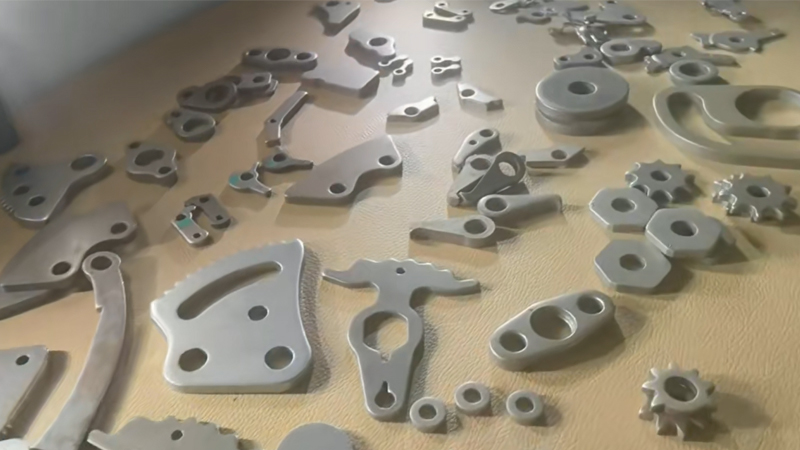
Fine blanked medical device components including surgical instrument parts, implant blanks, and precision connectors with burr-free edges
Material Engineering

Medical-Grade Materials & Processing Parameters

Each medical-grade material presents distinct fine blanking challenges. The table below summarizes the critical processing parameters that differ from commercial-grade carbon steel work.

MaterialSpecificationThickness RangeKey Processing Adjustment
316L StainlessASTM A240, annealed0.5–4 mmWork-hardening at shear edge increases die wear 2–3x; V-ring force at 35–45% of F1; cutting speed max 8 mm/s; AlCrN-coated die mandatory
17-4 PH StainlessASTM A693, H900 condition1–6 mmHigh shear strength (1100 MPa UTS); counter-pressure at 20–25% of F1; carbide die inserts recommended; die life 50K–100K hits per regrind
Ti-6Al-4VASTM B265, Grade 50.8–5 mmSpringback 2–3x steel; counter-pressure at 25–30% of F1; V-ring angle widened to 90°; galling risk requires high-lubricity die coatings
304 StainlessASTM A240, annealed0.5–3 mmSimilar to 316L but slightly lower work-hardening rate; suitable for less critical instrument components; die coating less aggressive than 316L
Cobalt-Chrome (CoCrMo)ASTM F1537, wrought1–4 mmExtreme hardness (35–45 HRC); galling severe; carbide die inserts mandatory; cutting speed max 5 mm/s; die life 3,000–8,000 hits
Biocompatibility note: Fine blanking does not alter the material's metallurgical properties — it is a cold-working process that produces a work-hardened shear edge but does not change the bulk chemistry or corrosion resistance of the alloy. Material certifications (mill certs, biocompatibility test reports) carry through from raw material to finished part unchanged. For implant-grade components, verify that the fine blanking lubricant is compatible with the subsequent cleaning and passivation process. See our materials processing guide for details.
Edge Quality

Zero-Burr Tolerance: Not a Figure of Speech

"Zero burr" is a real, common callout on medical device drawings — not marketing language. Parts that contact tissue, mate against sealing surfaces, or assemble into drug-delivery mechanisms cannot have burr that could detach, trap contaminants, or interfere with mating geometry. Fine blanking's V-ring and counter-pressure process is one of the few blanking methods that can realistically achieve burr heights below 0.02 mm without a secondary deburring operation.

Burr Height Below 0.02 mm

With properly tuned V-ring force (35–45% of F1 for stainless), counter-pressure at 20–25%, and die clearance at 0.3–0.4% of material thickness, fine blanking routinely produces burr heights of 0.01–0.02 mm — below the detection threshold of tactile measurement and verifiable only by optical comparison.

100% Smooth Shear Surface

Medical drawings typically specify 100% smooth-cut surface on functional edges — no fracture zone permitted. Fine blanking achieves this when counter-pressure is sufficient to maintain material compression through the full cutting stroke. The V-ring prevents lateral flow that would initiate fracture.

Surface Finish Ra < 0.4 μm

The fine blanked shear edge directly achieves surface roughness below 0.4 μm without grinding or polishing. For parts requiring Ra < 0.2 μm (e.g., implant-contacting surfaces), a controlled vibratory deburring pass enhances the edge without altering dimensions.

Controlled deburring recommendation: Even when fine blanking achieves near-zero burr, we recommend a controlled deburring pass for parts that will directly contact tissue or another critical surface. This removes micro-burr below the detection threshold of inline inspection and rounds the edge slightly for biocompatibility. Our deburring and polishing guide covers the methods appropriate for medical-grade components.
Typical Parts

Medical Components Produced by Fine Blanking

Medical device production volumes vary widely — a surgical instrument component might run in the low thousands annually, while a disposable device component could run in the millions. The part families below span both volume regimes.

Part CategoryTypical MaterialThicknessCritical Fine Blanking Feature
Surgical instrument components (forceps jaws, clamp levers)17-4 PH, 316L1.5–5 mmFunctional pivot holes and mating surfaces produced in one stroke; zero-burr on tissue-contacting edges
Implant blanks (orthopedic plate preforms)Ti-6Al-4V, CoCrMo2–6 mmNear-net-shape blanking reduces machining stock by 40–60%; edge work-hardening improves surface hardness
Connector & housing components316L, 3040.5–2 mmPin holes and slot features blanked to position; flatness below 0.05 mm for sealing surfaces
Blade & cutting edge components17-4 PH, 420 modified0.8–3 mmCutting edge geometry produced with 100% shear surface; edge sharpness controlled by V-ring position
Drug delivery mechanism components316L, 17-4 PH0.5–2 mmPrecision slot and hole tolerances (IT7); burr-free edges prevent particulate generation in mechanism
Sterilization tray & rack components316L1–3 mmCorrosion resistance maintained; vent holes and mounting features blanked clean without secondary drilling
Volume-appropriate tooling: For surgical instrument components at 2,000–10,000 parts/year, a compound die with 100% inspection is the right strategy. For disposable device components at 100,000+ parts/month, a progressive die with statistical process control (SPC) becomes economically justified. The inspection plan — not the die type — is the primary cost driver in medical fine blanking.
Quality & Compliance

ISO 13485 Considerations & Cleanroom-Adjacent Production

Medical device manufacturing requires a quality management system aligned with ISO 13485, which extends beyond ISO 9001 to include design controls, risk management (ISO 14971), process validation, and traceability requirements specific to medical devices. While our facility operates under ISO 9001:2015 certification, we work within customer-specific quality plans that map ISO 13485 requirements onto our fine blanking processes.

Key ISO 13485 considerations for fine blanking production include:

  • Process validation (IQ/OQ/PQ): Installation Qualification verifies the press is correctly installed and calibrated; Operational Qualification confirms it produces conforming parts across the operating range; Performance Qualification demonstrates consistent output over extended production. We provide the press documentation and process data to support your validation effort.
  • Lot traceability: Every production batch is traceable from raw material coil (heat number, mill cert) through die revision, press parameters (F1/F2/F3 logged per stroke), and final inspection. Records are retained per customer requirement — typically 5–7 years for Class II devices, longer for Class III.
  • Risk management: Process FMEA (PFMEA) documents potential failure modes and their detection/prevention controls. For medical fine blanking, critical failure modes include burr formation, dimensional drift, and surface contamination — each with specific detection methods and action thresholds.
  • Cleanliness control: Fine blanking uses cutting lubricants that must be fully removed before the part enters a cleanroom or sterilization process. We specify medical-grade lubricants compatible with standard cleaning protocols (ultrasonic, passivation) and document the lubricant grade in the process control record.

Cleanroom-adjacent production: Fine blanking itself is not a cleanroom process — it is a metalworking operation using hydraulic presses and cutting fluids. However, parts can be produced to cleanliness standards that allow direct transfer to a controlled environment for subsequent cleaning, passivation, and packaging. The key is preventing post-blanking contamination: parts are handled with clean gloves, stored in sealed containers, and shipped with residue-free packaging. The cleaning and sterilization steps occur at the customer's controlled facility, not at ours.

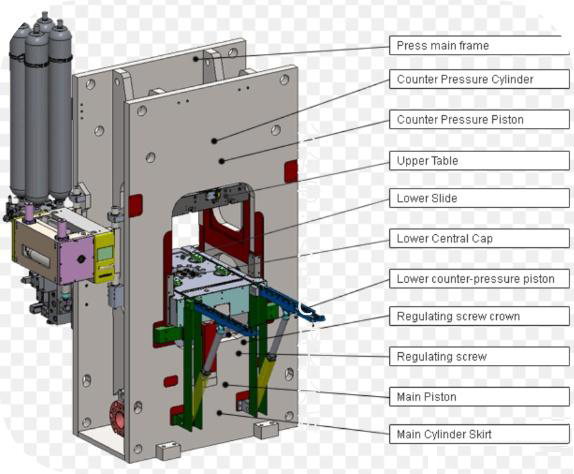
Fine blanking press configured for medical device component production with CNC-controlled triple-action hydraulics
Surface Finish

Surface Finish Requirements & How Fine Blanking Meets Them

Medical device drawings specify surface finishes that range from Ra 0.4 μm (standard functional surfaces) to Ra 0.1 μm (implant-contacting surfaces). Fine blanking's shear edge directly achieves the lower end of this range; the upper end requires post-processing.

Surface RequirementFine Blanking CapabilityPost-Processing Needed
Ra < 0.8 μm (general functional edge)Achieved directly off the pressNone
Ra < 0.4 μm (precision functional edge)Achieved with sharp die and correct parametersNone; verify with surface profilometer
Ra < 0.2 μm (implant-contacting surface)Approached but not consistently achieved on all materialsControlled vibratory deburring or electropolishing
Ra < 0.1 μm (mirror-finish surface)Not achievable by fine blanking aloneElectropolishing or mechanical polishing after blanking
Edge radius (rounded edge for biocompatibility)Fine blanking produces sharp edges by designTumble deburring or vibratory finishing to controlled radius (R0.05–0.15 mm)
Die condition link: Surface finish on the shear edge is directly dependent on die condition. A new, properly polished die cavity produces Ra 0.2–0.3 μm. As the die wears, surface roughness increases proportionally. For medical production, establish a die maintenance schedule based on surface finish measurement — not just hit count. A die producing Ra 0.35 μm at 30,000 hits may produce Ra 0.5 μm at 40,000 hits, crossing the specification threshold.
Quoting Requirements

What We Need Before Quoting a Medical Part

Medical fine blanking quoting requires more information than a commercial stamping quote. The documentation and inspection scope shapes die design, process planning, and pricing — not just paperwork after the fact.

Part Drawing with Full Tolerance Callouts

Include all dimensional tolerances, GD&T callouts, edge condition specifications (burr height limits, smooth-cut percentage), and surface finish requirements. If the drawing specifies a biocompatibility-driven surface finish, highlight it — it affects die coating choice and maintenance schedule.

Material Specification (Grade & Temper)

Material grade, specification (ASTM/AMS), and condition (annealed, precipitation-hardened). If the material is customer-supplied, confirm the form and thickness tolerance. Material choice directly determines die steel, coating, and force parameters.

Quality System & Validation Requirement

Specify whether ISO 13485 alignment, process validation (IQ/OQ/PQ), or specific FAI format is required. This shapes the documentation system, inspection plan, and process control records from the first production run.

Target Annual Volume & Lot Size

Annual volume determines die strategy (compound vs. progressive) and inspection plan (100% vs. SPC). Lot size affects traceability system design — smaller lots with full traceability cost more per part than larger lots with statistical sampling.

Have a Medical Device Fine Blanking Project?

Send us your part drawing, material specification, and quality system requirement. We will evaluate whether fine blanking is the right process for your medical component — and scope the die, press, and inspection plan to meet your documentation and edge-quality requirements.

💬