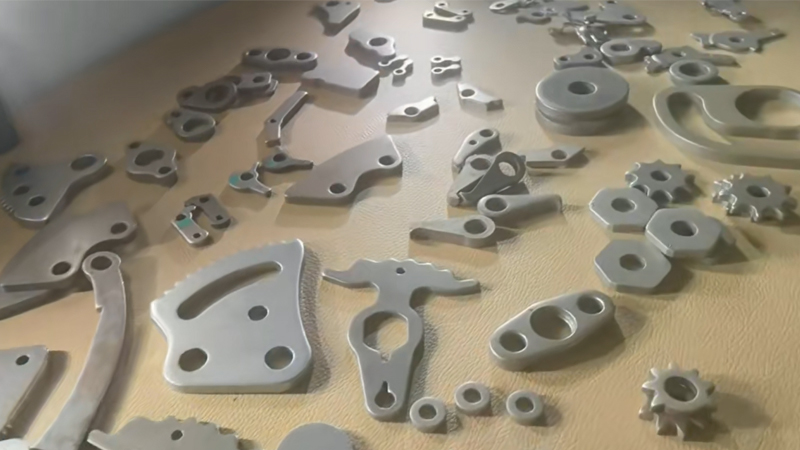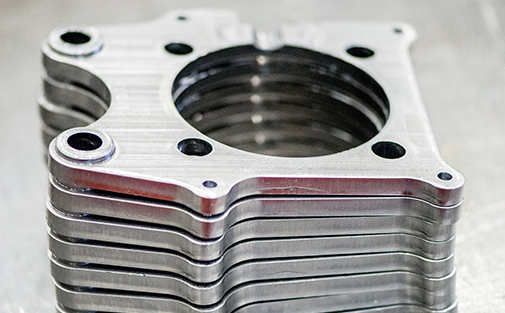
Brake caliper plates, ABS sensor rings, and brake pad shims demand 100% shear edges and IT7-8 tolerance — because brake components are safety-critical parts where edge fracture is not an option.
Automotive braking systems operate at the intersection of structural integrity, fatigue endurance and zero-defect manufacturing. Every component in the brake assembly — from the caliper bracket that clamps the pads against the disc, to the ABS sensor ring that reads wheel speed 50 times per revolution, to the backing plate that distributes friction material pressure — must survive millions of load cycles without edge degradation. Conventional stamping produces a fractured edge zone where tensile stress concentrates during service, initiating micro-cracks that propagate under cyclic braking loads. Fine blanking eliminates this failure mode entirely.
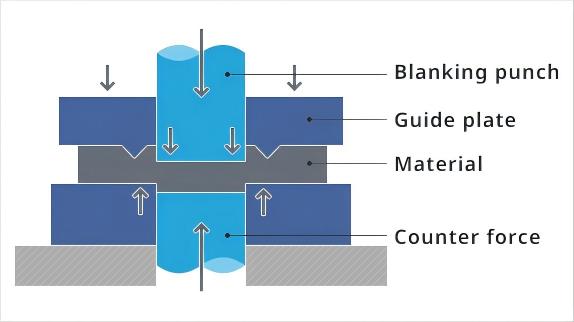
The fine blanking process uses three independently controlled hydraulic forces — V-ring impingement, counter-pressure and blanking force — to maintain the material in a state of triaxial compression throughout the shear zone. The result is a 100% smooth, work-hardened shear edge with no tear-through fracture zone. For brake components, this means the edge that bears service load is the same edge that came off the die: fully dense, strain-hardened, and dimensionally stable to IT7-8 tolerance. No secondary milling, no edge deburring, no reaming — the part is net-shape from the press.
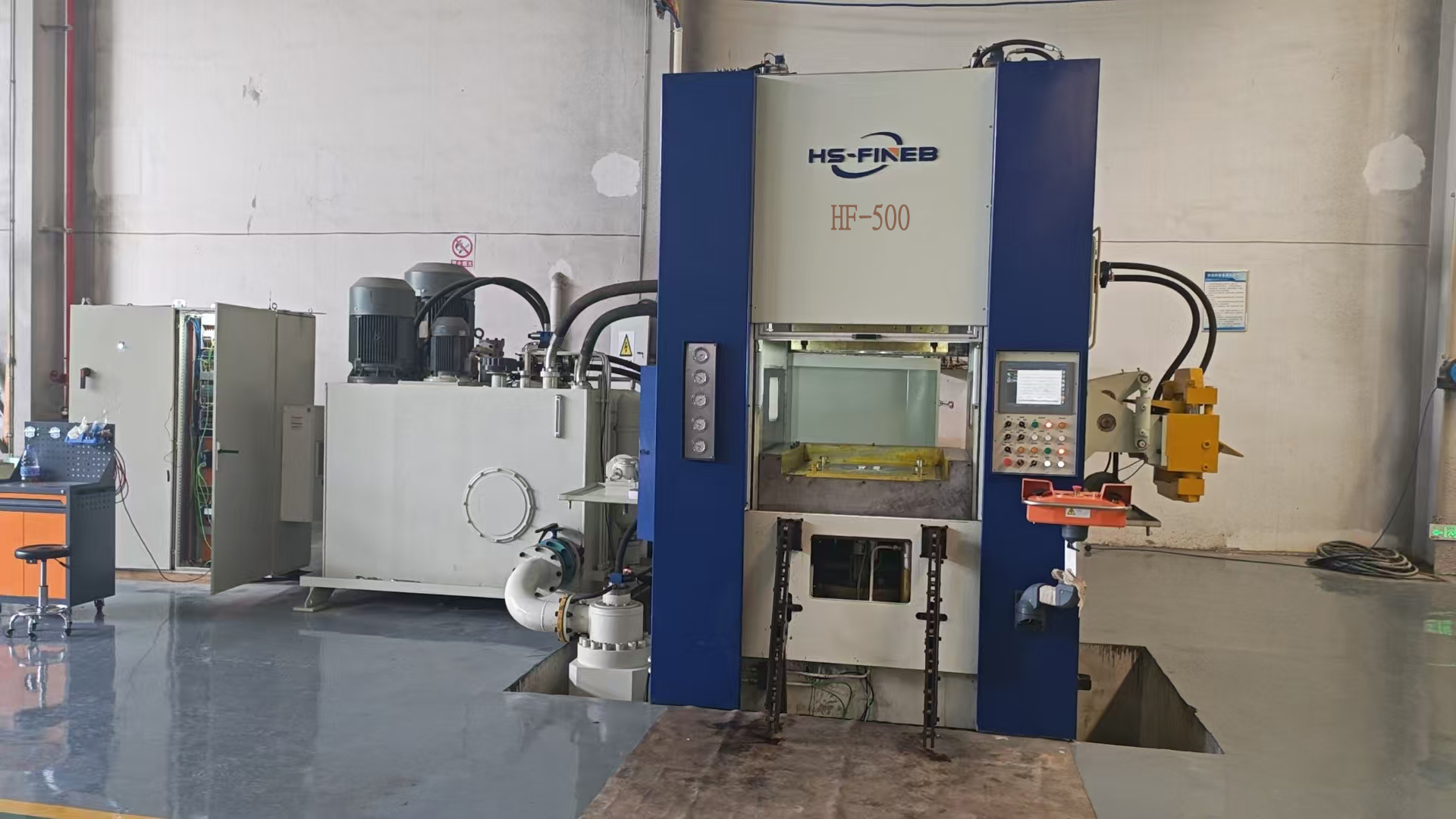
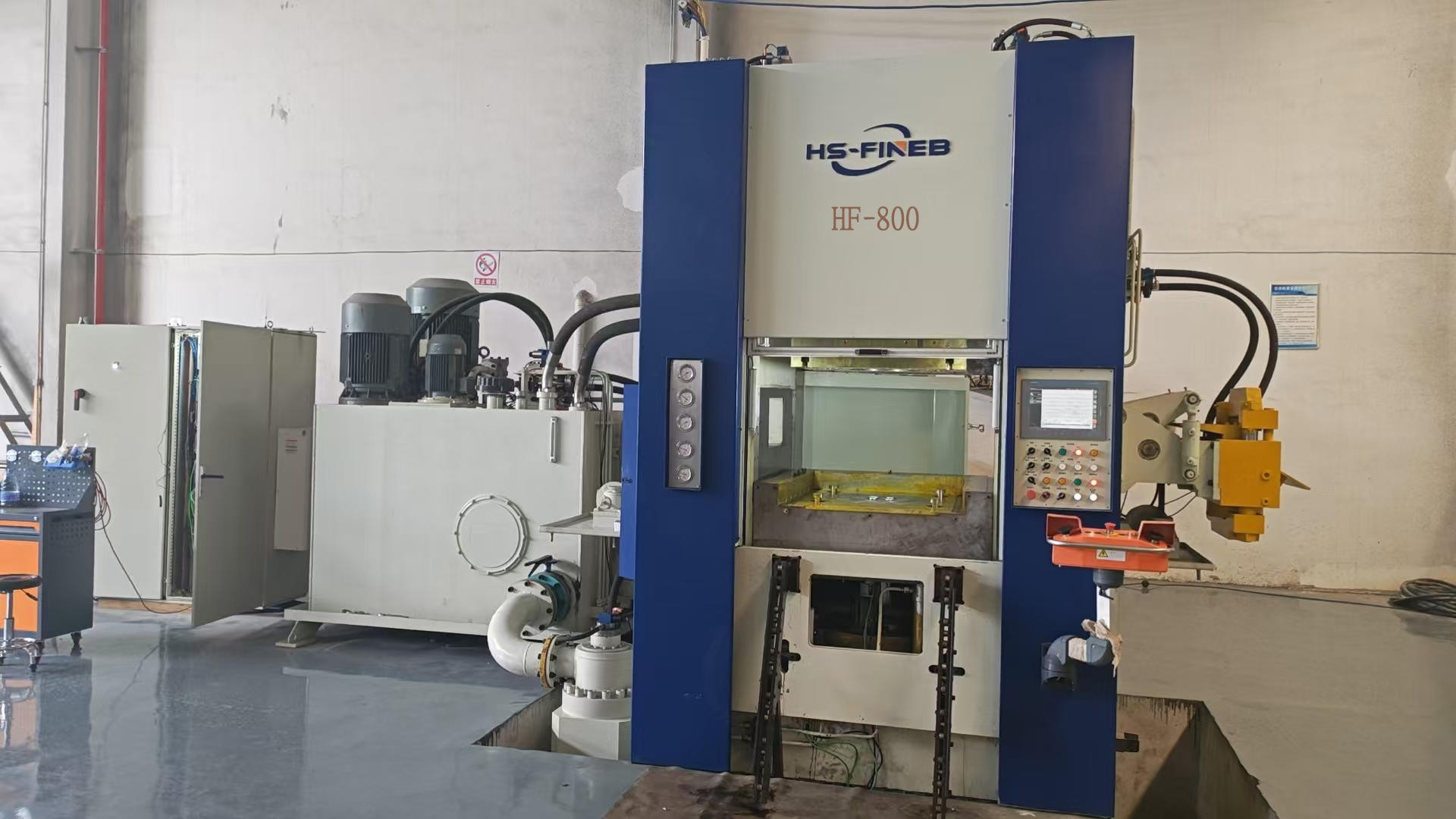
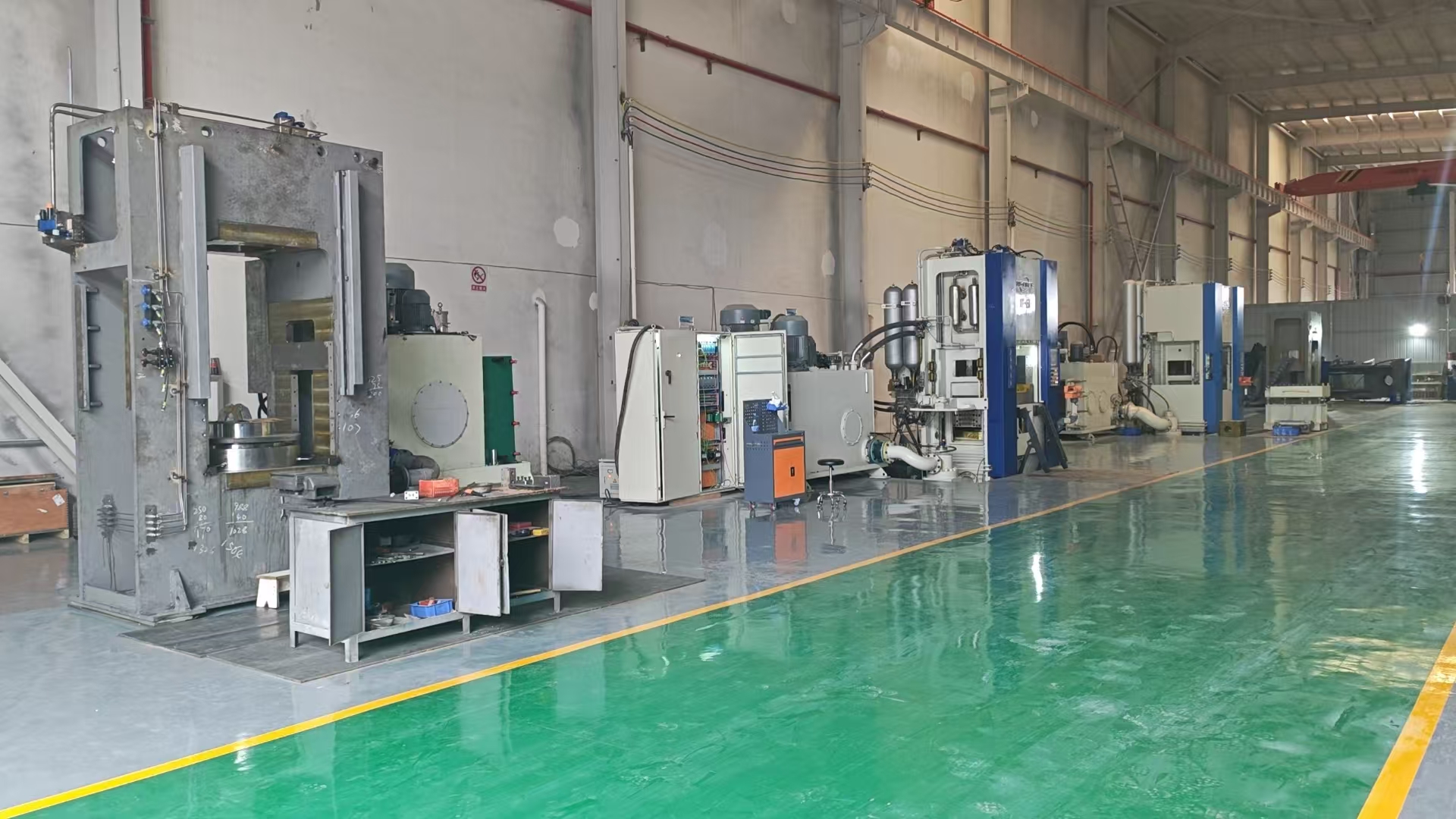
For Tier-1 brake system suppliers, the question is never whether to use fine blanking. It is which press platform delivers the force, die space and cycle rate to meet production volume at acceptable per-part cost. HS-FINEB's HF-400, HF-500 and HF-800 presses cover the full range of brake component production, from 400-ton caliper bracket blanking to 800-ton dual-piston caliper plate production.


A brake caliper bracket experiences cyclic loading at every stop: clamping force transfers through the bracket ears into the steering knuckle, creating alternating tensile and compressive stress at the mounting hole edges and the bracket profile transitions. The edge condition at these critical cross-sections directly determines the component's fatigue life.
Conventional stamping leaves a three-zone edge: a shallow rollover (die-roll), a burnished shear zone covering 30-50% of material thickness, and a rough fracture zone with jagged micro-cracks occupying the remaining 30-50%. These micro-cracks act as stress concentrators with a stress intensity factor that reduces fatigue life by 40-60% compared to a fully shear edge. Brake system validation protocols — including the VW 80098 and GMW engineering standards — require documented edge condition analysis for safety-critical brackets, and fracture-zone edges routinely fail the high-cycle fatigue screening at 500,000 load cycles.
Fine blanking produces a 100% shear edge because the V-ring forces material into the die cavity under compression, preventing the lateral material flow that triggers fracture. The counter-pressure holds the blank flat against the punch face, maintaining uniform stress distribution across the entire cut perimeter. The resulting edge is fully burnished, work-hardened to 10-15% higher hardness than the base material, and free of micro-crack initiation sites. Brake caliper brackets produced on the HF-400 platform with carbide tooling routinely pass fatigue validation at 1,000,000+ cycles with no edge degradation.
The ABS sensor ring — sometimes called a tone ring or reluctor wheel — is a toothed ring pressed onto the wheel hub or CV joint. An inductive or Hall-effect sensor reads the tooth passing frequency to determine wheel speed, feeding this signal to the ABS control unit at update rates exceeding 50 Hz per wheel. Tooth profile accuracy directly governs the signal-to-noise ratio of the speed measurement, and any pitch variation or runout translates directly into speed signal jitter that the ABS controller must filter out — or worse, interpret as incipient lock-up.
Fine blanking produces ABS sensor ring teeth in a single stroke using a carbide punch with the full involute or trapezoidal tooth profile ground into the cutting edge. The V-ring surrounds each tooth cavity, compressing material into the profile so that the tooth root, flank and tip all achieve 100% shear zone. Tooth pitch accuracy holds to ±0.02 mm, and total indicated runout (TIR) across all teeth on a single ring stays below 0.05 mm — specifications that conventional stamping cannot meet because the fracture zone introduces non-uniform tooth geometry that shifts the effective tooth pitch.
Typical ABS ring materials include 16MnCr5 case-hardening steel at 3-5 mm thickness, requiring 400-500 tons of blanking force depending on ring diameter and tooth count. The HF-500 press with its 5000 kN total pressure, 2500 kN V-ring force and programmable blanking speed of 5-45 mm/s is the production standard for ABS sensor ring manufacturing, delivering 50-60 SPM with carbide die inserts lasting 250,000-350,000 strokes before requiring regrind.


The brake pad backing plate is deceptively simple: a stamped steel plate with friction material bonded to one face. But its dimensional requirements are anything but simple. The plate must remain flat under thermal cycling from -40°C to 600°C at the friction surface, maintain parallelism between the piston contact area and the caliper finger contact area, and preserve the shear edge on the perimeter that seats against the caliper abutment. Any warping, burr formation or dimensional drift translates directly into uneven pad wear, brake pulsation and noise.
Fine blanking produces backing plates with flatness held to 0.05 mm across the full plate surface, because the counter-pressure pad applies uniform holding force across the entire blank during the cutting stroke — preventing the material relaxation and warping that occurs in conventional stamping where the blank is unsupported. The 100% shear edge on the perimeter eliminates the burr that would interfere with caliper abutment seating, and the work-hardened edge resists the deformation that occurs during aggressive braking when the pad is pushed laterally against the caliper fingers.
For high-strength brake pad backing plates in S420MC or 28MnB5 boron steel at 4-6 mm thickness, the HF-400 provides sufficient force for single-cavity production, while the HF-800 enables two-cavity or multi-layer progressive die configurations that double or triple throughput. Die life on carbide tooling for backing plate production typically reaches 300,000-400,000 strokes due to the moderate material thickness and relatively simple profile geometry.
Case-hardening manganese-chromium steel, the industry standard for ABS sensor rings and caliper pin guides. Core tensile strength 700-900 MPa after case hardening at 850-880°C, carburizing depth 0.6-1.2 mm. Fine blanking shear zone work-hardens to 280-320 HV, providing a pre-hardened edge that resists wear before the case-hardening treatment. V-ring depth 0.3-0.4 mm at 4 mm material thickness.
Boron-alloyed quench-hardening steel for high-load brake pad backing plates and caliper brackets. Hardened to 500-550 HB after austenitizing at 860-900°C and oil quench. The boron addition increases hardenability without the cracking sensitivity of higher carbon grades, making it ideal for fine blanking — the compressive stress state prevents the edge cracking that occurs in conventional stamping of boron steel.
Thermomechanically rolled fine-grained structural steel for brake backing plates and caliper mounting brackets. Minimum yield strength 420 MPa, excellent weldability and fatigue performance. The fine-grain microstructure responds well to fine blanking — die-roll stays below 10% of material thickness, and the 100% shear zone achieves uniform hardness without the hardness gradient that characterizes stamped S420MC edges.
| Brake Component | Typical Force | Material | Thickness | Die Life (strokes) |
|---|---|---|---|---|
| Brake caliper bracket | 500-800T | S420MC / 28MnB5 | 6-10 mm | 200,000-300,000 |
| ABS sensor ring | 400-500T | 16MnCr5 | 3-5 mm | 250,000-350,000 |
| Brake pad backing plate | 400-800T | S420MC / 28MnB5 | 4-6 mm | 300,000-400,000 |
| Brake pad shim | 200-320T | SUS304 / C67S | 0.5-1.5 mm | 400,000-500,000 |
| Caliper guide pin | 320-400T | 16MnCr5 | 4-6 mm | 200,000-300,000 |

Entry point for brake pad backing plates and caliper guide pins. 650×650 mm table, 14 mm max thickness, 65 SPM. Ideal for single-cavity production of S420MC backing plates.

Production standard for ABS sensor rings and mid-range caliper brackets. 2500 kN V-ring force, 1250 kN counter-pressure, 5000 kN total. Carbide die life 250,000+ strokes.

High-force platform for dual-cavity caliper bracket production and large-diameter ABS rings. 8000 kN total pressure supports multi-station progressive dies for brake component families.
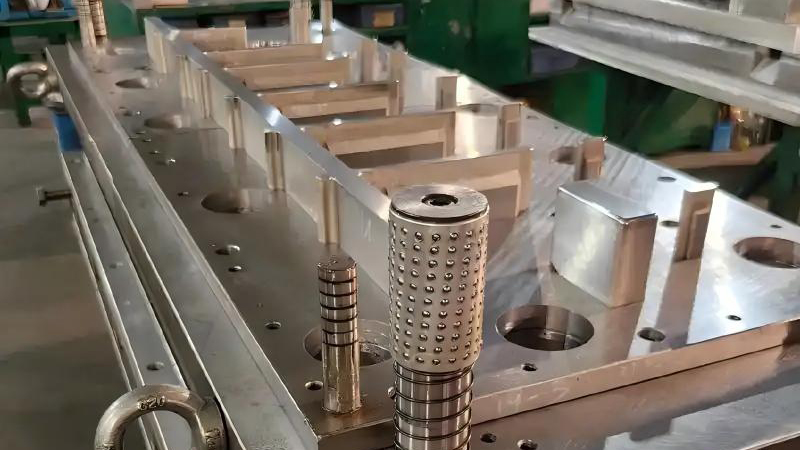
Brake component dies demand tungsten carbide cutting inserts — not tool steel. The abrasive nature of case-hardened 16MnCr5 and boron-alloyed 28MnB5 wears through D2 tool steel inserts in 30,000-50,000 strokes, while carbide grades K20-K30 maintain cutting edge sharpness for 200,000-400,000 strokes. HS-FINEB engineers each brake component die with wire-EDM ground carbide inserts, 0.5% material thickness cutting clearance, and V-ring geometry optimized per material grade and thickness.
The die design process begins with the customer's part drawing and material specification. Our engineers calculate the required V-ring depth, counter-pressure and blanking speed for the specific steel grade, then configure the die assembly — punch, die plate, V-ring plate, counter-pressure pad and stripping plate — as a matched system. Learn about our die design process →

Send your part drawing, material grade and target volume. Our engineers will calculate the required V-ring force, counter-pressure and blanking speed, assess die life expectancy, and recommend the right HF-series platform for your brake component production.