Side-by-side specifications for all nine HF-series fine blanking presses, with selection guidance by application range and comparison against Feintool and Mori equivalents.
The HS-FINEB HF-series comprises nine fine blanking press models spanning 200T to 1200T blanking force. All models share the same triple-force hydraulic architecture (V-ring impingement + counter-pressure + blanking force), CNC controller with programmable force profiles, whole-welded stress-relieved frame construction and hand-scraped guide way precision. The differences are in scale: die area dimensions, stroke length, motor power, machine weight and physical footprint scale with tonnage.
| Model | Blanking Force (kN) | V-Ring Force (kN) | Counter-Pressure (kN) | Die Area (mm) | Strip Width (mm) | Stroke (mm) | SPM | Motor (kW) | Weight (kg) | Height (mm) |
|---|---|---|---|---|---|---|---|---|---|---|
| HF-200 | 2000 | 600 | 300 | 600×500 | 30–160 | 25–150 | 30–60 | 22 | 12,000 | 2,800 |
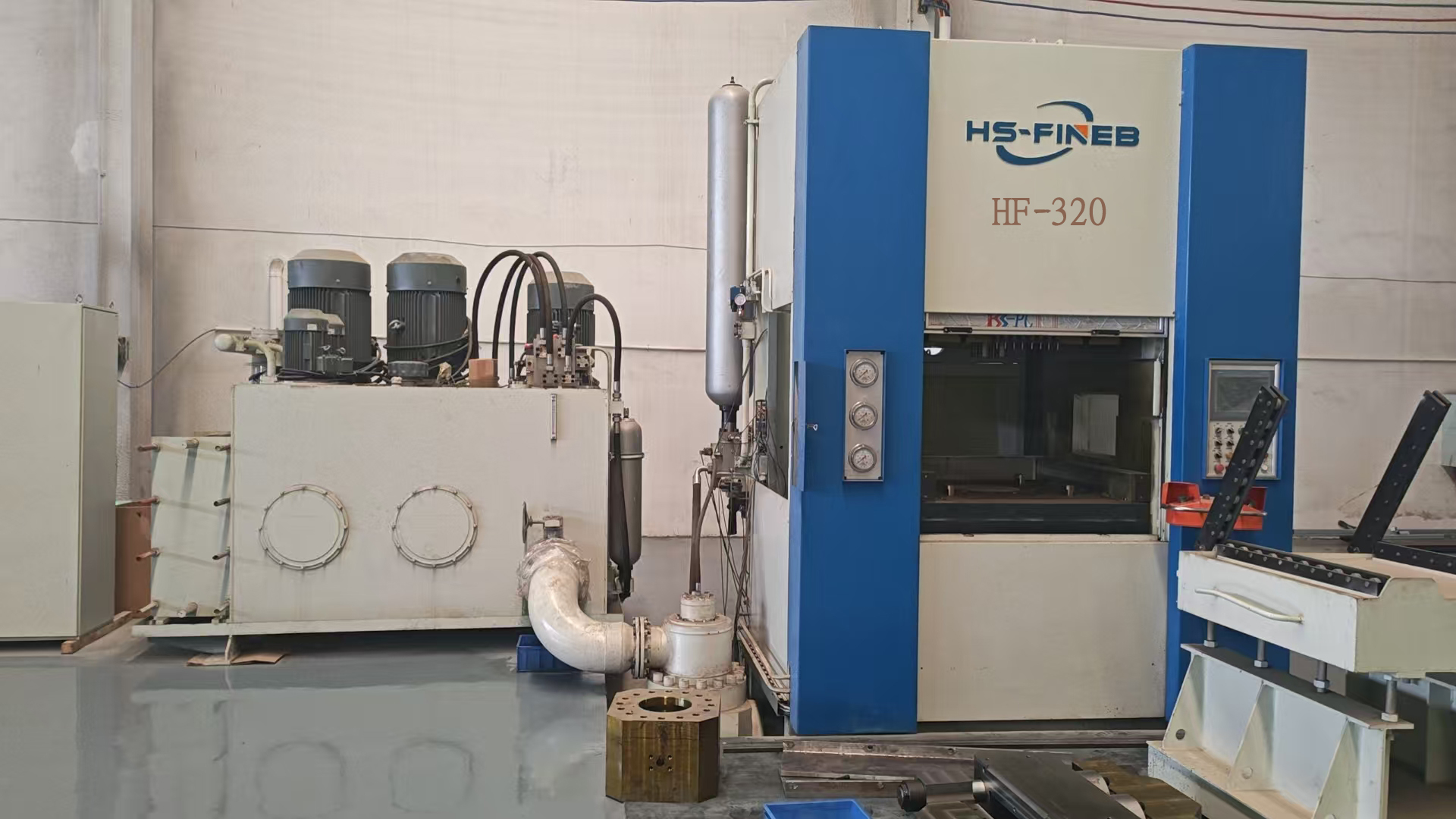
| HF-320 | 3200 | 1000 | 500 | 800×630 | 40–210 | 30–180 | 25–50 | 30 | 18,000 | 3,200 |
| HF-400 | 4000 | 1200 | 600 | 900×700 | 40–250 | 30–200 | 25–50 | 37 | 24,000 | 3,500 |
| HF-500 | 5000 | 1500 | 800 | 1000×800 | 50–300 | 40–220 | 20–45 | 45 | 32,000 | 3,800 |
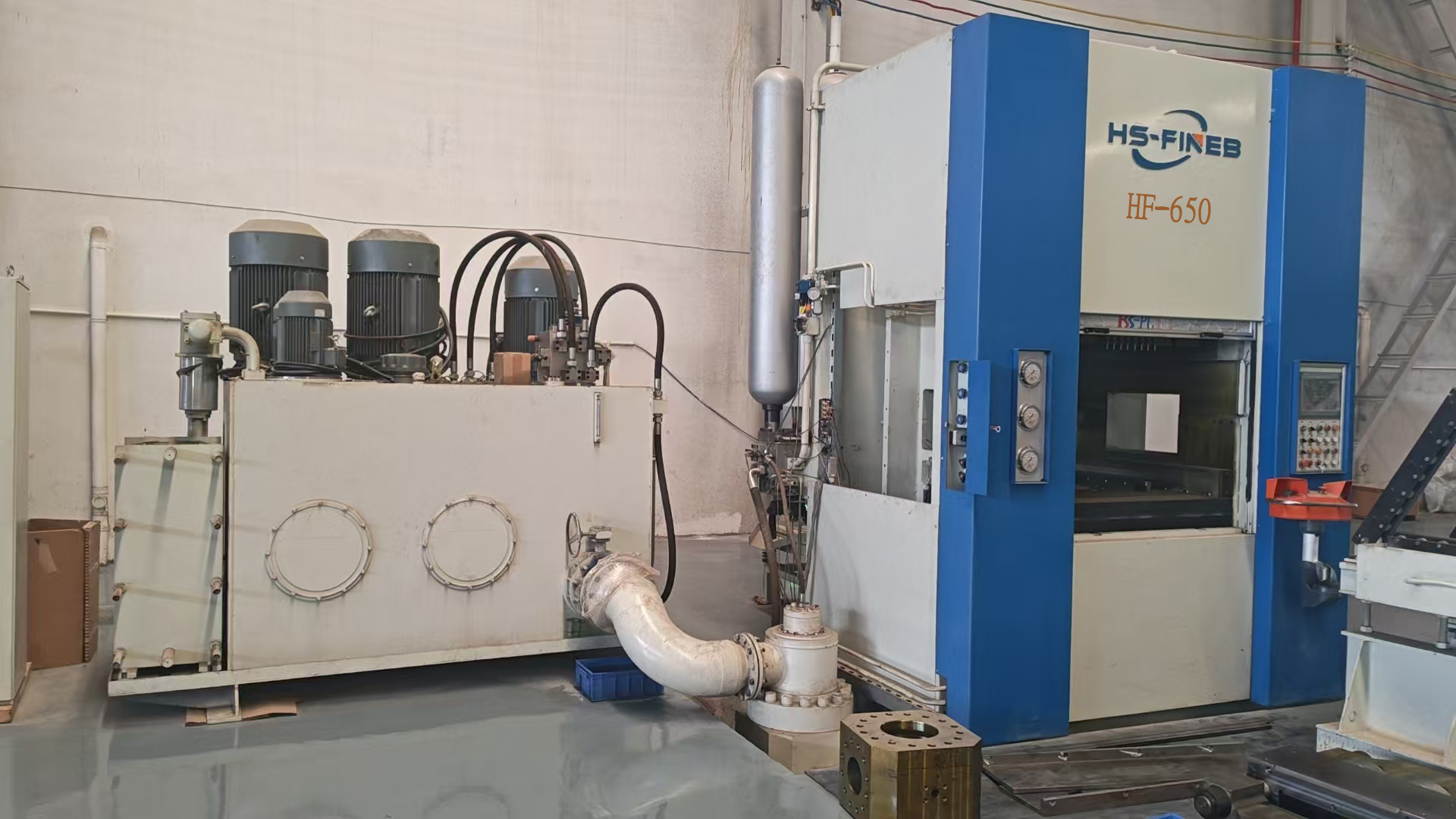
| HF-650 | 6500 | 2000 | 1000 | 1200×900 | 50–350 | 40–250 | 18–40 | 55 | 45,000 | 4,200 |
| HF-700 | 7000 | 2200 | 1100 | 1300×1000 | 60–380 | 40–250 | 15–35 | 55 | 52,000 | 4,400 |
| HF-800 | 8000 | 2500 | 1300 | 1400×1100 | 60–400 | 40–280 | 15–30 | 75 | 68,000 | 4,800 |
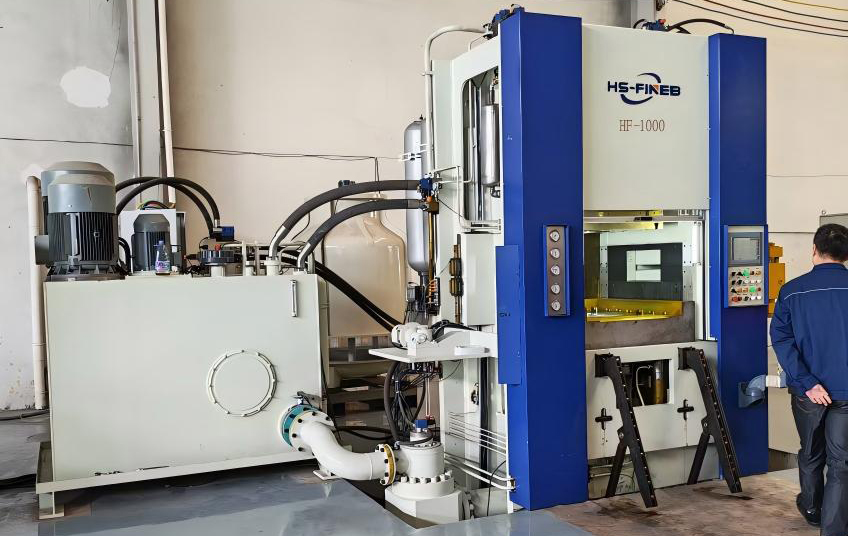
| HF-1000 | 10000 | 3200 | 1600 | 1600×1250 | 80–450 | 50–300 | 12–25 | 90 | 82,000 | 5,200 |
| HF-1200 | 12000 | 4000 | 2000 | 2000×1800 | 100–500 | 50–320 | 10–20 | 110 | 98,000 | 5,800 |
Specifications are indicative. Final specifications are confirmed in the technical specification document signed before production. V-ring force and counter-pressure are maximum rated values; actual operating values are set per part and material requirements.

The HF-200 (200T) and HF-320 (320T) are the entry-point models of the HF-series, designed for small precision components in thin-gauge materials. These presses excel in applications where part perimeter is small, material thickness is 1–6 mm, and production volumes are high — the sweet spot for fine blanking economics.
Typical applications: Electronic connector terminals (phosphor bronze, 0.5–2 mm), small precision washers (C45, 1–3 mm), instrument gears (16MnCr5, 2–4 mm), lock components (C45, 2–5 mm), small shielding cans and lead frames (0.3–1 mm electrical steel, copper alloys).
The HF-200's 600×500 mm die area accommodates small progressive dies (3–5 stations) and compound dies for simple geometries. The HF-320's larger 800×630 mm die area supports more complex progressive dies (5–8 stations) and larger single-stroke compound dies. Both models achieve 30–60 SPM, making them suitable for high-volume electronics and consumer hardware applications where annual volumes exceed 500,000 parts.
The compact footprint (HF-200 weighs only 12 tons and stands 2,800 mm tall) means these presses can be installed in standard industrial buildings without special foundation reinforcement — important for electronics manufacturers and job shops with limited floor space.

The HF-400, HF-500, HF-650 and HF-700 cover the most demanded tonnage range for fine blanking — the 400–700T sweet spot where automotive components, seat mechanisms and medium structural parts are produced. These models represent the majority of our production volume, reflecting the global fine blanking market where mid-range presses serve the automotive supply chain.
Typical applications: Seat recliner mechanisms (gears, plates, locking cams in 16MnCr5 and C45, 3–8 mm), brake caliper components (mounting plates, piston seals in C45 and ductile iron, 5–10 mm), transmission gears (planetary, helical in 20MnCr5, 4–8 mm), clutch plates and synchronizer rings (C45, 2–5 mm), lock cylinders and bolt mechanisms (C45, brass, 3–6 mm), pump and valve components (stainless, 3–8 mm).
The HF-500 (500T) is our most commonly ordered model — its 1000×800 mm die area accommodates complex progressive dies (8–12 stations) for multi-feature automotive parts, while its 50–300 mm strip width range covers most standard coil sizes. The HF-650 and HF-700 extend the die area to 1200×900 mm and 1300×1000 mm respectively, supporting larger part geometries and more station progressive dies for complex automotive mechanisms.
These models also serve the growing EV lightweighting market, where high-strength steel (S700MC, DP800) structural components at 5–10 mm thickness require 400–700T blanking force. The triple-force architecture is essential for these hard materials — conventional stamping would produce unacceptable edge quality and flatness.

The HF-800, HF-1000 and HF-1200 are the heavy-duty flagships of the HF-series, designed for large structural components, thick-plate parts and high-force applications that exceed the capabilities of mid-range presses. These models serve automotive structural, heavy machinery and industrial applications where material thickness exceeds 10 mm or part perimeter is large.
Typical applications: Chassis structural brackets (S700MC, 8–15 mm), large transmission gears (20MnCr5, 10–15 mm), heavy machinery components (C45, 42CrMo4, 10–20 mm), control arms and mounting brackets (DP800, 8–12 mm), pump support structures (stainless, 8–15 mm), large thrust washers (65Mn, 5–10 mm) for heavy equipment.
The HF-1200 is our flagship: 12,000 kN blanking force, 4,000 kN V-ring force, 2,000 kN counter-pressure, with a 2000×1800 mm die area capable of producing parts up to 500 mm in maximum dimension. At 98 tons and 5,800 mm height, it requires a dedicated foundation and overhead crane capacity of 100+ tons for installation. This is the press for the largest and thickest fine-blanked parts — the kind of structural components that would otherwise require expensive CNC machining or forging followed by machining.
The HF-800 and HF-1000 serve the gap between mid-range and flagship: large enough for 8–15 mm thick structural parts, small enough to fit in standard industrial facilities (HF-800 at 68 tons, HF-1000 at 82 tons). Many automotive Tier 1 suppliers choose the HF-800 or HF-1000 for structural component production lines where annual volumes of 50,000–200,000 parts justify dedicated press investment.
For buyers evaluating HS-FINEB against established brands, here is a specification-level comparison. The HF-series is designed to the same triple-force fine blanking principles as Feintool HFA and Mori FB presses, with comparable die areas, stroke ranges and force ratios. The primary differences are in brand-specific control system features, service network density and — most significantly — purchase price.
| Specification | HS-FINEB HF-500 | Feintool HFA-500 | Mori FB-500 |
|---|---|---|---|
| Blanking force | 5000 kN | 5000 kN | 5000 kN |
| V-ring force | 1500 kN | 1500 kN | 1500 kN |
| Counter-pressure | 800 kN | 800 kN | 800 kN |
| Die area | 1000×800 mm | 1000×800 mm | 950×780 mm |
| Max stroke | 220 mm | 250 mm | 230 mm |
| SPM range | 20–45 | 18–50 | 20–45 |
| Motor power | 45 kW | 55 kW | 45 kW |
| Control system | CNC with PROFIBUS | Feintool proprietary | Mori proprietary |
| Relative price | 1.0× | 2.5–3.0× | 2.0–2.5× |
The specifications are comparable across all three brands at equivalent tonnage — confirming that the fine blanking process fundamentals are shared. The price difference reflects brand premium, overhead structure and service network, not process capability. For buyers who need engineering quality at a competitive price, the HF-series delivers equivalent tonnage, die area and force architecture at 35–60% of the cost of equivalent Feintool or Mori presses.

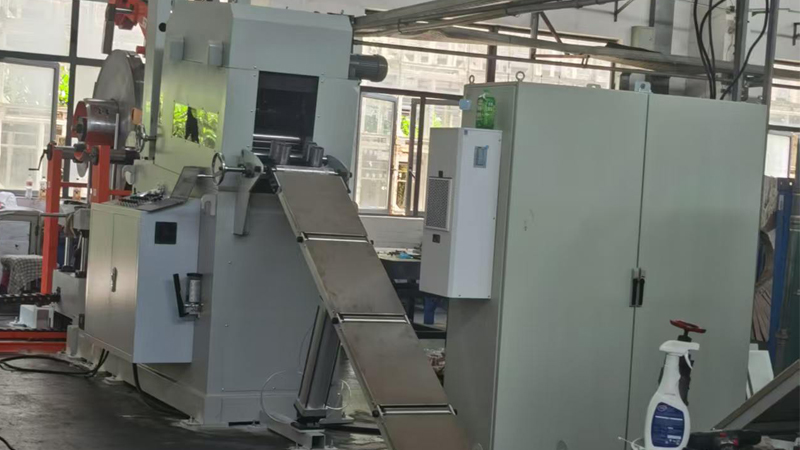
Every HF-series press can be integrated into a fully automated fine blanking production line with coil feeding and decoiling systems, waste shear conveyors, parts extraction systems and deburring and cleaning equipment. The CNC controller supports line integration through PROFIBUS fieldbus communication, enabling coordinated operation between the press, feeder, straightener and scrap conveyor. Tooling protection sensors monitor die clearance and material position in real time, auto-stopping the line if misfeed or slug pulling is detected — preventing die damage. For high-volume automotive applications, the complete production line achieves 30–45 SPM with unattended operation, reducing labor cost per part.
Our engineering team will assess your part drawings, material specifications and production volume to recommend the optimal HF-series model and configuration.