💬 WhatsApp Chat

Fine Blanking Press Buying Guide

How to calculate the exact tonnage you need — before you spend $200K+. A fine blanking press is not a catalog purchase. Tonnage determines whether your die produces 100% shear-edge parts or tears through material. This guide walks through force calculation, tonnage selection by application, the new-vs-refurbished decision, and an 8-point supplier evaluation checklist — based on 40 years of building and rebuilding fine blanking presses.

Reverse Engineering

Start With the Part, Not the Catalog

The most common — and most expensive — mistake in fine blanking press selection is starting with a tonnage number from a catalog and working backward to justify it. A buyer who needs a press for a 4 mm transmission gear in 16MnCr5 does not need "a 320-tonne press." They need a press that delivers 504 kN of total force with a 15-20% safety margin — which happens to map to the HF-650 model.

The correct approach is reverse-engineering: start with the part drawing and work forward through force calculation to tonnage selection. The part drawing tells you five things that determine everything else: material grade (sets shear strength τ), thickness (sets the t in the force formula), perimeter (sets the cutting length L), edge quality callout (sets V-ring and counter-pressure ratios), and flatness tolerance (sets counter-pressure magnitude).

From these five inputs, every other decision flows: tonnage, die envelope, feed width, coil specification, deburring method, and ultimately the line configuration. A supplier who quotes a press model without asking for your part drawing is selling you a catalog item — not a matched production solution.

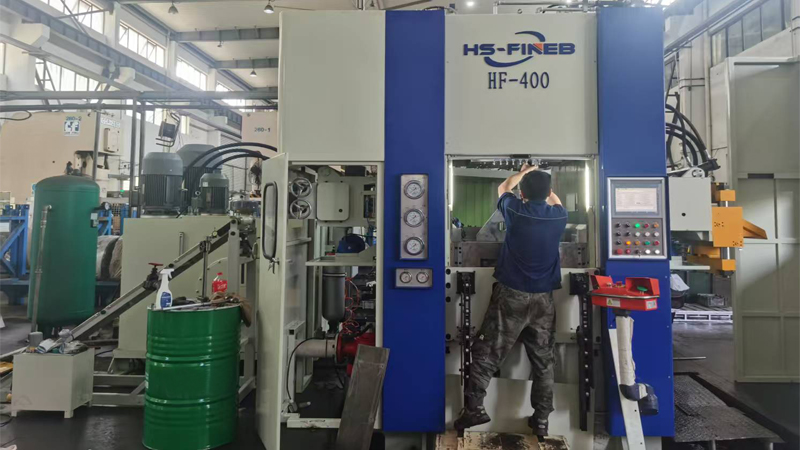
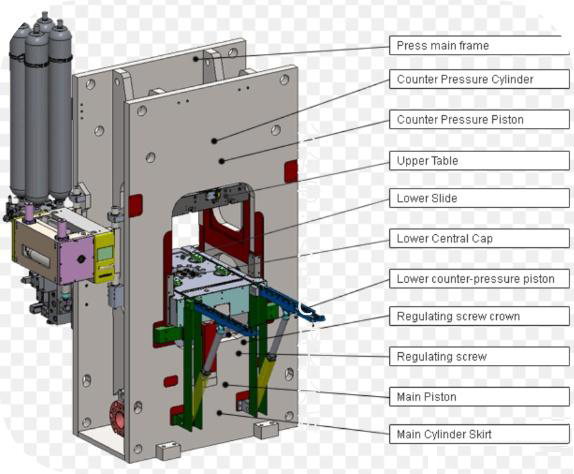
Fine blanking press machine structure and hydraulic system
Force Calculation

The Force Calculation Formula

Four forces act simultaneously in a fine blanking cycle. The press must deliver their sum — with margin.

Total Force = Blanking Force + V-Ring Force + Counter-Pressure + Ejector Force

Each force is calculated independently, then summed with a safety factor to select the press model. Here is the breakdown:

Blanking Force (BF)

BF = L × t × τ × 0.8

Where L = cutting perimeter (mm), t = material thickness (mm), τ = material shear strength (MPa), and 0.8 = the fine blanking factor — lower than conventional stamping because V-ring confinement reduces the specific cutting force.

Example: A gear with 150 mm perimeter, 6 mm thick, C45 steel (τ = 400 MPa): BF = 150 × 6 × 400 × 0.8 = 288 kN.

V-Ring Force (VF)

VF = 20-50% of BF

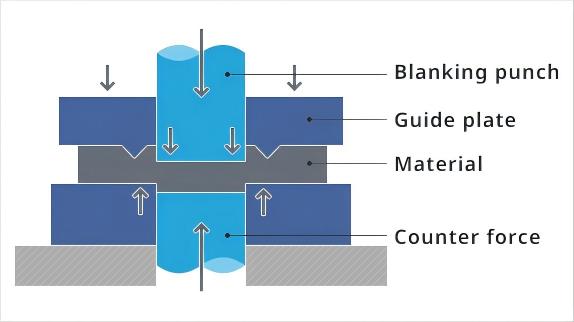
The V-ring impinges material around the cutting line to prevent lateral flow during shearing. The ratio depends on material thickness: 20-30% for thin material (1-3 mm), 30-40% for medium (3-6 mm), 40-50% for thick (6-12 mm). Higher ratio for thicker material because more force is needed to confine a thicker shear zone.

Example: VF = 50% × 288 = 144 kN.

Counter-Pressure (CP)

CP = 10-25% of BF

The counter-punch holds the part flat during shearing, controlling die-roll height and flatness. The ratio depends on part geometry: 10-15% for simple flat parts, 15-20% for parts with internal features, 20-25% for deep-draw or complex profiles where material flow must be tightly controlled.

Example: CP = 25% × 288 = 72 kN.

Ejector Force + Safety

Ejector Force = 5-10% of BF (stripping the part from the punch after shearing). Safety margin: 15-20% added to the total.

Example total: BF 288 + VF 144 + CP 72 + Ejector 20 = 524 kN. With 15% margin = 603 kN → HF-650.

The HF-650 (650 kN) provides the required force with adequate headroom for material hardness variation and die wear over the maintenance cycle. Selecting the HF-500 (500 kN) would run the press at 100% capacity — no margin for variation, and hydraulic system stress that shortens seal and pump life.

Application Mapping

Tonnage Selection by Application

Typical tonnage ranges by part type and material — use as a starting point, then confirm with force calculation.

🔌

Electronics Connectors

1-3 mm, phosphor bronze / copper alloy200T

Thin conductive materials with low shear strength. High SPM requirement. The HF-200 handles connector terminals, lead frames, and precision contacts at 40-80 SPM. Feeder pitch accuracy is the critical spec, not tonnage.

🔒

Lock Hardware

2-6 mm, C45 steel200-320T

Lock cylinders, hinges, security brackets. Medium shear strength, moderate volume. The HF-200 handles 2-3 mm parts; the HF-320 is needed for 4-6 mm thickness or larger perimeters. Edge quality callout typically IT7-8.

Automotive Gears

4-8 mm, 16MnCr5320-500T

Transmission gears, clutch plates, seat recliner mechanisms. Case-hardening steel with high shear strength. Gear tooth perimeter drives force calculation. The HF-320 handles 4 mm; 6-8 mm requires HF-400 or HF-500. Die-roll tolerance below 15% of thickness.

🚗

Brake Components

6-12 mm, HSLA steel400-650T

Brake backing plates, caliper brackets — safety-critical with thick material. High shear strength and large perimeter. The HF-400 handles 6-8 mm; the HF-650 is needed for 10-12 mm or multi-stage progressive dies.

🚀

Truck Powertrain

8-16 mm, 20MnCr5650-1000T

Heavy-duty transmission gears, clutch hubs, powertrain plates. Thick case-hardening steel with very high force requirement. The HF-650 handles 8-10 mm; the HF-800 to HF-1000 covers 12-16 mm. Large die envelope and high V-ring force needed.

Heavy Machinery

12-25 mm, alloy steel800-1200T

Excavator tooth plates, mining equipment wear parts, structural chassis components. The thickest and highest-force category. The HF-800 handles 12-16 mm; the HF-1000 and HF-1200 are required for 18-25 mm alloy steel. These applications push fine blanking's thickness limits — we'll tell you honestly if machining is the better route.

Investment Decision

New vs Refurbished Decision Framework

The right choice depends on your existing equipment, timeline, budget, and production volume.

🏠

Buy New When

  • No existing press in your facility — starting from scratch
  • Need latest CNC control, touchscreen HMI, and PROFIBUS/ProfiNet integration
  • Production volume justifies the capital investment (typically 500K+ parts/year)
  • Want full warranty coverage and factory acceptance test

Timeline: 4-8 months from order to commissioning. Cost: New 320T press approximately $200,000-400,000 depending on configuration and auxiliary equipment scope.

🛠

Refurbish When

  • Existing press (Feintool, Mori, or other brand) has 70%+ structural life remaining
  • Budget is 30-45% of new press cost
  • Timeline is 3-12 weeks vs 6-12 months for new build
  • Existing die tooling and auxiliary equipment can be retained

Cost: Refurbished Feintool/Mori 320T press approximately $80,000-150,000, including hydraulic seal replacement, control system upgrade, and ram parallelism realignment to 0.02 mm/1,000 mm.

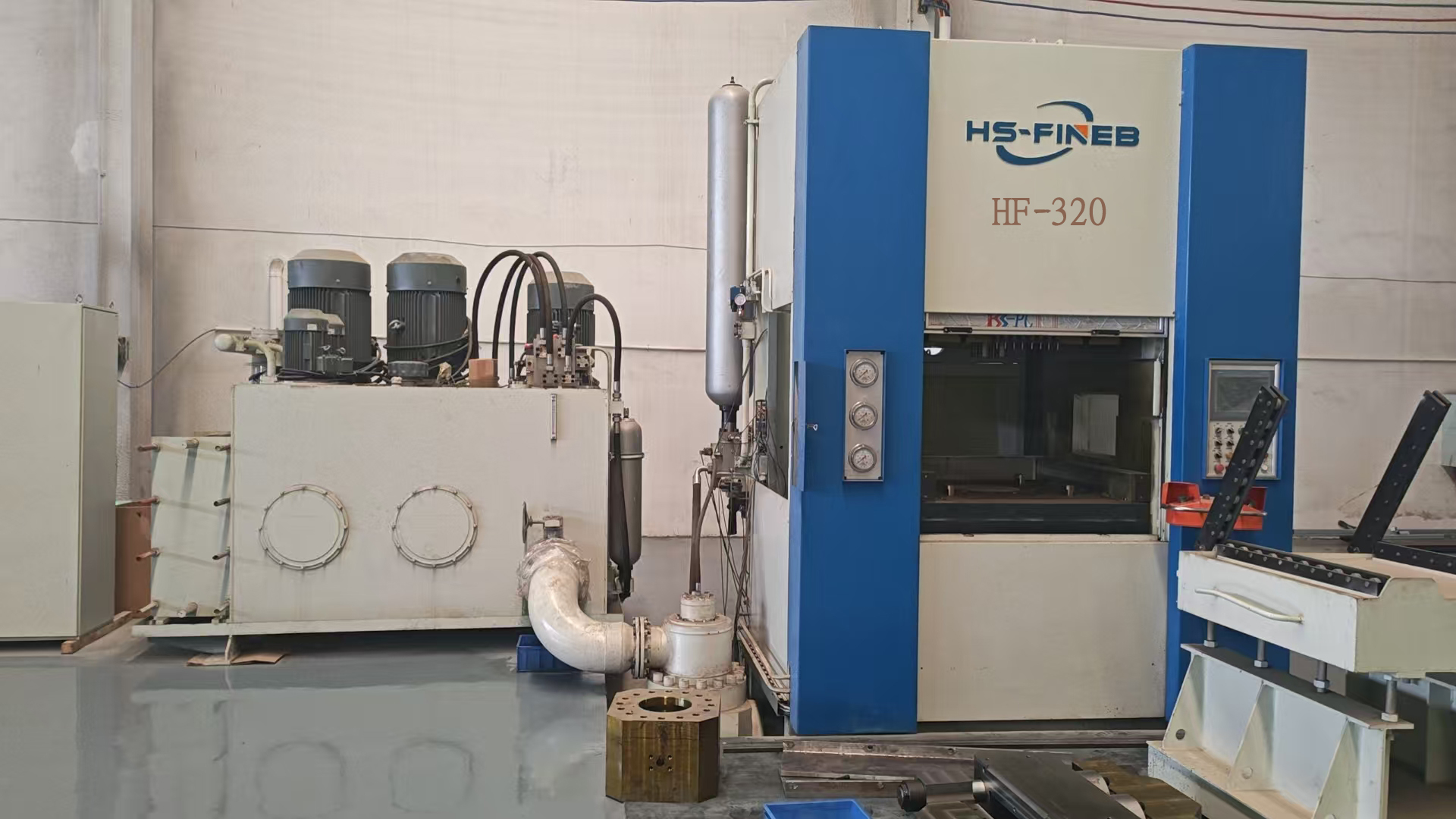
HF-320 fine blanking press 320 tonne hydraulic machine
Due Diligence

Supplier Evaluation Checklist

Eight criteria that separate a press builder from a precision partner. Use this checklist before signing a purchase order.

1. Manufacturing capability: In-house CNC machining, precision grinding (surface and cylindrical), hydraulic cylinder testing, and FEA-verified frame welding. A supplier who outsources all critical components cannot guarantee quality or control delivery timeline.

2. Engineering support: Does the supplier calculate your force requirement, design your die envelope, and configure your feed line — or do they just sell a press body? Ask for a sample force calculation on your part drawing before committing.

3. Reference installations: Ask for 3+ installations running similar applications (material, thickness, volume). Contact at least one reference and ask about downtime, spare parts availability, and dimensional consistency over the first 100,000 strokes.

4. After-sales service: Response time commitment (24-48 hours remote, 3-7 days on-site), spare parts inventory in your region, and remote diagnosis capability via PLC access. A press that is down for two weeks waiting for a replacement seal costs more than the seal.

5. ISO 9001 + CE certification: Non-negotiable for automotive and export markets. Ask for current certificates, not expired ones. CE compliance requires documentation of risk assessment, emergency stop circuits, and guarding — all of which affect your liability.

6. Delivery timeline: Typical 4-8 months for new presses, 3-12 weeks for refurbishment. Get the timeline in writing with milestone payments tied to specific deliverables (design freeze, frame completion, factory acceptance test, shipment).

7. Warranty terms: 12 months parts and labor is the industry standard. Confirm what "parts" includes — hydraulic seals, proportional valves, and PLC components are the high-cost failure items. Extended warranty (24-36 months) is negotiable and worth it for high-volume production lines.

8. Training and documentation: Operator training (3-5 days on-site), maintenance manual with scheduled service intervals, PLC program access (not password-locked), and spare parts list with supplier part numbers. A supplier who password-locks the PLC controls your service costs forever.

Send Your Drawing — Get the Configuration

Email your part drawing, material grade, and target volume. Our engineers will calculate the exact force requirement, recommend the correct HF-series model, and return a complete line proposal within 24 hours — no catalog quoting, no guesswork.

💬