A fine blanking press without matched feeding, tooling and finishing produces scrap — not parts. The press is 40% of a production cell. The other 60% — decoiler, straightener, servo feeder, die, and deburring station — is where part quality, material utilization, and throughput are actually decided. HS-FINEB engineers all six stations as one system, calibrated to your part drawing before the first component is built.
A buyer who purchases a 320-tonne press and bolts on a generic decoiler-feeder from a catalog will produce parts — for the first shift. By the third shift, feed-pitch drift from an untensioned coil, flatness error from an unleveled strip, and burr growth from a die running outside its clearance window compound into a reject rate that turns a precision investment into a scrap generator.
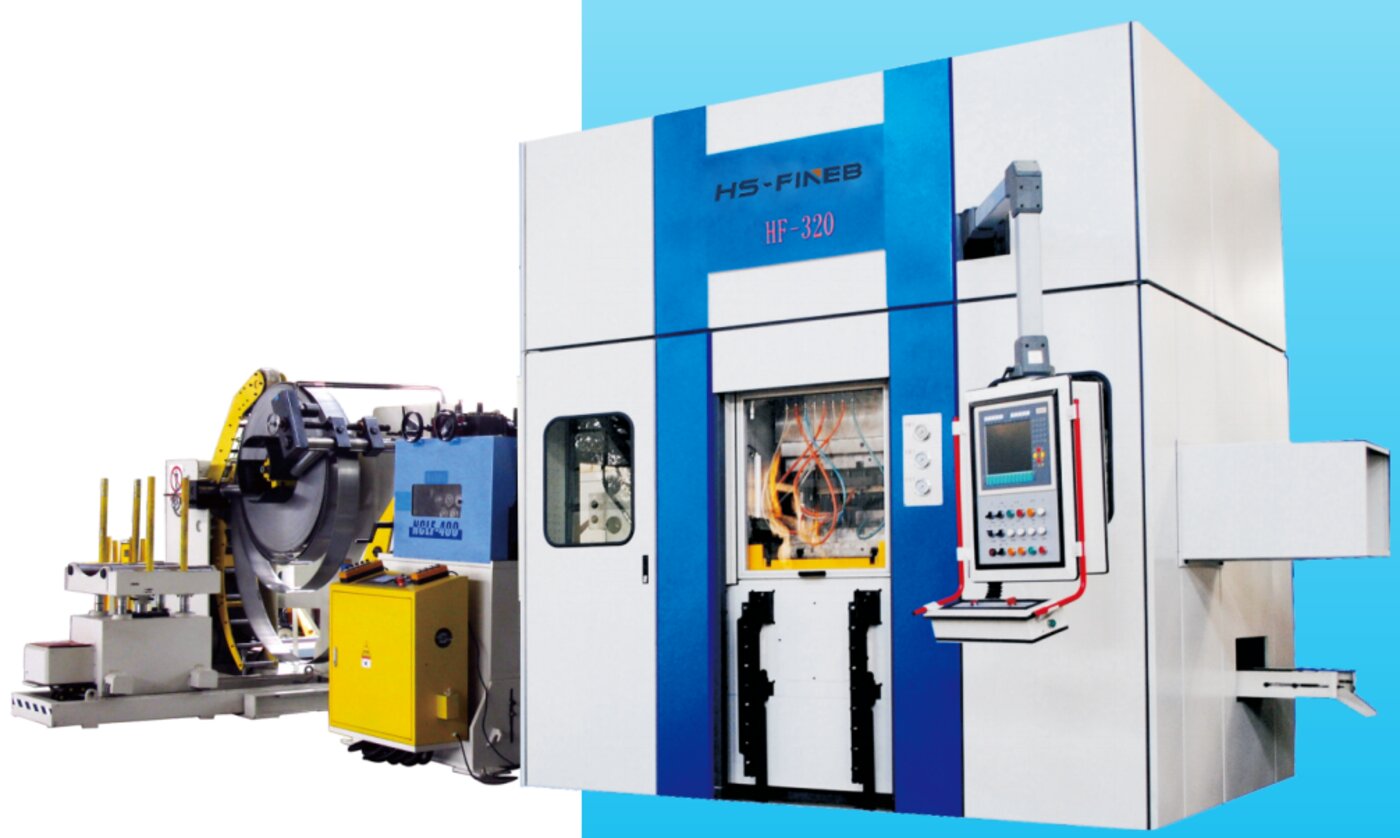
A complete fine blanking line has six stations, and each one passes its errors forward. The decoiler passes tension variation to the straightener. The straightener passes flatness error to the feeder. The feeder passes pitch inaccuracy to the die. The die passes burr and tolerance drift to the deburring station. The deburring station either corrects or compounds the problem — depending on whether it was specified against the part or pulled from a catalog.
This is why HS-FINEB engineers the entire line as one system. The part drawing — material, thickness, perimeter, tolerance — flows backward through the line: force calculation determines press tonnage, tonnage determines die envelope, die envelope determines feed width, feed width determines coil specification, coil specification determines decoiler and straightener configuration, and the burr tolerance callout determines deburring method. Every station is matched to every other station before the line is built.

Each station has a specific job. Get any one wrong, and the error propagates downstream.
Holds 5,000-15,000 kg coils with hydraulic mandrel expansion, edge-guide sensing, and pneumatic tension brake. Coil weight determines changeover frequency: a 5,000 kg coil on a line running 30 SPM needs changing every 4-6 hours; a 15,000 kg coil runs a full shift. Tension profiling across the full coil diameter range — from 1,200 mm full coil to 400 mm core — prevents the strip overrun and slack that cause die-entry misalignment.
5-9 roll leveler calibrated to material yield strength and thickness. Eliminates coil-set (the curvature retained after winding), strip crown, and edge wave before the strip reaches the feeder. Without leveling, material variation causes 0.1-0.3 mm flatness errors in the finished part — enough to push a ±0.1 mm tolerance band out of spec. Roll count and diameter are sized to material thickness: thin material (1-3 mm) uses 7-9 rolls; thick material (6-16 mm) uses 5-7 rolls with larger diameter.
Pitch accuracy ±0.1 mm with SICK absolute encoder closed-loop verification, synchronized to press stroke rate. Roll feed for strip, grip feed for thick plate. Feed pitch determines material utilization — a 0.1 mm over-feed wastes 0.1 mm of material per stroke, which compounds to 5-8% material loss across a high-volume run. Feed speed limits press SPM: a feeder that cannot accelerate fast enough becomes the throughput bottleneck, not the press.
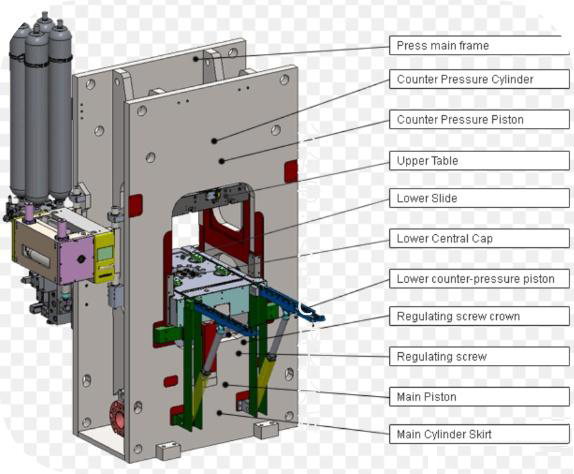
The heart of the line. Triple-action hydraulic — blanking force, V-ring force, and counter-pressure each regulated independently by proportional valves. Tonnage is calculated, not guessed: Total Force = Blanking Force + V-Ring Force + Counter-Pressure + Ejector Force. Blanking Force = perimeter × thickness × shear strength × 0.8. The 0.8 factor reflects fine blanking's lower specific cutting force due to V-ring confinement. A safety margin of 15-20% is added to select the press model.
V-ring, punch, die insert, ejector, and stripping system. Die clearance at 0.5% of material thickness. Tool steel selection: D2 (60-62 HRC) for 100K hits between regrinds, PM steel for 300K-500K, solid carbide for ultra-high-volume abrasive materials. Die life ranges from 150,000 to over 1,000,000 hits depending on material, coating (TiCN, DLC), and maintenance discipline. Die complexity directly affects setup time: a single-stage blanking die sets up in 2-4 hours; a 5-stage progressive die requires 8-16 hours of timing and alignment.
Burr removal, cleaning, inspection — the final quality gate. Burr height tolerance on the part drawing determines method selection: under 0.02 mm requires abrasive belt or wire brush; under 0.05 mm on complex geometry requires vibratory finishing; zero-burr medical and electronics callouts require ultrasonic cleaning after deburring. The station connects to the press output conveyor, so deburring runs at press cycle rate — not as a separate batch operation that doubles handling and adds lead time.

HS-FINEB engineers a fine blanking line through a seven-step reverse-engineering process that starts with your part drawing and ends with a commissioned production cell.
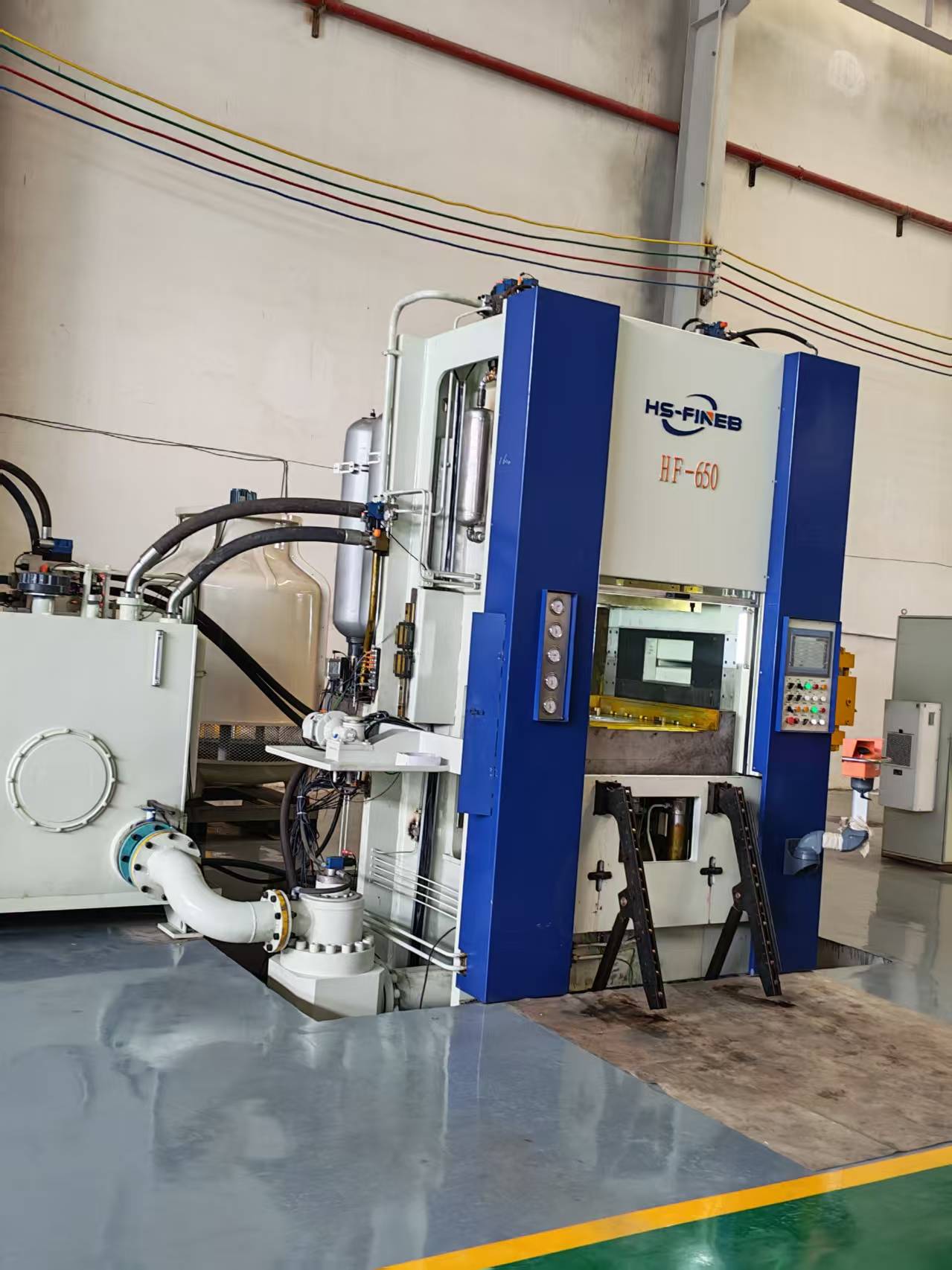
1. Part drawing analysis: Material grade, thickness, perimeter, projected shear area, edge quality callout (die-roll height, burr limit), flatness tolerance, and annual volume establish the force calculation baseline. 2. Force calculation: Blanking Force = L × t × τ × 0.8. V-Ring Force = 20-50% of BF. Counter-Pressure = 10-25% of BF. Total + 15-20% safety margin = required tonnage. 3. Tonnage selection: Map calculated force to the HF-series model that exceeds it with margin — an HF-320 for 280 kN, an HF-650 for 580 kN.
4. Die envelope: Define die plate dimensions, V-ring profile, clearance, and strip layout with nesting optimization. 5. Feeding specification: Coil width, strip pitch, feed accuracy, and stroke rate determine decoiler capacity, straightener roll count, and servo feeder model. 6. Deburring integration: Burr tolerance callout selects the method (belt, brush, vibratory, ultrasonic) and the station is sized to press cycle rate. 7. Commissioning: On-site installation, trial parts, parameter tuning (V-ring pressure, counter-pressure, feed pitch, stroke rate), and first-article dimensional verification before production release.
The financial case for a complete integrated line versus standalone press purchase or machining alternative.
Fine blanking from coil achieves 60-75% material utilization through strip-layout nesting optimization. Conventional machining from bar stock typically achieves 40-60%. On a 16MnCr5 part at $1.20/kg, the utilization difference saves $0.24-0.42 per kg of finished part weight — which compounds to six-figure annual savings on high-volume automotive runs.
A complete integrated line runs with one operator who monitors the HMI, changes coils, and performs quality checks. The equivalent machining cell requires 3-5 operators across turning, milling, drilling, and deburring stations. At $25/hour loaded labor, the difference is $150,000-250,000 per year per shift.
A typical 320T fine blanking line produces 20-60 parts per minute depending on part complexity and stroke rate. A machining cell producing the same geometry — turn, drill, mill, deburr — produces 2-8 parts per minute. A single fine blanking line replaces an entire machining department, with tighter tolerance and 100% shear edge quality.
Send your part drawing, material grade, thickness, and target volume. Our engineering team will return a complete line proposal — press model, die plan, feeding specs, and deburring integration — within 24 hours.