💬 WhatsApp Chat

MOQ and Lead Times for Fine Blanking Press Orders

Understanding minimum order quantity and production timelines for custom-built fine blanking presses — from technical confirmation through factory acceptance testing to export shipment.

Ordering Information

Minimum Order Quantity: One Unit

Fine blanking presses are not commodity products. Every HF-series machine is built to order, configured around the customer's specific part geometry, material grade, production volume and die requirements. The minimum order quantity is therefore one unit — there is no economic incentive to order more than you need, and no penalty for ordering a single press. Whether you need an HF-200 for small electronic connectors or an HF-1200 for structural automotive components, each machine receives the same engineering attention: frame design validation, hydraulic circuit specification, CNC controller programming and acceptance testing tailored to your application.

This custom-build model means the quotation process begins with a technical exchange, not a price list. Our engineers review your part drawings, material specifications and expected production rate, then configure the press parameters — V-ring force, counter-pressure, blanking speed, die area, strip feed pitch — to match. The resulting Proforma Invoice is application-specific, not a catalog price. This is why two HF-500 presses can have different lead times and configurations: one may be specified for 8 mm HSLA steel with a progressive die, another for 3 mm stainless with a compound die.

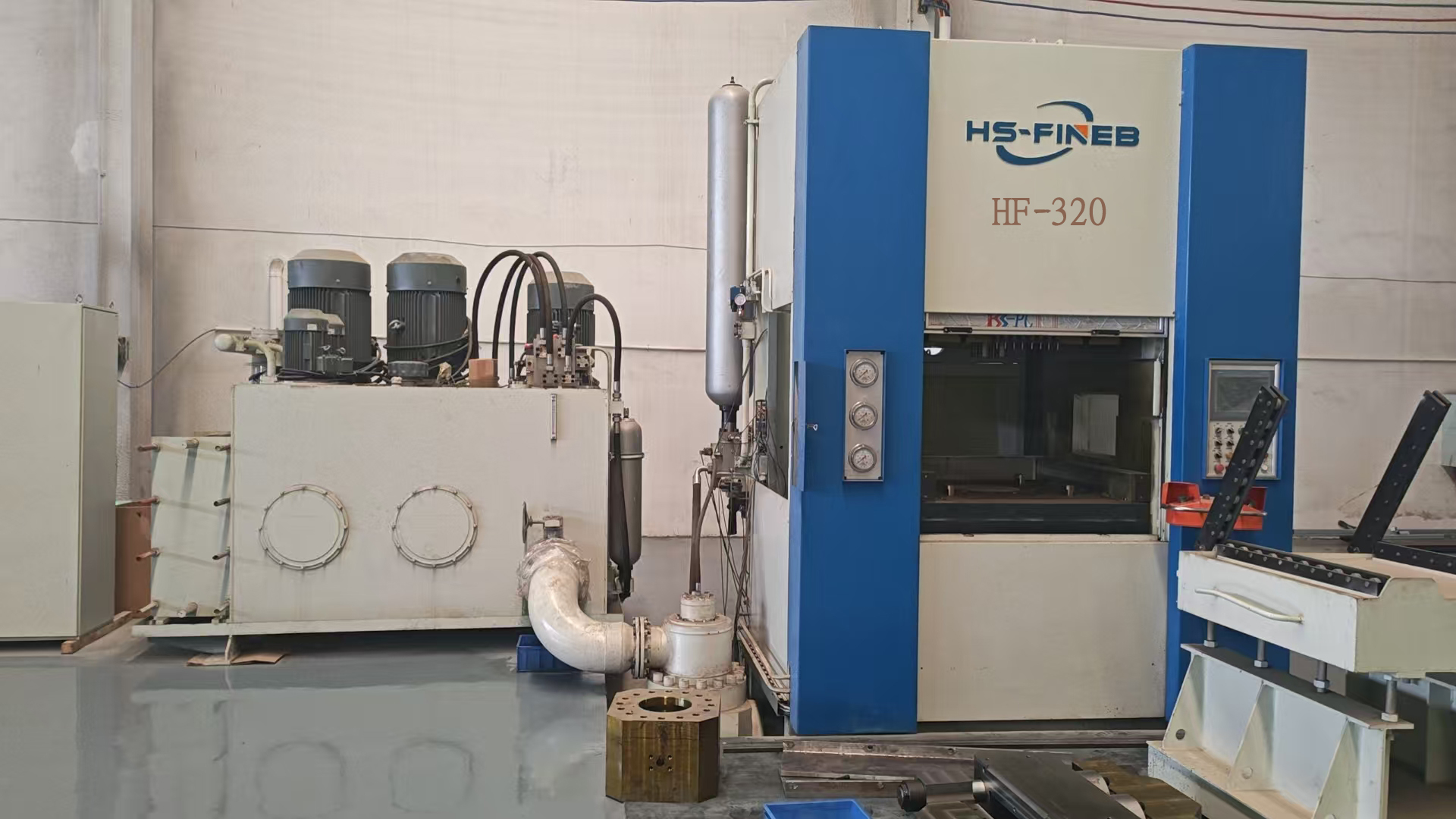
HS-FINEB HF-320 fine blanking press on factory floor ready for shipment
Production Timeline

Lead Time Breakdown by Manufacturing Phase

A fine blanking press is built through seven sequential phases. Each phase has a defined duration, and the total lead time ranges from 16 to 26 weeks depending on model size, customization level and current production schedule. The timeline below reflects a standard build for an HF-500 (500T) press — one of our most commonly ordered models. Smaller presses (HF-200/HF-320) typically complete 2–4 weeks faster; larger presses (HF-800 and above) may add 4–6 weeks due to heavier frame welding, longer stress-relief cycles and larger component machining times.

📝

1. Technical Confirmation

Duration: 1–2 weeks. Our engineering team reviews your part drawings, material grade, thickness range and die specifications. We confirm press model, tonnage, die area dimensions, hydraulic circuit configuration, CNC controller programming parameters and auxiliary equipment selection. This phase ends with a signed technical specification document that freezes the build scope.

2. Frame Welding & Stress Relief

Duration: 4–6 weeks. The whole-welded frame is fabricated from certified steel plate by qualified welders following documented welding procedure specifications (WPS). After welding, the frame enters the stress-relief furnace for thermal treatment at 550–600°C, holding temperature for 2–4 hours depending on section thickness, followed by furnace cooling. This eliminates residual welding stresses that would cause geometry drift over years of cyclic loading.

3. Machining & Assembly Prep

Duration: 4–6 weeks. The stress-relieved frame is precision-machined on CNC floor boring machines and CNC plano-milling machines. Platen flatness is ground to within 0.02 mm/m². Guide way surfaces are hand-scraped to achieve ram parallelism within microns over the full stroke. Simultaneously, hydraulic cylinders, rams and platens are machined and surface-finished.

4. Hydraulic System Build

Duration: 2–3 weeks. Hydraulic circuits are assembled in a controlled-environment area. Proportional valves are bench-tested, accumulators are pre-charged to specification, and each circuit (blanking, V-ring, counter-pressure) is independently pressure-tested for leakage and response time. All hydraulic components carry traceable serial numbers linked to the press build record.

🔌

5. Electrical & Control

Duration: 2 weeks. The control panel is built with PLC/SNC controller, PROFIBUS fieldbus wiring, HMI programming and sensor calibration. Absolute encoder feedback systems are integrated. All electrical schematics are documented and supplied with the machine. The CNC controller is programmed with the force profile parameters confirmed during the technical specification phase.

🛡

6. FAT & Testing

Duration: 1–2 weeks. The fully assembled press undergoes Factory Acceptance Testing: hydraulic pressure test at 1.25× rated pressure, ram parallelism measurement across the full die area using dial indicators, blanking trials on customer-specified material (when available), and full force verification — V-ring force, counter-pressure and blanking force independently measured against specification. The FAT report documents every measured parameter.

📦

7. Packing & Shipping

Duration: 2–4 weeks. The press is prepared for export shipment: anti-corrosion treatment, vacuum-sealing of critical components, custom wooden crate fabrication matched to machine dimensions, container loading and shipping documentation. For oversized presses (HF-1000/HF-1200), special flat-rack containers and route surveys may be required, adding 1–2 weeks.

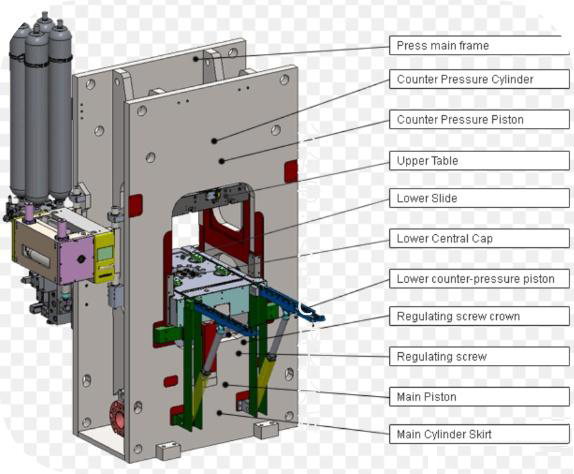
Fine blanking press internal structure during assembly phase showing hydraulic system and frame

Total Lead Time: 16–26 Weeks

The seven-phase sequence totals 16–26 weeks from signed technical specification to port of dispatch. The range reflects model size (larger presses take longer in every phase), customization level (special die area dimensions, non-standard strip widths, integrated automation) and current production floor loading. We provide a firm delivery schedule with each quotation, updated weekly during the build so you can plan your installation, tooling delivery and production start dates with confidence.

Rush production is available for urgent orders. By allocating additional welding stations, running stress-relief furnace on overtime shifts and prioritizing machining capacity, we can compress the total timeline by 3–5 weeks. Rush production carries a surcharge of 8–15% depending on the compression required and current schedule. Contact our sales team with your required delivery date, and we will assess feasibility within 48 hours.

Tonnage Impact

How Lead Time Varies by Press Model

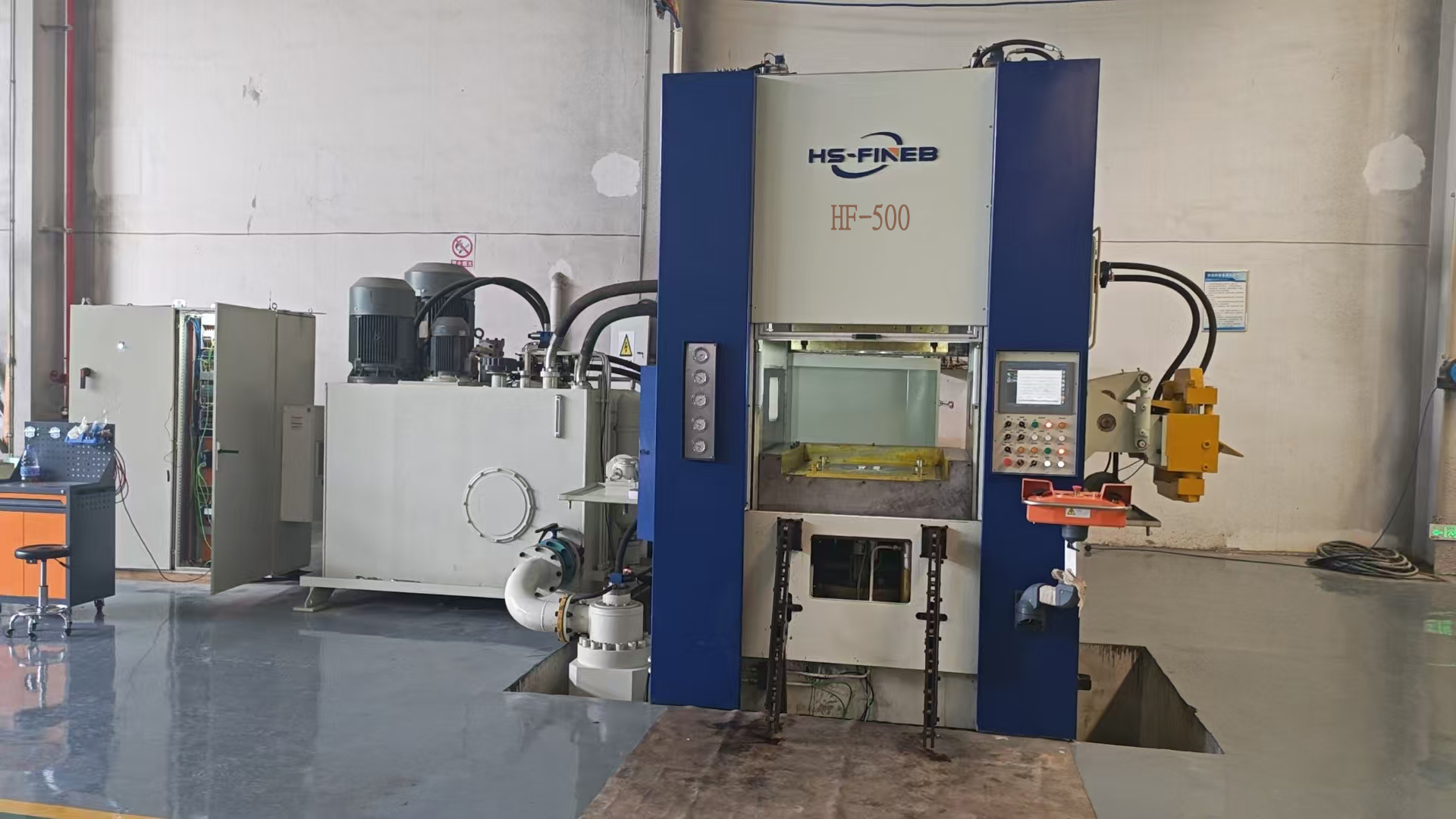
HS-FINEB HF-500 fine blanking press 500 ton capacity in factory

Lead time scales with press tonnage because every phase is affected by machine size. The frame of an HF-200 weighs approximately 12 tons and can be stress-relieved in a standard furnace cycle. The HF-1200 frame weighs over 90 tons, requiring a larger furnace, longer heating and cooling cycles (up to 72 hours versus 24 hours for smaller frames), and heavier lifting equipment throughout fabrication and assembly.

Machining time also scales: the HF-1200 platen is approximately 2,000 mm × 1,800 mm, requiring multiple setups on the CNC floor boring machine, whereas the HF-200 platen at approximately 600 mm × 500 mm machines in a single setup. Hydraulic system build time increases with cylinder bore diameter, pipe routing complexity and accumulator capacity. The following table summarizes typical lead time ranges by model size:

ModelTonnageTypical Lead TimeRush Available
HF-200 / HF-320200–320T16–20 weeks12–15 weeks
HF-400 / HF-500400–500T18–22 weeks14–17 weeks
HF-650 / HF-700650–700T20–24 weeks16–19 weeks
HF-800 / HF-1000800–1000T22–26 weeks18–21 weeks
HF-12001200T24–28 weeks20–23 weeks
Additional Lead Times

Spare Parts, Dies & Auxiliary Equipment

Spare Parts Lead Time

Critical spare parts — seals, hydraulic valves, proximity switches, filter elements — are stocked at our facility and ship within 3–7 days via DHL Express. We provide a recommended spare parts list with every press quotation, organized into Tier 1 (consumables: oil, filters, seals — ship in 3–5 days), Tier 2 (wear items: guide bushings, punch holders — ship in 1–2 weeks) and Tier 3 (major components: hydraulic cylinders, control boards — ship in 4–8 weeks). First-time buyers receive a startup spares package included with the machine. See our spare parts inventory for details.

Fine Blanking Die Lead Time

Progressive and compound fine blanking dies take 8–12 weeks to manufacture, depending on complexity, number of stations and material grade. Die manufacturing runs in parallel with press build — the die is typically ready for installation during the FAT phase, allowing die tryout on the actual press before shipment. This parallel approach saves 6–8 weeks compared to sequential ordering. Die design review begins during the technical confirmation phase, ensuring the die and press are engineered as one system.

📦

Auxiliary Equipment

Coil feeding systems, decoilers, straighteners and waste shears add 4–6 weeks to the total timeline when ordered with the press. These are typically ordered simultaneously and arrive at the customer facility ahead of or alongside the press, ready for production line integration. We recommend ordering auxiliary equipment with the press rather than separately to ensure interface compatibility and coordinated delivery.

🗣

Communication During Build

Throughout the production timeline, you receive weekly progress updates with photographs from the factory floor. Major milestones — frame completion, stress relief completion, hydraulic system pressure test, FAT — trigger additional reports with measured data. You are welcome to visit the factory for FAT in person, or participate via live video link. All communication is in English with our engineering team.

Planning a Fine Blanking Press Purchase?

Our engineering team responds to technical inquiries within 48 hours with a firm quotation, delivery schedule and recommended configuration for your specific part and material.

💬