Programmable motion control for fine blanking: how servo direct-drive technology compares with hydraulic and mechanical systems — advantages, limitations and selection criteria.
A servo fine blanking press replaces the conventional flywheel-and-crank mechanical drive or the hydraulic cylinder drive with a direct-drive servo motor system. The servo motor — typically a high-torque permanent-magnet synchronous motor — drives the ram through a ball-screw or planetary roller-screw mechanism, providing fully programmable control over ram position, velocity and force throughout the entire stroke. Unlike a mechanical press where the stroke profile is fixed by the crank geometry, or a hydraulic press where speed control depends on valve response, a servo press can execute any position-versus-time profile that the application requires.
In fine blanking, this programmability is transformative. The ideal fine blanking stroke consists of a rapid approach (to minimize cycle time), a slow and precisely controlled shear phase (0.5-5 mm/s for optimal edge quality), and a rapid return. A mechanical press cannot vary speed within the stroke; a hydraulic press can vary speed but with response limitations from proportional valve dynamics. A servo press can transition from 50 mm/s approach to 1 mm/s shear in milliseconds, hold the shear speed constant within ±0.1 mm/s, and return at 60 mm/s — all under closed-loop position feedback.
Current servo press technology covers the force range from approximately 200 tons to 1,600 tons, making it applicable to the majority of fine blanking applications. The technology has matured significantly over the past decade, with improvements in servo motor torque density, roller-screw load capacity and CNC control systems bringing servo presses into mainstream fine blanking production.

Energy efficiency is the most significant advantage: servo presses typically reduce energy consumption by 70-90% compared to hydraulic systems of equivalent tonnage. A hydraulic press continuously runs its pump motor regardless of actual force demand, while a servo motor draws current only when generating force. For a 400-ton press running at 30 SPM, this can mean annual energy savings of 60,000-80,000 kWh. Additional advantages include elimination of hydraulic oil (no leaks, no oil changes, no fire risk, no environmental disposal), quieter operation (typically 75-80 dB vs 85-92 dB for hydraulic), and reduced maintenance (no seals, valves, accumulators or filters to service). The servo system also offers superior positioning accuracy — ram position is controlled to within ±0.01 mm under closed-loop feedback, compared to ±0.05-0.1 mm for hydraulic.
Programmable bottom-dead-center (BDC) control is the defining advantage over mechanical presses. On a crank-driven press, BDC is fixed by the crank geometry and any variation in material thickness or die height causes force spikes or under-stroking. A servo press can sense force buildup as the punch approaches BDC and adjust ram position in real-time, maintaining consistent die contact force regardless of material variations. Dwell time at BDC — critical for coining and sizing operations in progressive dies — is fully programmable from 0 to 500 ms. Variable speed within a single stroke enables the optimal approach-shear-return profile that mechanical presses cannot achieve. Force monitoring is inherent to the servo system: motor torque directly correlates with ram force, providing real-time force data without external load cells.
The programmable motion profile is where servo technology delivers its greatest value in fine blanking. A typical optimized profile for a 3 mm steel part: approach at 40-60 mm/s until the punch is 2 mm above the material surface, decelerate to 3 mm/s shear speed through the full material thickness, dwell at BDC for 50-100 ms for coining, then return at 50-60 mm/s. The shear speed phase — the most critical parameter for edge quality — can be held constant to within ±0.1 mm/s, compared to ±0.5-1.0 mm/s on a hydraulic press. For thin materials (below 2 mm), the shear speed can be increased to 5-8 mm/s without quality degradation; for thick or high-strength materials (above 6 mm or stainless steel), it should be reduced to 1-2 mm/s.
Current servo fine blanking presses cover 200-1,600 tons, with the most common models in the 200-800 ton range. The force is generated by the servo motor's torque transmitted through the roller screw — a mechanism that converts rotational torque to linear force with efficiency above 90%. Force monitoring is inherent: the servo controller measures motor current, which directly corresponds to torque and therefore to ram force, providing real-time force data at 1,000+ Hz sampling rate. This enables in-process quality monitoring: a sudden force increase indicates material thickening or die interference, while a force drop suggests material thinning or a missed feed. The CNC system can trigger automatic stop or part-rejection based on these force signatures.

Despite its advantages, servo technology has two inherent limitations that affect its applicability to certain fine blanking applications. First, maximum force is constrained by servo motor size and roller-screw capacity. While 1,600-ton servo presses exist, they require exceptionally large motors and screws, making them significantly more expensive than equivalent hydraulic presses at the upper tonnage range. For applications requiring 800 tons or more, the cost premium of servo over hydraulic can exceed 40-60%, and the energy savings may not justify the additional capital expenditure within a reasonable payback period.
Second, servo presses have a force-duration limitation that hydraulic presses do not. A hydraulic press can sustain full force indefinitely (as long as the pump runs), while a servo motor's peak torque is typically rated for short durations (30-60 seconds) with a continuous torque rating of 60-75% of peak. For applications requiring sustained high force — such as deep coining or heavy forming operations — a hydraulic press may be more appropriate.
Higher initial cost is the third consideration. A servo press typically costs 30-50% more than a comparable hydraulic press. The payback period through energy savings and reduced maintenance depends on utilization: at 2-shift operation (4,000 hours/year), payback typically occurs in 3-5 years; at single-shift operation, it may extend to 7-10 years.
Material thickness is 5 mm or below, where the force requirements are within servo motor capacity and the programmable shear speed delivers measurable edge quality benefits. Annual production volume exceeds 500,000 parts, where energy savings and reduced maintenance accumulate significantly. Part geometry includes coining, sizing or forming operations that benefit from programmable dwell time and BDC control. The application requires clean operation (no oil contamination) — such as medical or food industry parts. The facility has limited electrical capacity or environmental restrictions on hydraulic oil.
Material thickness exceeds 5 mm or blanking force exceeds 800 tons, where servo motor and roller-screw costs become prohibitive. The application requires sustained high force (deep forming, heavy coining) beyond the servo motor's continuous rating. The part requires multi-force control — independent V-ring, counter-pressure and blanking circuits — which is more naturally implemented with multiple hydraulic cylinders than with multiple servo drives. Budget constraints prioritize lower initial capital cost over long-term operating savings. The production environment already has hydraulic infrastructure and maintenance capability.
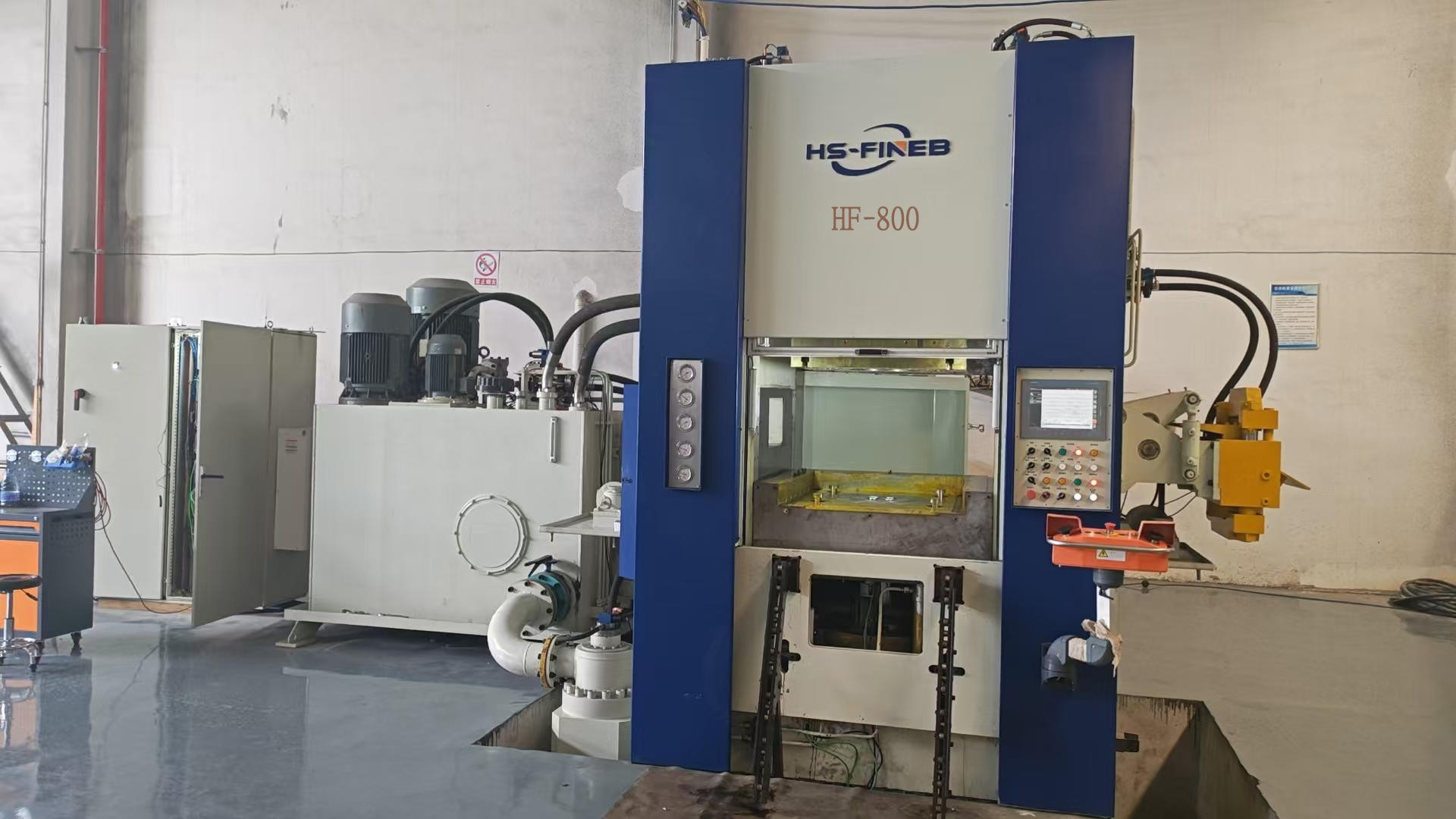
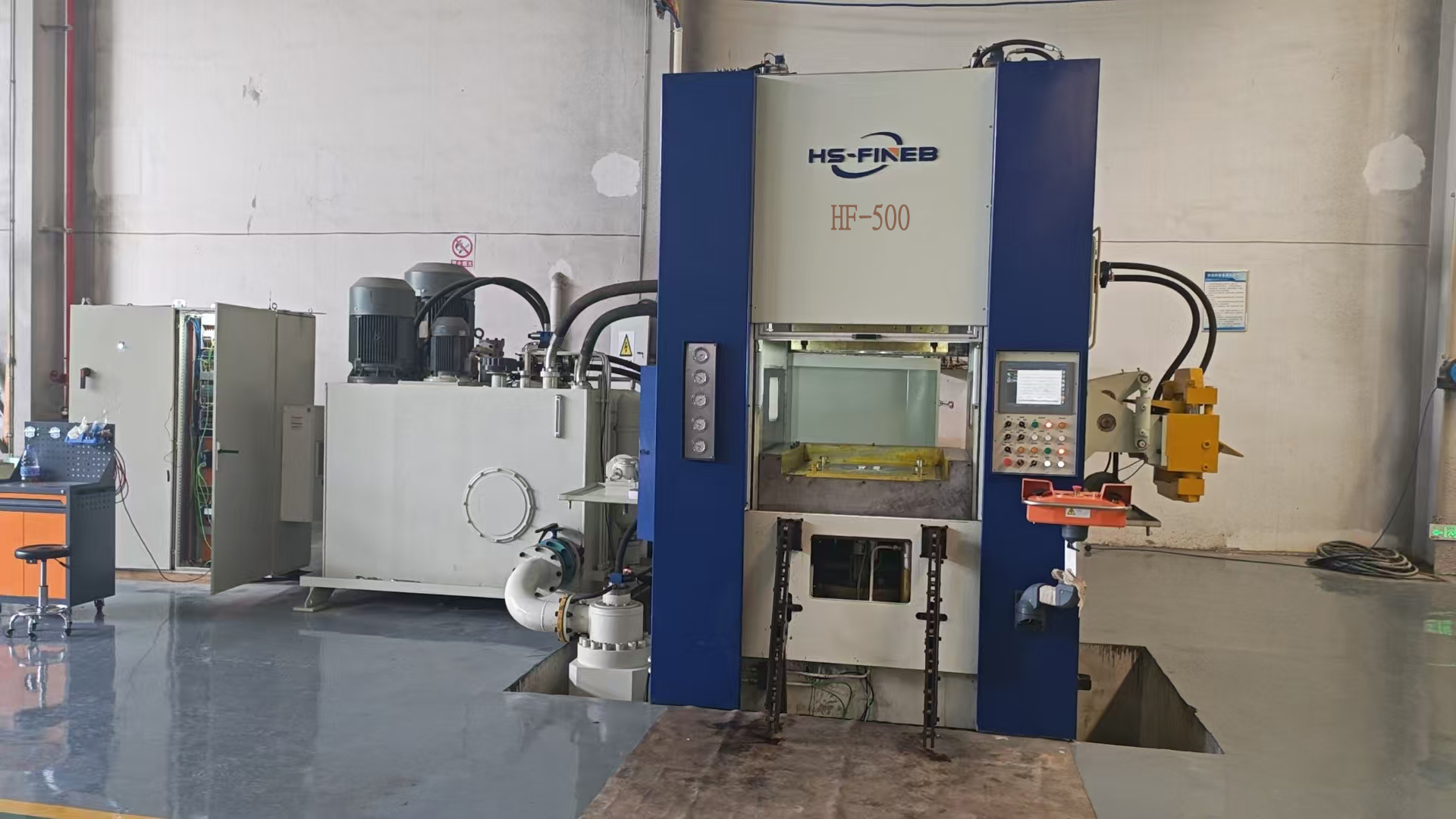
HS-FINEB is actively developing servo-driven fine blanking press technology as a complement to our established HF-series hydraulic press line. Our current hydraulic presses already incorporate servo technology in the feeding system (Lenze servo drives for coil feed positioning) and in the proportional valve control system (servo-valve response for force profile programming). The next development phase integrates a servo direct-drive ram system on select models in the 200-500 ton range, targeting applications in thin-gauge (1-4 mm) high-volume production where the programmable motion profile delivers maximum value.
Our engineering approach retains the triple-force architecture — V-ring, counter-pressure and blanking — that is fundamental to fine blanking, while replacing the hydraulic blanking cylinder with a servo-driven ram. The V-ring and counter-pressure systems remain hydraulic, as these auxiliary forces are relatively low and sustained, making hydraulic implementation more cost-effective than adding two additional servo drives. This hybrid approach captures the primary benefits of servo technology (programmable shear speed, energy efficiency, BDC control) while maintaining the proven reliability of hydraulic force control for the auxiliary systems.

Tell us your material, thickness, part geometry and annual volume — our engineers will recommend the optimal drive system and press model for your fine blanking application.