Why lubrication is the single most critical process variable in fine blanking — from the physics of 2000+ MPa contact pressure at the die interface to lubricant selection, application methods, film thickness control and the HS-FINEB integrated lubrication system design.
Fine blanking generates contact pressures at the die-material interface that exceed 2000 MPa — pressures in the regime of cold welding. Without proper lubrication, the material welds to the die edge during the shear stroke, causing galling (material transfer to the die surface), which progressively degrades edge quality, increases die-roll, and ultimately causes die failure through chipping and adhesive wear. Die life can drop by 80% or more when lubrication is inadequate or interrupted.
The physics of the lubrication challenge in fine blanking differ from conventional stamping. In conventional stamping, the tear zone (which accounts for 60–80% of the edge) allows some material flow without die contact — the lubrication requirement is lower. In fine blanking, the entire edge is a shear surface in intimate contact with the die wall throughout the stroke. The lubricant film must survive the full shearing duration at full contact pressure — there is no tear zone to relieve the contact stress.
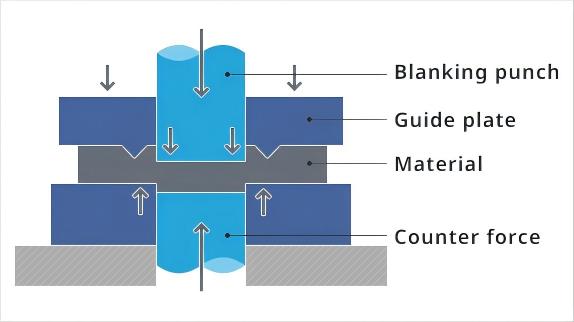
The counter-pressure in fine blanking adds another complexity: the material is under triaxial compression, which increases the actual contact pressure beyond the nominal blanking force per unit area. The V-ring indention creates additional local pressure concentration. A lubricant that works in conventional stamping may fail completely in fine blanking — the film strength, additive package and viscosity must be selected for the fine blanking pressure regime.

Easier to clean from parts after blanking (warm water wash or ultrasonic), making them preferred for parts that go directly to assembly or coating without intermediate processing. Lower film strength than oil-based lubricants — suitable for mild steels and non-ferrous materials at moderate thickness (≤4 mm). The water content can cause corrosion if parts are not promptly cleaned or if the cleaning process is incomplete. Typical film: 0.5–1.5 g/m².
Better film strength and extreme-pressure (EP) additive performance — suitable for stainless steel, HSLA grades and thicker materials (>4 mm). The oil film survives higher contact pressures and longer shear durations. The trade-off is harder cleaning: requires alkaline wash or solvent degreasing. Oil-based lubricants also present mist and fire safety considerations in high-volume operations. Typical film: 1–3 g/m².
Synthetic and semi-synthetic lubricants combine the cleaning ease of water-soluble with the film strength of oil-based — at higher cost. They use synthetic ester base stocks with tailored additive packages for fine blanking pressure regimes. Increasingly specified in automotive supply chains where parts must meet cleanliness standards (e.g., VDA 19.1 particle count) without aggressive cleaning. Bio-based synthetic lubricants are gaining traction for sustainability compliance.

The roller coater applies lubricant to the strip surface before it enters the die. A felt or steel roller runs in the lubricant bath, picks up a controlled film, and transfers it to the strip. The roller-to-strip gap (typically 0.05–0.15 mm) controls film thickness. Advantages: uniform film across the full strip width, adjustable film thickness, continuous operation without interruption. The roller coater is the standard method on HS-FINEB production lines, integrated into the feeding system upstream of the press.
Nozzle-based spray applies lubricant to specific areas of the strip or directly into the die cavity. Advantages: targeted application (only where needed, reducing lubricant consumption and cleaning burden), adjustable spray pattern and volume. Disadvantages: mist generation requiring extraction, potential for non-uniform coverage at high line speeds, and nozzle clogging with high-viscosity lubricants. Spray is used when the part geometry requires lubricant only in specific areas (e.g., deep-drawn features within a blanked part).
Simple gravity-feed drip onto the strip or die surface. Lowest cost and lowest performance — inconsistent film thickness, waste from oversaturation, and potential for dry areas. Suitable only for low-volume or prototype operations where lubricant consumption is not a cost factor. Not recommended for production fine blanking.
Mild steel (C45, 16MnCr5) works with standard EP additives (sulfur-phosphorus). Stainless steel (304, 316L) requires chlorine-free EP additives because stainless is prone to galling at the die edge — the lubricant film must have higher film strength and anti-weld additives. Aluminum requires specialized lubricants with boundary additives to prevent adhesion to the die. Copper and brass work well with most lubricants but may stain with high-sulfur formulations.
Thicker materials (>6 mm) require higher viscosity lubricants because the longer shear duration at the die interface demands a thicker, more persistent film. Thinner materials (≤3 mm) can use lower viscosity for easier cleaning. Parts with deep features or contours require lubricants with better flow characteristics to reach all cutting line geometries — a lubricant that pools in low spots and leaves high spots dry will produce inconsistent edge quality.
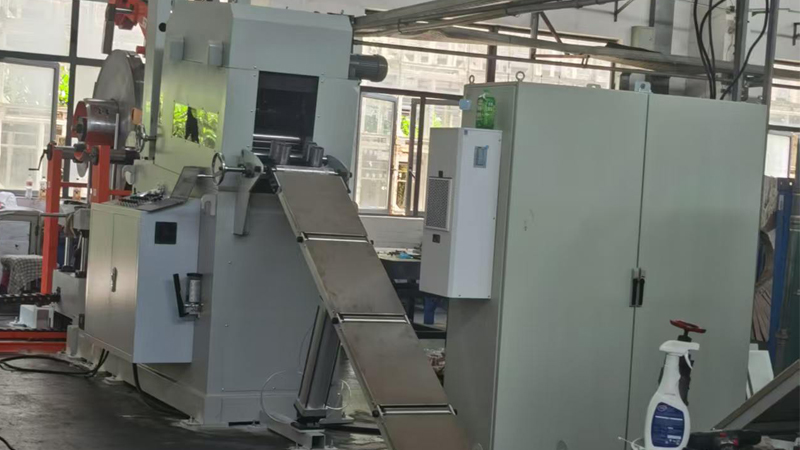
The HS-FINEB lubrication system is integrated into the production cell as a subsystem of the coil feeding line, not a separate add-on. The system consists of a roller coater with adjustable gap (0–0.5 mm, set via handwheel with dial indicator), a lubricant circulation system with multi-stage filtration (50 μm return filter, 10 μm pressure filter), and a flow meter providing feedback to the cell controller. The circulation system maintains lubricant level, temperature (optional cooling), and cleanliness — when the filter differential pressure exceeds threshold, the controller alerts the operator for filter replacement.
The roller coater is positioned between the straightener and the servo feeder, applying lubricant to both surfaces of the strip. For applications requiring single-side lubrication (e.g., pre-lubricated material from the supplier), the upper roller can be disengaged. The lubricant bath has a capacity matched to the production volume — typically 20–50 liters for a 650-ton press cell, with refill frequency of every 8–16 hours of continuous operation.
The system includes a lubricant condition monitoring point where samples can be drawn for analysis. Regular analysis (viscosity, total acid number, additive depletion, contamination particle count) is part of the preventive maintenance schedule — degraded lubricant is the second most common cause of die wear after die clearance drift.

Too thin: die galling, material transfer to die edge, degraded edge quality, shortened die life. Too thick: staining on part surfaces, cleaning problems (especially for parts going to coating or welding), increased lubricant consumption and cost, and potential for lubricant migration into downstream processes. The optimal film thickness is application-specific — our engineers set it during process validation based on material, thickness, die geometry and required die life. The roller gap and lubricant viscosity are the two primary control variables.
Filter replacement every 2,000 operating hours maintains lubricant cleanliness. Lubricant testing (viscosity, additive depletion, contamination) every 500 hours catches degradation before it affects production. Waste oil disposal must comply with local environmental regulations — HS-FINEB systems include a waste oil drain point for easy collection. Bio-based lubricants reduce environmental impact and are increasingly specified in European and Japanese supply chains. Mist collection (extraction hood above the die area) maintains workplace air quality in high-volume operations.
Proper lubrication reduces die-roll by 20–30% and improves surface finish (Ra) on the shear edge by providing a consistent film that reduces friction variation during the shear stroke. The investment in a well-designed lubrication system pays back through extended die life, reduced reject rates, and lower cleaning costs downstream — a fraction of the total cell cost with an outsized impact on part quality and die economics.
HS-FINEB designs and supplies integrated lubrication systems as part of complete fine blanking production cells. Contact our engineers for a system configured to your material and production volume.