💬 WhatsApp Chat

Single vs Multi-Station Fine Blanking Press: Which to Choose?

An engineering and economic comparison of single-station and multi-station fine blanking presses — covering production rate, tooling investment, die change flexibility, part complexity handling, strip layout design, material utilization, and a decision framework for choosing the right configuration based on production volume, part geometry, material, and budget.

Press Configuration

Understanding the Two Approaches

Fine blanking presses come in two fundamental configurations. A single-station press holds one die set — typically a compound die — and performs one complete blanking operation per stroke cycle. The material is fed, blanked, and the finished part is ejected, then the cycle repeats. A multi-station press holds a progressive die with multiple stations arranged along a strip. Each stroke advances the strip one pitch, and each station performs one operation (piercing, blanking, forming, trimming). A finished part exits the final station with every stroke.

The choice between single-station and multi-station is not simply a throughput decision — it affects tooling investment, die changeover time, part complexity capability, material utilization, floor space, and the production flexibility needed to respond to changing order volumes. The wrong choice can lock a manufacturer into a tooling configuration that cannot economically serve its market. This article provides a structured comparison and decision framework. For background on the fine blanking process itself, see What Is Fine Blanking?

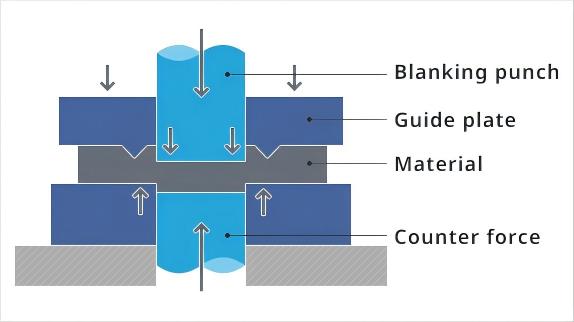
Fine blanking process showing material being sheared in a single-station press operation
Single-Station Presses

Single-Station Fine Blanking Press Characteristics

One Die, One Operation Per Stroke

A single-station press holds one die set in the bolster. The die is typically a compound die that performs all cutting operations (outer blank, inner holes, cutouts) in a single downward stroke. The material is fed as individual blanks or short strips, the die closes, all features are sheared simultaneously, and the finished part is ejected. This simplicity means the die can be designed, manufactured, and validated faster than a progressive die — typically 6–10 weeks versus 12–20 weeks for a multi-station progressive die.

💰

Lower Tooling Investment

A compound die for a single-station press costs $8,000–$30,000 depending on part size and complexity, compared to $30,000–$120,000 for a comparable progressive die with multiple stations. The savings come from fewer die plates, fewer punches, simpler strip carrier design, and no inter-station pilot alignment system. This makes single-station the preferred choice for prototype development, R&D validation, and production of parts where the tooling investment must be amortized over fewer parts.

🔄

Higher Flexibility and Quick Die Change

Single-station presses excel at flexibility. A die change takes 15–45 minutes using standardized clamping systems (magnetic bolsters or hydraulic clamps), compared to 1–3 hours for a multi-station progressive die with strip feed setup and pilot alignment. This rapid changeover makes single-station presses ideal for job shops, tier-2 suppliers, and manufacturers producing multiple part numbers in small-to-medium lot sizes. The press can switch between part numbers within a single shift, enabling lean manufacturing with minimal work-in-process inventory.

📊

Ideal Volume: 5,000–50,000 Parts/Month

Single-station presses are most economical in the 5,000–50,000 parts/month volume range. At these volumes, the tooling cost per part remains competitive ($0.10–$0.50 per part for a $15,000 die producing 100,000 parts over its life) while the press utilization is high enough to justify the capital investment. Below 5,000 parts/month, the press sits idle too often; above 50,000 parts/month, the single-station cycle time becomes the production bottleneck and a multi-station press becomes economically attractive.

Multi-Station Presses

Multi-Station Fine Blanking Press Characteristics

Progressive Die, Multiple Operations Per Stroke

A multi-station press holds a progressive die with 3–12 stations arranged along the strip feed direction. Each stroke advances the strip one pitch (the distance between corresponding points on consecutive parts), and each station performs one operation. A part that requires piercing, blanking, forming, and trimming would use four stations — each station performs its operation on a different part position simultaneously. The final station cuts the finished part free from the strip carrier. This parallel processing means every stroke produces one finished part, regardless of how many operations the part requires.

📈

3–5x Higher Throughput

A multi-station press produces 3–5x more parts per hour than a single-station press of equivalent tonnage, because the cycle time per finished part is the press stroke time divided by one (not by the number of operations). A single-station press producing a part with four features needs four strokes (or one stroke with a complex compound die); a multi-station press produces one finished part per stroke after the strip is filled. For a 30 SPM (strokes per minute) press, this means 1,800 finished parts per hour on a multi-station versus 450 on a single-station with the same press speed. See our multi-station press page for specifications.

🔧

Higher Tooling Investment, Part Complexity Handling

The progressive die for a multi-station press costs 3–5x more than a compound die for the same part, because it requires multiple die plates, a carrier strip design, pilot alignment between stations, and more complex die assembly. However, this investment buys the ability to produce complex parts with forming, drawing, or bending operations integrated into the blanking line — operations that would require separate secondary operations on a single-station press. The progressive die can also incorporate idle stations for future feature additions, providing design flexibility for part evolution.

🛡

Ideal Volume: 100,000+ Parts/Month

Multi-station presses are most economical at 100,000+ parts/month, where the higher tooling investment is amortized across sufficient volume. At 200,000 parts/month with a $60,000 progressive die, tooling cost per part is $0.03 over a 2,000,000-part die life — dramatically lower than the $0.15–$0.30 per part achievable with single-station tooling. The multi-station configuration also achieves higher material utilization through optimized strip layout: by nesting parts tightly in the carrier strip, utilization can reach 70–85% versus 50–65% for single-blank single-station feeding.

Side-by-Side

Comparison Table

Factor Single-Station Multi-Station
Die typeCompound die (1 set)Progressive die (3–12 stations)
Operations per stroke1 complete part1 finished part (all features)
Throughput (30 SPM)~450 parts/hr~1,800 parts/hr
Tooling cost$8,000–$30,000$30,000–$120,000
Die change time15–45 min1–3 hr
FlexibilityHigh (quick part changeover)Low (dedicated to one part)
Part complexityFlat parts, cut features onlyForming, bending, drawing integrated
Material utilization50–65%70–85%
Ideal volume5k–50k parts/month100k+ parts/month
Floor spaceSmaller (no strip feed)Larger (decoiler, feed, straightener)
Decision Framework

How to Choose: Single vs Multi-Station

The decision between single-station and multi-station configuration should be driven by four primary factors. Evaluate each against your specific production context:

📊

1. Production Volume

Volume is the primary driver. Below 50,000 parts/month, single-station is almost always the better choice — the multi-station tooling investment cannot be amortized efficiently, and the press would be underutilized. Between 50,000 and 100,000 parts/month, the decision depends on part complexity and material cost: high-cost materials favor multi-station's better utilization; simple parts favor single-station's lower tooling cost. Above 100,000 parts/month, multi-station is strongly preferred — the throughput advantage and lower per-part tooling cost dominate.

2. Part Complexity

If the part requires only flat cutting features (outer profile, holes, cutouts), a single-station compound die handles it efficiently. If the part requires integrated forming, bending, coining, or drawing operations alongside cutting, a multi-station progressive die is necessary — these operations cannot be performed in a single compound die stroke. Parts for seat mechanisms with bends and forms, or electronics connectors with formed contacts, typically require multi-station tooling.

📦

3. Material and Utilization

Material cost affects the utilization tradeoff. For expensive materials such as stainless steel ($4–$8/kg) or specialty alloys, the multi-station's 70–85% utilization versus single-station's 50–65% can save $0.10–$0.30 per part in material cost — enough to justify the higher tooling investment even at moderate volumes. For low-cost mild carbon steel ($0.80–$1.50/kg), the material savings from better utilization rarely offset the higher tooling cost below 100,000 parts/month.

💰

4. Budget and Production Flexibility

Consider both capital budget and operational flexibility. A single-station press with one compound die represents $15,000–$35,000 total tooling investment; the same part on a multi-station press requires $30,000–$120,000. If the production contract is short-term or uncertain, single-station's lower investment reduces financial risk. If the manufacturer serves multiple customers with diverse part numbers in small lots, single-station's quick die change (15–45 min) provides the flexibility to serve a mixed customer base efficiently. Multi-station dies are typically dedicated to a single part number for the die's entire life.

Real-World Examples

Application Suitability by Industry

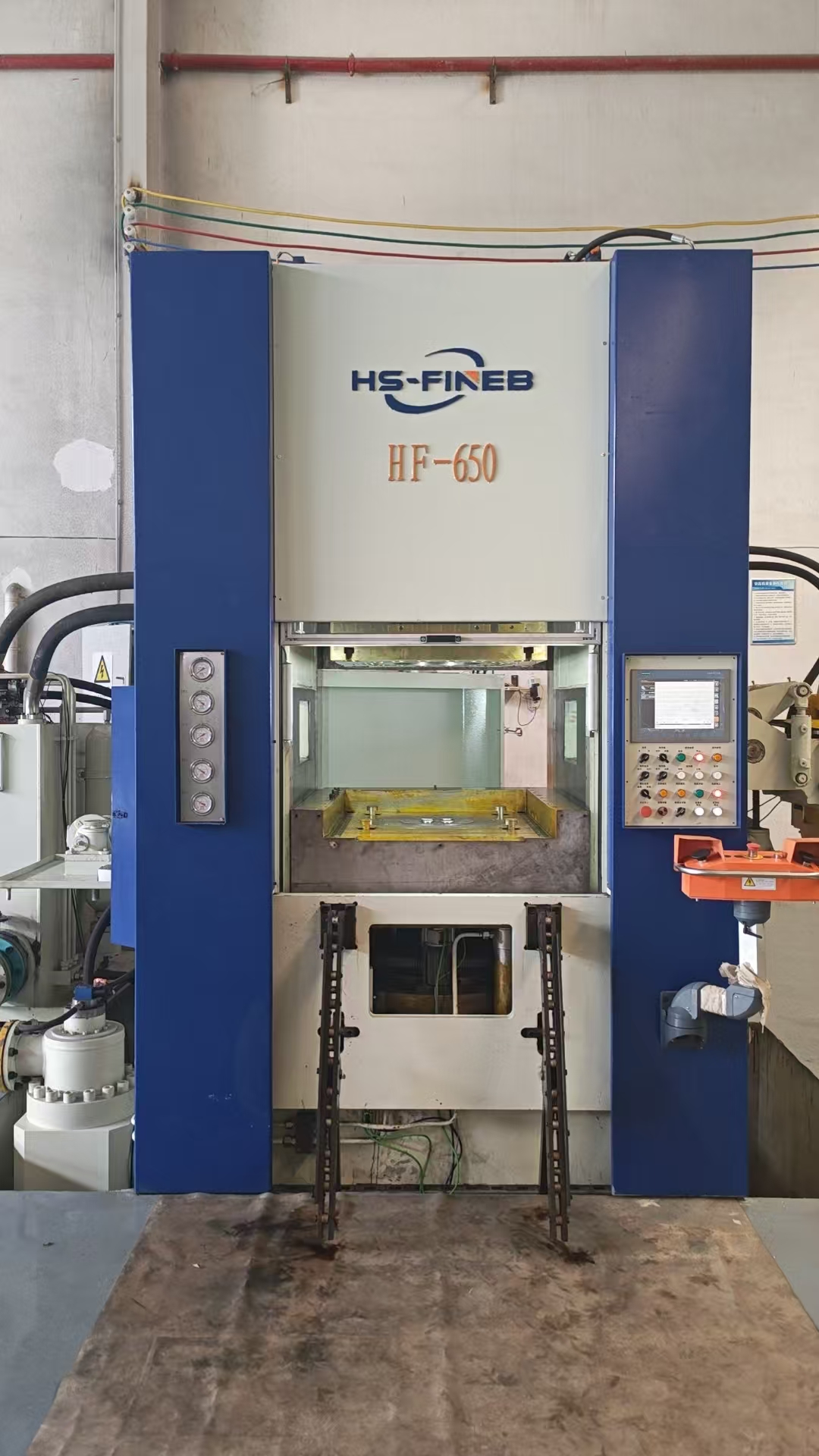
HS-FINEB HF-650 complete fine blanking press with hydraulic system

Single-Station Applications

Single-station presses dominate in lock and security hardware manufacturing, where part variety is high and lot sizes are moderate (10,000–30,000 per part number). Lock plates, key blanks, and security components are flat parts with cut features — ideal for compound dies. Similarly, aerospace components and medical device parts, produced in lower volumes with frequent design changes, favor single-station flexibility. R&D and prototype production also uses single-station presses exclusively, because the die can be modified quickly and the press can switch between part numbers within minutes.

Multi-Station Applications

Multi-station presses dominate in automotive braking components, transmission gears, and seat mechanisms — all high-volume automotive applications where 200,000–2,000,000 parts per year per part number are common. The progressive die integrates forming and blanking operations, and the high throughput justifies the dedicated tooling. Electronics connectors with formed contacts and tight pitches also require multi-station progressive dies for volume production. For these applications, the multi-station press achieves a per-part cost 40–60% lower than single-station at equivalent volume.

HS-FINEB manufactures both single-station and multi-station fine blanking presses across the 200–1200 ton range. Our engineering team can recommend the optimal configuration based on your part drawing, material specification, and annual volume. We also provide die design services for both compound and progressive dies. Contact us for a configuration recommendation tailored to your application.

Choosing Between Single and Multi-Station?

HS-FINEB engineers will analyze your part geometry, material, production volume, and budget to recommend the optimal press configuration. Contact us for a configuration assessment and tooling cost estimate.

💬