💬 WhatsApp Chat

Used Fine Blanking Machines

We do not maintain a static “for sale” listing — inventory turns over and stale listings do buyers more harm than good. Tell us your tonnage range, budget, and application, and we will match against current availability with an honest condition assessment before you commit.

Sourcing Service

Our Used Machine Sourcing Approach

A used fine blanking press can represent excellent value — 40–70% of the cost of a new machine at 80–90% of the production capability, delivered in a fraction of the lead time. But the used fine blanking market has a real information asymmetry problem: a machine that looks clean in photos can have frame distortion, hydraulic system wear, or obsolete control components that only surface under load.

As a manufacturer who also builds new presses and refurbishes existing ones, we have the engineering depth to evaluate a used machine on its actual condition — not its appearance. We inspect the press, assess its remaining service life, identify what needs refurbishment, and give you a transparent recommendation: buy it as-is, refurbish it first, or walk away.

If a used machine needs work before it is production-ready, we can bundle sourcing, refurbishment, and installation into one project rather than three separate transactions with three separate parties. This integrated approach eliminates the finger-pointing that plagues the used equipment market.

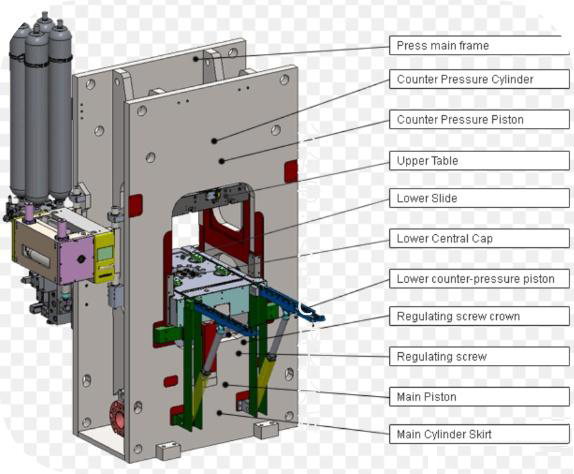
Fine blanking press structure showing hydraulic circuits, frame, guideway, and die area of a used machine under inspection
Inspection Checklist

What We Check Before Recommending a Used Machine

We evaluate every candidate machine across four critical systems. A deficiency in any one can make a seemingly good deal expensive — or dangerous — in production.

1. Frame & Guideway Condition

The single most important factor — and the one most likely to make a used machine a bad deal regardless of price. We inspect the press frame for cracks (particularly at stress concentration points around the crown and bed), weld integrity, casting condition, and machining surface wear. The four-poster guideway is checked for parallelism, perpendicularity, and bearing surface wear using dial indicators under simulated load.

Frame deflection is measured at rated tonnage — a press that deflects beyond 0.05 mm per meter of bed width under load will produce inconsistent edge quality across the bed, regardless of how well the hydraulic system functions. Frame problems are the most expensive to fix and often make a machine uneconomical to refurbish.

2. Hydraulic System Condition

We inspect pumps, valves, cylinders, and seals for wear, leakage, and response time. Hydraulic oil is sampled and analyzed for contamination (particulate count per ISO 4406), water content, and viscosity degradation. Accumulator pre-charge pressure is verified, and pressure relief valve settings are tested under load.

Cylinder internal seal wear is assessed by measuring counter-piston and V-ring ram drift under sustained pressure. A machine with leaking cylinder seals will not hold counter-pressure or V-ring force consistently — the two forces most critical to fine blanking quality. Hydraulic system refurbishment is typically viable and cost-effective if the frame is sound.

3. CNC Control System Status

We assess whether the control system’s hardware (PLC, servo drives, HMI panels, position sensors) is still supported by the manufacturer and whether spare parts are realistically obtainable. An otherwise excellent machine with an obsolete, unsupported controller is a liability — a single failed board can render it unusable for weeks.

If the original controller is end-of-life, we evaluate whether a control system retrofit is feasible and cost-effective. Modern CNC retrofits with current-generation PLCs and servo systems can extend a machine’s productive life by 10–15 years at a fraction of replacement cost.

4. Die Area & Tooling Interface

We inspect the bolster plate for wear, flatness, and T-slot condition; the ram face for parallelism and mounting hole integrity; and the tooling connector system for compatibility with standard die configurations. Die area condition directly affects part quality — a worn bolster plate or non-parallel ram creates uneven die clearance across the bed.

We also verify that the ejector system stroke, counter-piston travel, and V-ring ram dimensions are within specification and compatible with the customer’s intended die set. Tooling interface mismatch is a common cause of extended setup time and compromised part quality on used machines.

Why frame condition matters most: A worn hydraulic system can be rebuilt. An obsolete controller can be retrofitted. A damaged die area can be re-machined. But a cracked or distorted frame cannot be economically repaired — the machine is scrap. This is why frame inspection is our first and most rigorous checkpoint on any used fine blanking press.
Assessment Process

Our 5-Step Used Machine Assessment Process

From your requirement to a production-ready press on your floor — here is how we manage each sourcing project.

StepActivityTypical DurationDeliverable
1. RequirementsYou provide tonnage range, part material, production volume, target lead time, and budget. We confirm whether a used machine is the right choice or a new HF-series press offers better total cost of ownership.1–2 daysRequirements brief & recommendation
2. Market SearchWe search our network of used equipment dealers, auction houses, and factory closures across Asia, Europe, and North America for candidate machines matching your specification.1–4 weeksCandidate list with asking prices
3. On-Site InspectionOur engineer travels to the machine’s location and performs the full 4-point inspection checklist. We test-run the press under load and measure critical parameters.2–5 daysInspection report with condition rating
4. RecommendationWe present our honest assessment: buy as-is, refurbish first, or reject. If refurbishment is needed, we provide a scoped work order with cost and timeline.3–5 daysDecision report & optional refurbishment quote
5. Delivery & CommissioningWe arrange purchase, transport, customs, installation, and commissioning. For refurbished machines, all work is completed before delivery or on-site as agreed.4–12 weeksProduction-ready press on your floor
Brands We Source

Major Fine Blanking Press Brands

We source and service used fine blanking presses from all major manufacturers. Our brand-specific expertise means we know each manufacturer’s common failure modes, spare parts availability, and refurbishment requirements.

Feintool

The dominant fine blanking press brand globally. We source used Feintool presses (MFP, FBT, XFT series) and provide Feintool refurbishment services including hydraulic rebuilds, control retrofits, and die area re-machining.

Mori

Japanese-built fine blanking presses known for frame rigidity and long service life. We source used Mori presses and provide Mori press repair services including hydraulic system rebuilds and spare parts supply.

Schuler

German-engineered fine blanking presses with robust hydraulic systems. We source used Schuler presses and provide Schuler service including inspection, refurbishment, and control system retrofits.

Hydrel

Swiss-precision fine blanking presses, typically in the 50–320-ton range, favored for electronics and small precision components. We source used Hydrel presses and provide hydraulic and mechanical refurbishment to restore original precision specifications.

Osterwalder

Swiss-built fine blanking presses known for compact design and reliability in the 80–400-ton range. We source used Osterwalder presses and provide full refurbishment including hydraulic system rebuild and CNC control upgrades where the original controller is obsolete.

Other Brands

We also source used fine blanking presses from other manufacturers including Yamada, KOMATSU, and Chinese domestic brands. Contact us with the specific brand, model, and tonnage you are looking for — if we cannot source it, we will tell you honestly.

Cost & Timeline

Cost Savings & Lead Time Considerations

Cost Savings

A used fine blanking press typically costs 40–70% of an equivalent new machine, depending on age, brand, condition, and market availability. The savings are most significant for higher-tonnage presses (400T and above) where new machine prices escalate steeply.

Tonnage ClassNew Machine (Est.)Used Machine (Est.)Savings
200–320T$280K–$450K$120K&ndash$250K45–55%
400–650T$500K–$850K$200K–$400K50–60%
700–1200T$900K–$1.8M$350K–$800K55–65%

These ranges are indicative only — actual pricing depends on the specific machine, its condition, and market dynamics at the time of sourcing. A refurbishment budget should be factored in: typically 10–25% of the used machine purchase price for a press in fair-to-good condition.

Lead Time

A used fine blanking press can be on your production floor in 3–6 months — compared to 8–14 months for a new machine. The timeline breaks down as follows:

  • Market search: 1–4 weeks to locate a matching candidate
  • On-site inspection: 1–2 weeks including travel and report
  • Purchase & payment: 1–2 weeks for contract and deposit
  • Refurbishment (if needed): 4–12 weeks depending on scope
  • Transport & customs: 3–6 weeks for international shipping
  • Installation & commissioning: 1–2 weeks on-site

The most variable component is refurbishment time — a machine needing only hydraulic seals can be ready in 2–3 weeks, while a full rebuild including control retrofit may take 10–12 weeks. We provide a firm timeline in the refurbishment work order before you commit.

Honest assessment: We would rather tell you a specific used machine is not worth the asking price than sell you a problem — especially since we are the ones who will likely get the call if it needs refurbishment later. Our sourcing fee is a fixed percentage of the purchase price, not a markup on the machine itself, so our incentive is to find you the right press at a fair price, not to push any particular unit.

Tell Us What You Are Looking For

Send your tonnage range, target application, budget, and timeline. We will tell you honestly what is realistically available and what condition to expect at that budget.

💬