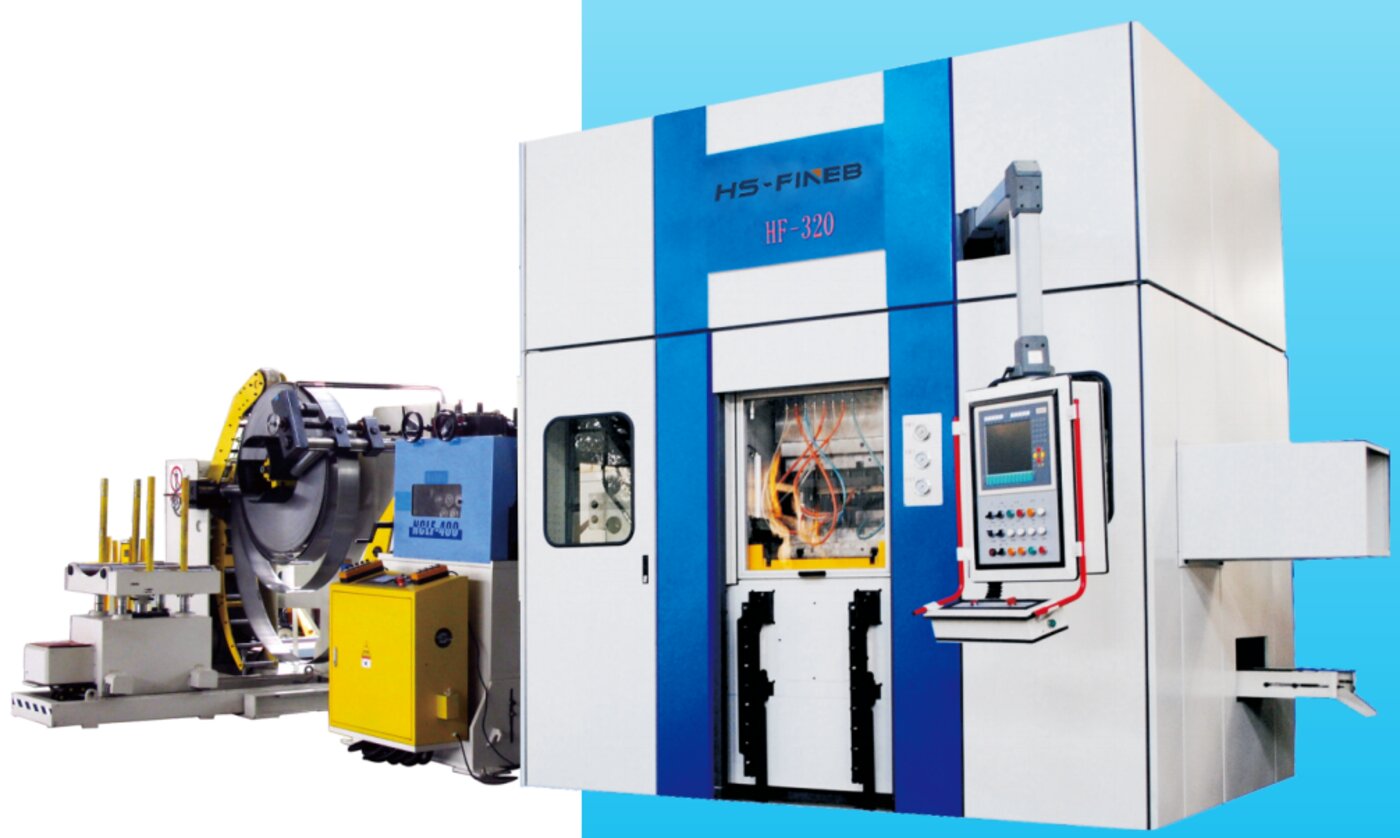
A fine blanking press is only 40% of a production line. The other 60% — coil feeding that holds ±0.1 mm pitch accuracy, die tooling engineered for V-ring impingement and counter-pressure, and deburring that reduces burr height below 0.02 mm — determines whether you produce precision parts or scrap. We engineer the complete line, not just the press body.
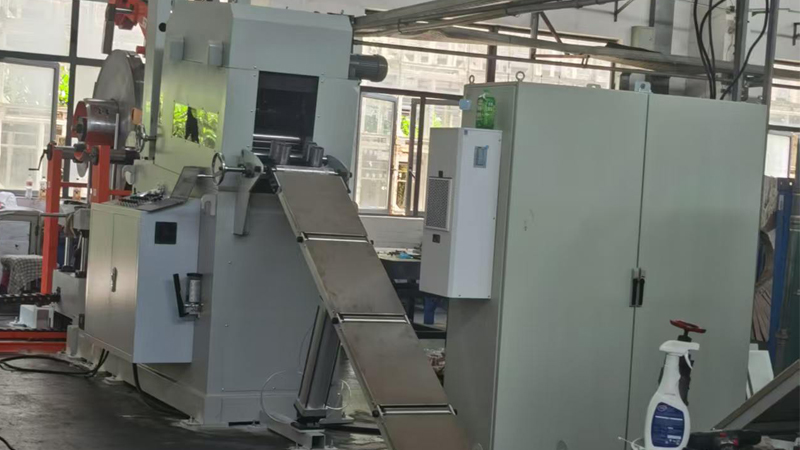
A 15,000 kg coil with 2 mm of crown variation, fed directly into a fine blanking die without leveling, produces parts with 0.3 mm flatness errors — enough to fail IT7-8 tolerance bands across an entire shift. Our decoiler-straightener-feeder line eliminates that variation before the strip reaches the die.
A die producing 50,000 parts per month in 16MnCr5 needs PM tool steel with TiCN coating to reach 300,000 hits before regrind. We select V-ring geometry, tool steel grade, and surface treatment based on your material, volume, and tolerance requirements — not from a catalog.
A brake backing plate with 0.1 mm of burr on the mating diameter causes assembly interference — the part will not seat in the caliper housing. Our deburring stations reduce burr height to under 0.02 mm while preserving the IT7-8 tolerance fine blanking already achieved.
Press, coil feeding, die tooling, deburring, and lifecycle service — configured as one integrated production cell. Every component is matched to your part geometry, material grade, and target volume before the line is built.
Consider a 15,000 kg coil of 16MnCr5 with 2 mm of crown variation. Fed directly into a fine blanking die without leveling, that coil produces parts with 0.3 mm flatness errors — enough to push a ±0.1 mm tolerance band out of spec across an entire shift. Our decoiler-straightener-feeder line eliminates this variation before the strip reaches the die entry.
Feeding accuracy: ±0.1 mm pitch repeatability with SICK absolute encoder feedback, synchronized to the press stroke rate. Decoiler capacity: up to 15,000 kg coil weight with automatic tension profiling across the full coil diameter range — from 1,200 mm full coil to 400 mm core. Straightener: 5-7 roll configuration sized to material thickness and yield strength, eliminating coil-set, crown, and edge wave before the strip enters the servo feeder.
Why it matters: Feed accuracy drifting over a shift is rarely the feeder itself — it is decoiler tension creeping as the coil diameter shrinks. We tune tension profiles across the entire coil run, not just at start-up. A coil that starts flat at full diameter and arrives warped at the core costs a full shift of scrap before anyone notices the dimensional drift.


Fine blanking produces a cleaner edge than conventional stamping — die-roll height is typically 10-30% of material thickness — but most precision parts still require a controlled deburring pass before welding, plating, or assembly against a tight-fit mating surface.
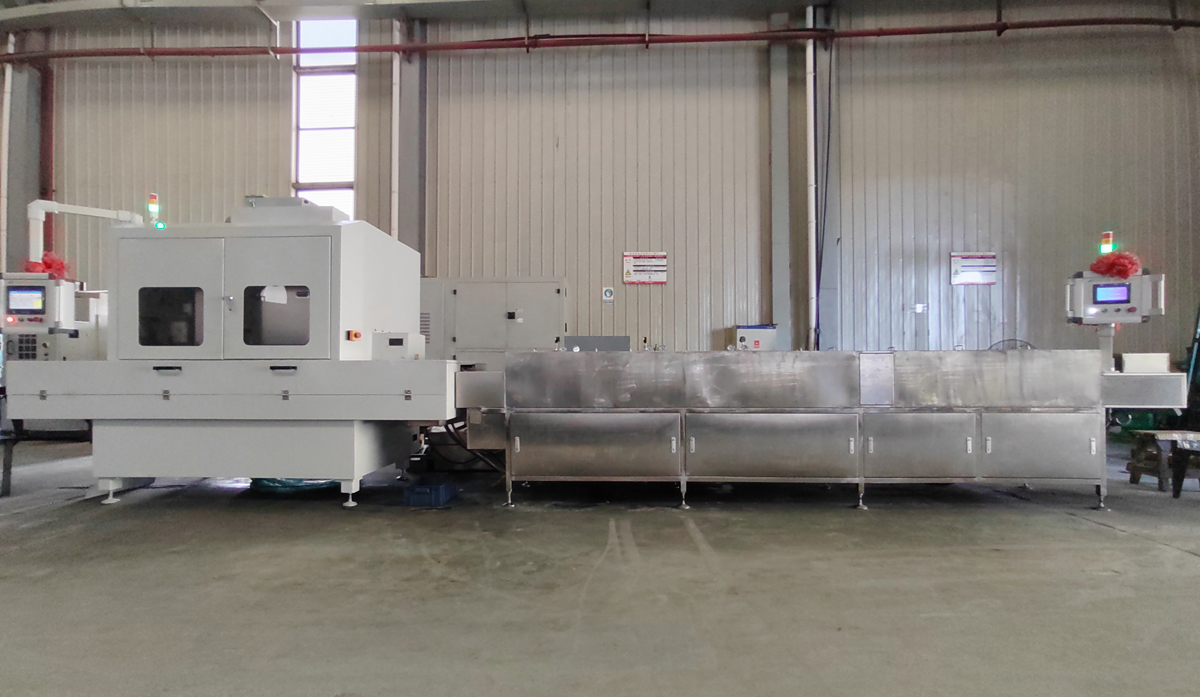
Method selection: Abrasive belt machines (60-120 grit) handle flat parts with burr heights up to 0.3 mm, reducing them to under 0.02 mm in a single pass. Wire brush deburring rounds complex edges without altering critical dimensions — ideal for gear teeth and spline profiles. Vibratory finishing processes small parts in batch loads, achieving consistent edge break across thousands of parts per cycle. Each method preserves the IT7-8 tolerance fine blanking already achieved.
Scenario: A brake backing plate with 0.1 mm of burr on the mating diameter causes assembly interference — the part will not seat in the caliper housing. Our deburring station reduces burr height to under 0.02 mm, and the integrated ultrasonic cleaning station removes residual fines and stamping lubricant, ensuring surface cleanliness meets automotive PPAP requirements before the part reaches plating or heat treatment.
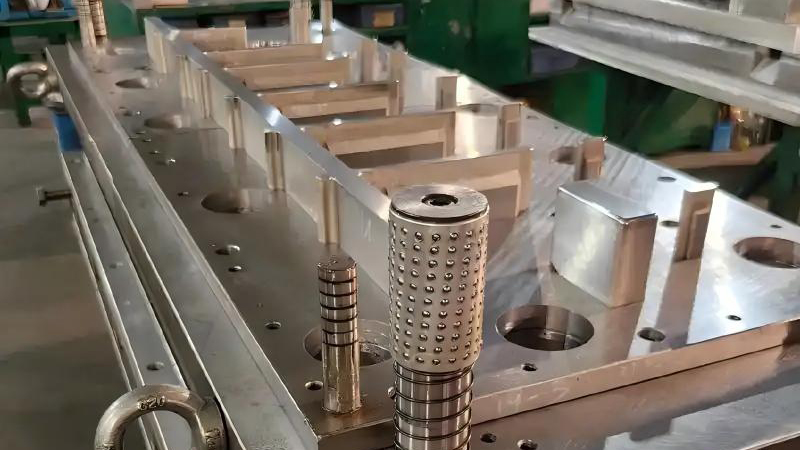
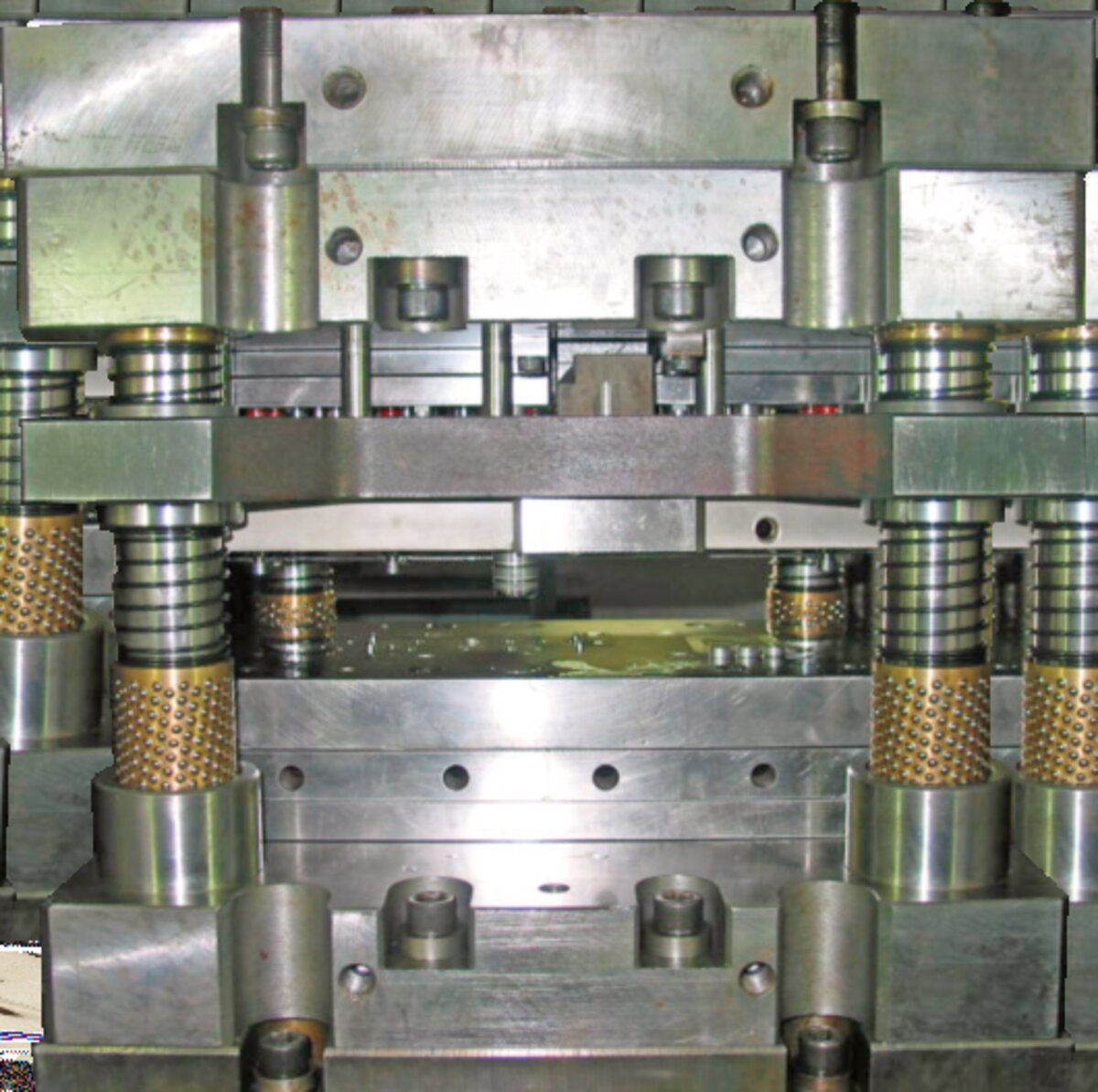
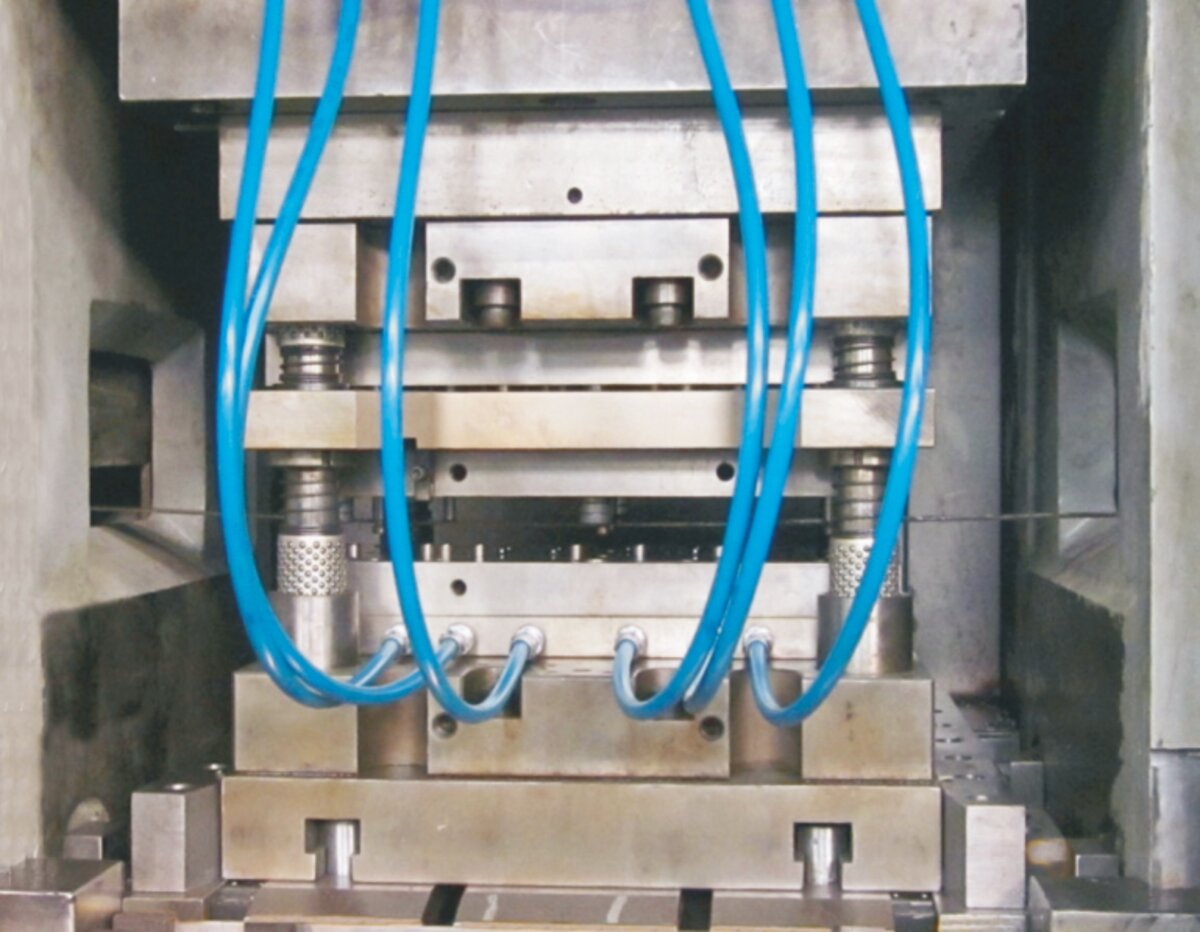
Tooling design determines whether a fine blanking press delivers its full capability. A die built for the wrong material or volume will produce parts within tolerance — for the first 10,000 strokes. After that, V-ring degradation, clearance drift, and cutting-edge wear turn a good die into a scrap generator. Our die design office sits beside the press engineering team, so machine parameters and mold geometry are validated together from the first trial.
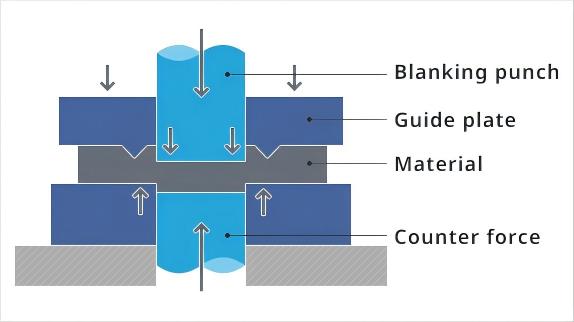
Tool steel selection: D2 tool steel (60-62 HRC) for medium-volume production up to 100,000 strokes between sharpenings. Powdered metal steel (PM) for high-volume applications requiring 300,000-500,000 strokes between regrinds. Solid carbide inserts for ultra-high-volume cutting edges on abrasive materials. V-ring geometry: Triangle impingement profile for standard materials; ASV (asymmetric V-ring) profile for high-strength steels above 600 MPa tensile strength, where deeper impingement is needed to prevent material flow during shearing.
Clearance: 0.5% of material thickness for die-punch clearance — a 2 mm part gets 0.01 mm. This tight clearance is what produces the burr-free, tear-free edge that distinguishes fine blanking from conventional stamping.
Design capabilities: Strip layout optimization with nesting efficiency analysis, multi-stage progressive tooling for complex geometries, counter-pressure and ejection strategy tuned to part geometry, simulation-based force verification, and rapid prototyping for first-article validation.
Heat treatment: Vacuum hardening to 60-62 HRC for D2 tooling, with cryogenic treatment for PM steel to stabilize carbide structure and extend die life by 30-40%. Surface coating: TiCN coating reduces friction and extends edge life by 2-3x on abrasive materials. DLC coating for ultra-high-volume applications where lubricant retention on the cutting edge is critical.
Scenario: A die producing 50,000 parts per month in 16MnCr5 (1.7131) needs PM tool steel with TiCN coating to reach 300,000 hits before regrind. With standard D2 and no coating, the same die would require sharpening every 80,000-100,000 strokes — three to four production stoppages per month for die maintenance. Our die shop handles machining, wire EDM, grinding, and assembly in-house — the entire tooling lifecycle stays under one roof.

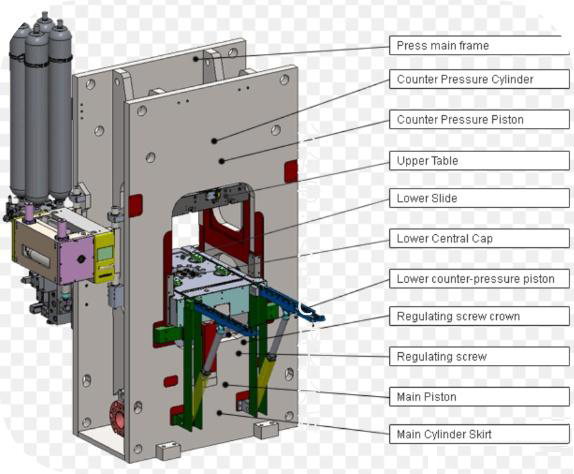
HS-FINEB fine blanking presses feature an integral welded frame structure, FEA-verified for rigidity under maximum tonnage. The four-pillar guiding system with long bushing contact area maintains ram parallelism within 0.02 mm/1,000 mm under eccentric loading — the condition that occurs every time a progressive die stations off-center or a part ejects asymmetrically.
Frame: Integral welded steel construction with stress-relief annealing after welding, eliminating residual stresses that would otherwise cause frame distortion under cyclic loading. Guiding: Four-pillar column bushings with long contact surface for ram stability under off-center loads. Hydraulics: Triple-action independent circuits for punch, V-ring, and counter-pressure with proportional valve control — each force regulated separately, which is the defining feature of a true fine blanking press. Control: Industrial PC with PROFIBUS/ProfiNet fieldbus, touchscreen HMI with recipe storage for up to 100 part programs, and real-time force monitoring at each stroke phase.

Review material grade, thickness, projected shear area, edge quality requirement (die-roll height, burr limit), and annual volume to establish the force calculation baseline.
Select HF model based on total force (shear + V-ring + counter-pressure), die space dimensions, feeder width, and hydraulic configuration.
Define V-ring profile, counter-pressure ratio, ejection timing, clearance at 0.5% of material thickness, and strip layout with nesting optimization.
Match decoiler capacity (up to 15,000 kg), straightener roll count, servo feeder pitch, deburring method, and scrap handling to the part and press.
Tune V-ring pressure, counter-pressure, stroke rate, and feed pitch. Verify die-roll height, burr height, flatness, and dimensional tolerance before production release.
Integral welded steel frame validated by FEA under maximum tonnage. Stress-relief annealing eliminates residual stresses. Four-pillar guiding maintains ram parallelism within 0.02 mm/1,000 mm under eccentric loading.
Industrial PC with PROFIBUS/ProfiNet fieldbus. Touchscreen HMI stores up to 100 part-program recipes with individual pressure curves, stroke parameters, and feed pitch settings. Real-time force monitoring and alarm diagnostics at each stroke phase.
Triple-action independent circuits — punch, V-ring, and counter-pressure — each regulated by proportional valves. Accumulator system for energy-efficient high-speed stroking. This independent three-force control distinguishes a true fine blanking press from a conventional stamping press.
Lenze servo feeder delivering ±0.1 mm pitch accuracy synchronized to press stroke rate. SICK absolute encoder for closed-loop position verification. Decoiler tension profiling maintains strip stability from 1,200 mm full coil to core.
Email your part drawing, material grade, thickness, target volume, and required tolerance. Our engineering team will return a press model, die tooling plan, and auxiliary equipment configuration within 24 hours.