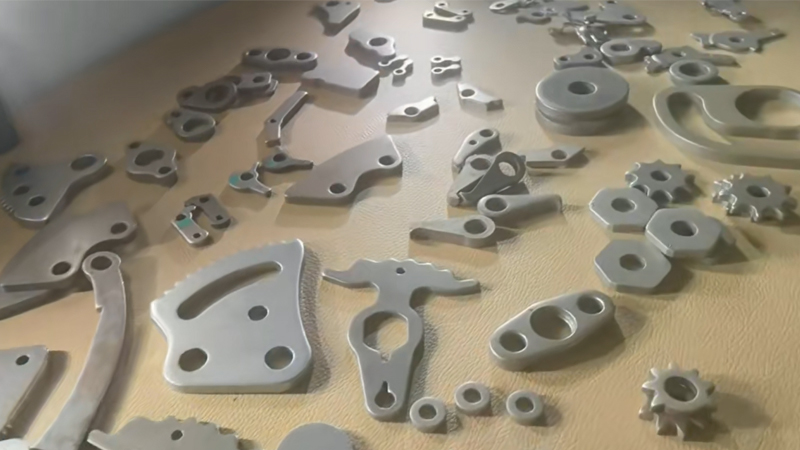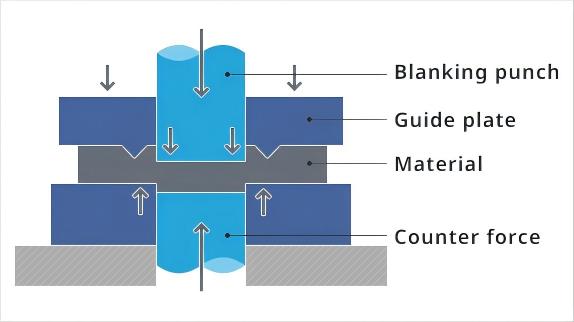
Thick-plate structural components for excavators, loaders, and construction equipment — fine blanked from 8–14 mm S700MC, Hardox, and 28MnB5 boron steel at 800–1200 ton tonnage, where the cut edge is a wear surface, a bearing face, or a bolt pattern that must hold tolerance under vibration and load.
This is where fine blanking's advantages must be weighed against its limits honestly. Thick, large-format structural parts can absolutely benefit from fine blanking's edge quality — but they also push toward the top of our tonnage range, and past a certain size, conventional stamping or laser cutting may genuinely be the more practical choice. We tell you which is which before quoting.
Fine blanking wins when the cut edge itself is functional: a bearing surface, a bolt pattern that needs to hold tolerance under vibration, or a part that would otherwise need a secondary machining pass to clean up a stamped edge. Eliminating that secondary operation is often the actual cost justification for choosing fine blanking on a heavy part — not the piece price alone. A 10 mm thick excavator tooth adapter blanked conventionally requires edge milling to achieve the flatness and surface finish needed for the pin bore mating surface. Fine blanked, that surface comes off the press ready for assembly.
Fine blanking does not automatically win when the part is large, low-volume, and has no functional edge requirement. For a one-off or small-batch large structural blank where the edge will be welded or hidden inside an assembly, laser or plasma cutting is more economical. We will tell you that directly rather than push a fine blanking quote that does not make sense for your volume.
Heavy machinery fine blanking involves materials that are 3–5x thicker and 2–3x stronger than typical automotive fine blanking stock. The tonnage requirements scale accordingly — a part that needs 200T in 3 mm mild steel may need 1000T in 12 mm S700MC.
| Material | Typical Spec | Thickness | UTS (MPa) | Fine Blanking Challenge |
|---|---|---|---|---|
| S700MC | EN 10149-2, thermomechanically rolled | 6–14 mm | 750–950 | High shear strength demands 800T+ press; V-ring force at 40–50% of F1; double V-ring (top and bottom) required above 8 mm |
| Hardox 400 | SSAB wear plate, quenched | 6–12 mm | 1250 (nominal) | Extreme hardness (370–430 HBW); die life 5,000–15,000 hits per regrind; carbide die inserts mandatory; cutting speed max 5 mm/s |
| 28MnB5 (Boron steel) | EN 10083, boron-alloyed | 8–14 mm | 550–700 (pre-heat-treat) | Typically fine blanked in annealed condition then heat-treated (quenched/tempered) to 45–50 HRC; die clearance must account for post-heat-treat dimensional change |
| Hardox 500 | SSAB wear plate, quenched | 6–10 mm | 1600 (nominal) | Even harder than Hardox 400; limited to simpler geometries; die life 2,000–8,000 hits; requires press at maximum tonnage |
| 42CrMo4 | EN 10083, alloy steel | 8–14 mm | 700–900 (annealed) | Good fine blanking response in annealed condition; post-blanking heat treatment to 28–34 HRC for wear applications |
The part categories below represent the range of heavy machinery components where fine blanking provides measurable advantage over conventional stamping plus secondary machining.
| Part Category | What Drives the Requirement | Typical Material & Thickness | Recommended Press |
|---|---|---|---|
| Excavator tooth adapters | Pin bore mating surface requires flatness < 0.1 mm and 100% shear edge for pin retention | 28MnB5, 10–14 mm | HF-1000 or HF-1200 |
| Bucket pin retainers | Wear surface on retaining edge; burr-free for assembly interchangeability | Hardox 400, 8–12 mm | HF-800 or HF-1000 |
| Gear segments (slew drive) | Tooth profile requires IT8 tolerance and work-hardened shear edge for wear resistance | 42CrMo4, 8–12 mm | HF-800 or HF-1000 |
| Structural brackets & mounting plates | Bolt pattern flatness under load; eliminates secondary milling of mounting face | S700MC, 6–10 mm | HF-650 or HF-800 |
| Chassis components | Large footprint, dimensional stability across the part | S700MC, 8–12 mm | HF-1000 or HF-1200 |
| Drivetrain / gearbox housing blanks | Precision hole patterns in thick material; bearing seat surfaces | 42CrMo4, 10–14 mm | HF-1000 or HF-1200 |
| Wear plate segments | Hardox edge quality directly affects wear life; shear edge has 15–20% higher wear resistance than cut edge | Hardox 400/500, 6–10 mm | HF-800 or HF-1000 |
Heavy machinery fine blanking lands at the top of our tonnage range. The HF-800, HF-1000, and HF-1200 are the presses most commonly specified for this segment, each offering specific capabilities for thick-plate work.
Suitable for S700MC up to 10 mm and Hardox 400 up to 8 mm. F2 rated at 400T (50% of total) for double V-ring applications. Bed size accommodates parts up to 600 × 500 mm. The entry point for structural bracket and wear plate production.
Covers S700MC up to 14 mm, Hardox 400 up to 12 mm, and 28MnB5 up to 14 mm. F2 rated at 500T. Larger bed (800 × 600 mm) handles chassis components and gear segments. CNC-controlled cutting speed essential for Hardox — programmed at 3–5 mm/s.
The top of our range. Handles the heaviest combinations — 14 mm Hardox 500, 14 mm 28MnB5 with double V-ring, large gearbox housing blanks. F2 at 600T. Bed size 1000 × 800 mm. This is where large-format structural blanks and drivetrain components land.
For heavy machinery components, the cut edge is often a wear surface — a pin bore, a sliding contact, or an edge exposed to abrasive material (soil, gravel, aggregate). Fine blanking's work-hardened shear edge provides measurable wear performance advantages over cut or machined edges.
The fine blanking process plastically deforms the material at the shear edge, increasing surface hardness by 30–50 HV compared to the bulk material. For S700MC, the shear edge surface hardness typically reaches 280–320 HV (bulk: 230–260 HV). This work-hardened layer extends 0.1–0.3 mm into the material from the cut surface.
Conventional stamping and flame/plasma cutting produce edges with micro-cracks and heat-affected zones that become crack initiation sites under cyclic loading. Fine blanking's 100% smooth shear surface eliminates these initiation points, extending fatigue life by 2–5x on components subject to vibration and impact loading.
Bolt patterns and bearing surfaces produced by fine blanking maintain their dimensional integrity under load because the edge is perpendicular and work-hardened — there is no fracture zone to compress or deform under bolt preload. This is particularly important for chassis mounting points subject to vibration loosening.
Boron steel (28MnB5) components are typically fine blanked in annealed condition, then quenched and tempered to 45–50 HRC for wear applications. The fine blanked edge responds uniformly to heat treatment because the work-hardened layer transforms predictably during austenitizing — unlike flame-cut edges with non-uniform microstructure.
For this segment specifically, we start by confirming fine blanking is the right process before talking tonnage. Send your part drawing, target volume, and current process (if any), and we will give you a straight answer on fit before quoting a press or die.
The evaluation covers three questions:
If fine blanking is a good fit, our HF-1000 and HF-1200 class presses and custom build program is where most of this work lands. For material-specific processing parameters, see our materials guide.
Send us your part drawing, material specification, and target volume. We will tell you whether fine blanking is the right process for your thick-plate component — and if it is, scope the press, die, and feed line to match your tonnage and edge-quality requirements.