A detailed engineering comparison of servo-driven and hydraulic fine blanking press technologies — covering force architecture, response time, motion profiles, energy efficiency, maintenance, cost, noise, force capacity and application suitability to help you choose the right technology for your production.
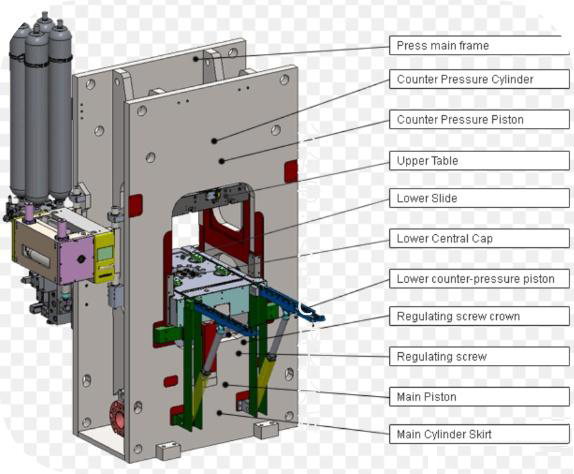
Hydraulic fine blanking presses generate force through fluid pressure acting on a piston. A variable-displacement pump pressurizes hydraulic oil (typically ISO VG68) which acts on the main ram cylinder, the V-ring (ring gear) cylinder, and the counter-pressure (ejector) cylinder. Force is proportional to pressure times piston area — the press can generate any force up to its rated maximum by modulating hydraulic pressure through proportional valves. The three force systems (blanking, V-ring, counter-pressure) are independently controlled through separate hydraulic circuits, each with its own pump, valve, and cylinder.
Servo fine blanking presses generate force through an electric motor driving a mechanical linkage (toggle, crank, or ball-screw). The motor’s torque is amplified by the linkage geometry to produce ram force. Force is proportional to motor torque times the mechanical advantage of the linkage at the current ram position. The mechanical advantage varies through the stroke — maximum at bottom dead center (BDC) where the toggle is nearly straight, lower at mid-stroke. This means the press’s force capacity is not constant through the stroke, unlike a hydraulic press where force is constant at any position given sufficient pressure.

The hydraulic proportional valve has a response time of approximately 50 ms — the time from command signal change to the valve spool reaching its new position. The servo motor responds in approximately 5 ms — 10x faster. This faster response means the servo press can adjust force in real-time during the blanking stroke, compensating for material variation or die wear. The hydraulic press’s 50 ms response is adequate for most fine blanking applications (the blanking stroke itself takes 200–500 ms), but it cannot match the servo’s dynamic correction capability.
The hydraulic press’s ram speed varies with load — as the punch contacts the material and the blanking force rises, the ram slows because the hydraulic system cannot maintain flow at the elevated pressure. This means the shear speed is not constant through the cut, which can affect edge quality on thick or hard materials. The servo press offers a fully programmable motion profile: constant speed through the shear zone, dwell at bottom dead center for a programmable time, rapid return. The ability to maintain constant shear speed is a genuine advantage for edge quality on challenging materials.
Hydraulic presses operate at 30–50% overall energy efficiency. The main motor runs continuously, pumping oil through the system even when the ram is idle between strokes. Energy is lost in valve throttling (pressure drops across proportional valves) and in the continuous pumping against system back-pressure. Servo presses achieve 80–90% efficiency because the motor only consumes energy during the stroke — during the return and idle phases, the motor draws minimal power. Over a year of two-shift operation, the energy savings can be $15,000–$30,000 depending on local electricity rates.
Hydraulic presses require oil changes (every 4,000–6,000 hours), seal replacement (every 30,000–40,000 hours), filter replacement (every 2,000 hours), and proportional valve calibration (annually). The hydraulic system is the primary maintenance burden. Servo presses require bearing lubrication (grease every 2,000 hours), motor and belt inspection (annually), and gearbox oil change (every 10,000 hours). The maintenance burden is lower in total cost and labor hours, but the servo’s mechanical linkage (toggle, ball screw) has a finite fatigue life that requires monitoring.

The servo press is typically 20–40% more expensive than an equivalent hydraulic press at the same tonnage. The premium comes from the servo motor (high-torque, low-speed permanent magnet motor), the precision gearbox or ball screw, and the more sophisticated controller required for motion profile programming. For a 400-ton press, the servo premium might be $80,000–$150,000 over a $350,000 hydraulic equivalent. However, the energy savings over 5–7 years can offset this premium, particularly in high-utilization operations.
Hydraulic presses generate approximately 85 dB at the operator position, primarily from pump noise, oil flow, and valve switching. Servo presses generate approximately 75 dB — 10 dB lower, which is perceived as half the noise level. The lower noise is a significant ergonomic and regulatory advantage, particularly in European facilities subject to noise exposure regulations (87 dB daily exposure limit per EU Directive 2003/10/EC).
Hydraulic force capacity is effectively unlimited — to build a larger press, you simply use a larger cylinder and higher flow pump. The practical limit is frame size and hydraulic component availability. HS-FINEB builds hydraulic fine blanking presses up to 1200 tons. Servo force capacity is limited by the motor and gearbox — the practical maximum is approximately 1600 tons using current motor and linkage technology. For presses above 1000 tons, hydraulic remains the only practical option. For presses below 400 tons, servo is increasingly viable.
Thick materials (>6 mm) where the high shearing force favors hydraulic’s constant-force capability; high-tonnage applications (>400 tons) where servo technology reaches its practical limit; applications requiring V-ring impingement force and counter-pressure (hydraulic’s triple-cylinder architecture is well-established for this); cost-sensitive applications where the 20–40% servo premium is not justified; and operations with moderate utilization (single or double shift) where energy savings are less impactful.
Thin materials (≤5 mm) where the servo’s constant shear speed improves edge quality; high-volume applications (>30 SPM) where the faster cycle rate and lower energy consumption per stroke compound; facilities with strict noise regulations; applications requiring programmable motion profiles (e.g., coining or sizing operations integrated with blanking); and operations running 24/7 where the energy savings are maximized. Servo is also preferred in electronics and precision automotive applications where the 5 ms force response enables real-time process control.
The servo press is gaining market share, particularly in the 100–400 ton range where electronics, connectors and thin-gauge automotive parts dominate. Annual servo press sales are growing 8–12% versus flat-to-declining hydraulic press sales in this segment. However, hydraulic presses will remain dominant for high-force applications above 500 tons, where the servo’s force limitation and cost premium make it impractical. The most likely long-term scenario is convergence: hybrid presses combining servo-driven feeding and positioning with hydraulic force generation, capturing the advantages of both technologies. HS-FINEB monitors both technologies and offers hydraulic presses across the full 200–1200 ton range, with servo-driven auxiliary systems (feeding, ejection) integrated into the cell architecture.
HS-FINEB engineers will help you evaluate the right press technology for your material, thickness, production volume and budget. Contact us for a technology recommendation tailored to your application.