💬 WhatsApp Chat

Fine Blanking Copper and Brass Alloys: Processing Guide

Non-ferrous material guide covering pure copper, brass and phosphor bronze — with V-ring force optimization, tool material selection and surface finish data for electrical and decorative applications.

Non-Ferrous Materials

Copper and Brass in Fine Blanking

Non-ferrous alloys — copper, brass and bronze — represent a growing segment of fine blanking production, driven by demand for precision electrical contacts, connector terminals, decorative hardware and heat management components. These materials offer distinct advantages over steel in the fine blanking process: they do not work-harden at the shear zone to the same degree as steel, they exhibit excellent ductility that supports clean shearing, and in many cases they can achieve 100% shear edge quality with reduced V-ring force.

The fundamental difference between fine blanking non-ferrous alloys and steel lies in the material behavior during shearing. Steel work-hardens at the shear zone as the V-ring indents the material and the punch begins cutting, progressively increasing the material's resistance to deformation. Copper and brass, by contrast, flow more readily under the compressive stress state created by the V-ring and counter-pressure, resulting in a cleaner shear with less die-roll and lower required holding force.

This guide covers three primary non-ferrous material categories: pure copper (C11000/E-Cu), brass (C26000/CuZn37), and phosphor bronze (C51000/CuSn6). For each, we discuss fine blankability, recommended process parameters, tool material selection, achievable surface finish and cost considerations that influence material selection for volume production.

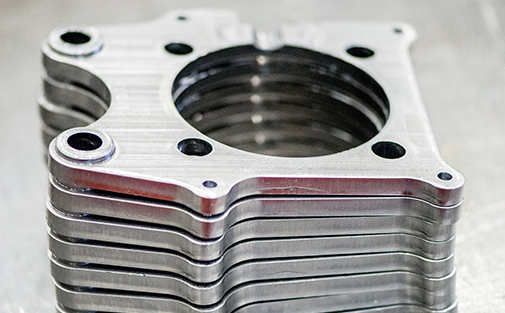
Fine-blanked copper and brass precision parts with clean shear edges and bright surface finish
Material Categories

Non-Ferrous Alloys for Fine Blanking

Pure Copper (C11000 / E-Cu)

Excellent fine blankability. Soft and ductile (HV 40-80 in the annealed condition), pure copper flows readily under V-ring compression, producing 100% shear edges with die-roll below 5% of material thickness. In some thin-gauge applications (below 2 mm), 100% shear edge can be achieved without a V-ring at all — the counter-pressure alone provides sufficient material constraint. However, the very softness that makes copper easy to fine blank also means it tends to stick to the die surface during stripping, requiring polished die surfaces and effective lubrication. Primary applications include electrical contacts, bus bars, heat sinks, terminals and grounding components where the 99.9% copper content provides maximum electrical and thermal conductivity.

📝

Brass (C26000 / CuZn37)

Excellent fine blankability — often cited as the easiest engineering material to fine blank. The 63/37 copper-zinc ratio produces a single-phase alpha structure with good ductility (elongation above 30%) and moderate shear strength. In the annealed condition (HV 60-90), brass achieves 100% shear edge with die-roll below 5% of material thickness and surface roughness Ra below 0.2 µm — the best surface finish of any commonly fine-blanked material. V-ring force can be reduced to 10-20% of blanking force. Brass does not exhibit the sticking tendency of pure copper, and its natural corrosion resistance eliminates the need for plating in many applications. Typical uses include electrical terminals, connectors, decorative hardware, instrument plates and valve components.

Phosphor Bronze (C51000 / CuSn6)

Good fine blankability in the annealed condition (HV 80-120). The tin content (5-7%) provides higher strength and spring properties than brass, making phosphor bronze the standard material for fine-blanked spring contacts, relay contacts, switch components and electrical brush holders. V-ring force at 15-25% of blanking force, counter-pressure at 15-20% of blanking force. Edge quality is 100% shear with die-roll below 10% of material thickness. The material's work-hardening characteristic during forming operations (such as coining or bending within a progressive die) must be considered when designing multi-station tools, as the hardened sections may exhibit different blanking behavior at subsequent stations.

💧

Advantages Over Steel Fine Blanking

Copper and brass offer three processing advantages over steel in fine blanking. First, the absence of significant work hardening at the shear zone means lower V-ring force is needed (10-20% vs 20-40% for steel), reducing total force requirements and enabling smaller press tonnage for the same part. Second, the natural lubricity of copper alloys reduces galling and improves die life. Third, achievable surface finish is superior — Ra below 0.2 µm for brass vs 0.3-0.4 µm for steel — which eliminates secondary polishing for visible-surface applications. These advantages must be weighed against higher material cost, which is typically 3-5 times that of carbon steel per kilogram.

Process Parameters

V-Ring Force & Counter-Pressure

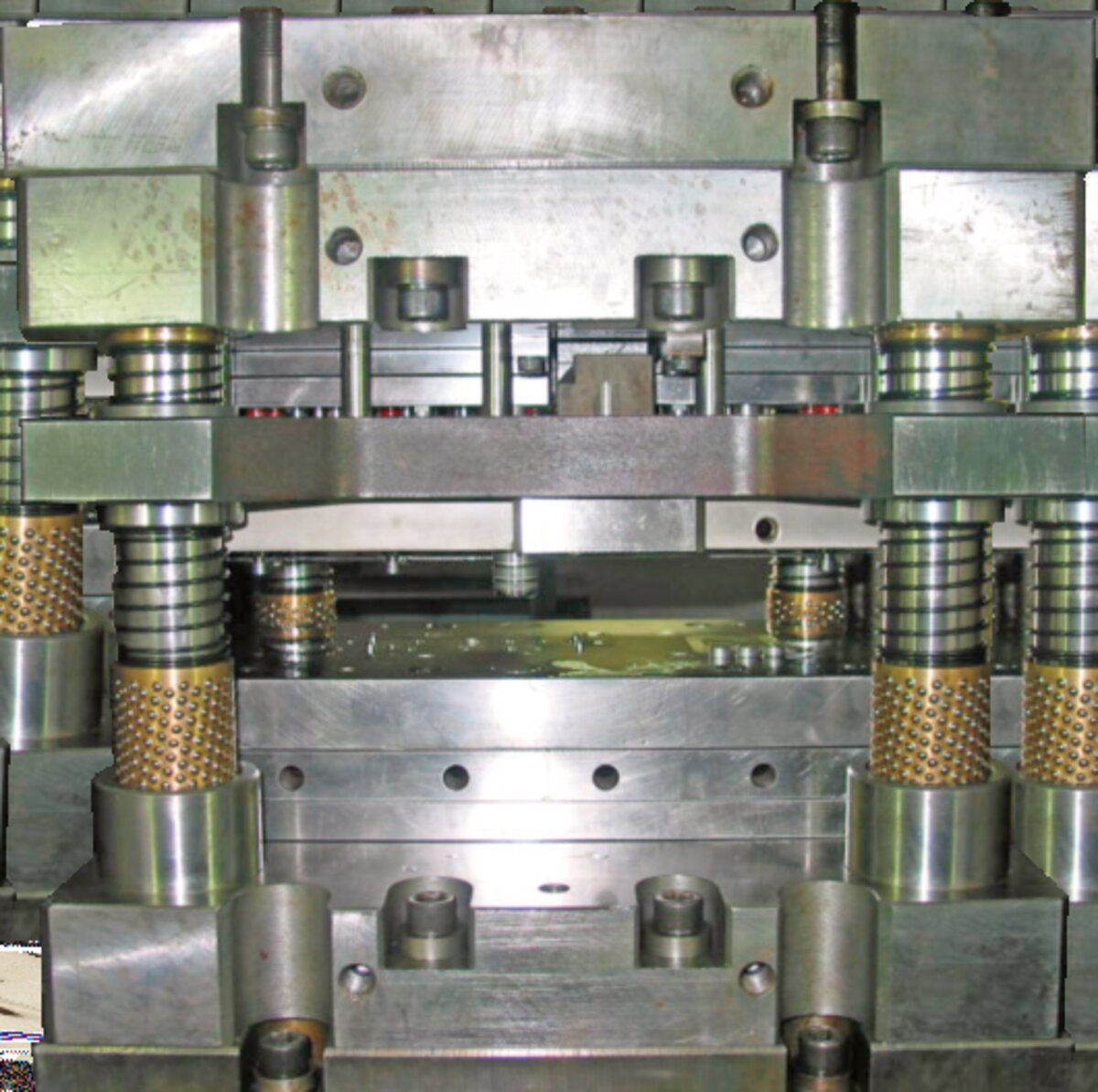
Fine blanking die for copper alloy showing V-ring geometry and polished cutting edges

V-ring force optimization for non-ferrous alloys differs significantly from steel. Because copper and brass flow more readily under compression, the V-ring does not need to impinge as deeply or with as much force to prevent material flow during shearing. Recommended V-ring force is 10-20% of blanking force for pure copper and brass, and 15-25% for phosphor bronze — compared to 20-40% for carbon steel and 30-50% for stainless steel.

The V-ring geometry itself can be modified for non-ferrous materials. A standard V-ring for steel has a 60° included angle with a protrusion height of approximately one-third of material thickness. For copper and brass, the angle can be reduced to 45-50° and the protrusion height to one-quarter of material thickness, as the softer material requires less impingement depth to achieve full constraint.

Counter-pressure for non-ferrous alloys is typically set at 15-25% of blanking force — slightly lower than for steel (20-30%) — because the softer material is less prone to bulging or tearing at the shear zone. However, for parts with large surface area or thin walls (such as heat sink fins), counter-pressure may need to be increased to prevent distortion during ejection.

Die clearance for copper and brass should be set at 0.3-0.5% of material thickness — tighter than the 0.5% standard for steel — because the softer material flows more readily and a tighter clearance produces a cleaner shear with less burr formation.

Tooling & Surface Finish

Die Material Selection

Tungsten Carbide for Volume Production

For production volumes exceeding 200,000 strokes, tungsten carbide dies are strongly recommended for copper and brass fine blanking. Carbide achieves 3-5 times the tool life of D2 tool steel on non-ferrous materials — routinely exceeding 1,000,000 strokes between sharpenings on brass. The superior wear resistance of carbide also maintains edge sharpness longer, preserving surface finish quality (Ra below 0.2 µm) throughout the production run. Die polishing is critical: carbide cutting edges should be diamond-polished to a mirror finish (Ra below 0.05 µm) to prevent copper adhesion and ensure clean stripping.

🔎

Surface Finish Expectations

Non-ferrous fine blanking produces the best surface finish of any fine-blanked material family. Brass achieves Ra below 0.2 µm consistently — a mirror-bright edge that requires no secondary polishing for decorative applications. Pure copper achieves Ra 0.2-0.3 µm. Phosphor bronze, due to its higher tin content and slightly harder structure, achieves Ra 0.3-0.4 µm. These values represent the as-blanked condition with properly maintained tooling; worn or poorly polished dies will produce visible drag marks and increased surface roughness that degrade both appearance and function of electrical contact surfaces.

Cost Considerations

Material Cost vs. Tool Life Economics

While non-ferrous material cost is typically 3-5 times that of carbon steel per kilogram, the total cost equation for copper and brass fine blanking is more favorable than the material cost differential suggests. Tool life on non-ferrous materials is 2-3 times longer than on steel of equivalent thickness, reducing per-part tooling cost. Press tonnage requirements are lower (due to reduced V-ring and counter-pressure forces), potentially enabling a smaller, less expensive press. And the elimination of secondary polishing or deburring operations for many non-ferrous applications further reduces total processing cost.

For high-volume electrical contact production (annual volumes above 1 million parts), brass fine blanking with tungsten carbide tooling typically achieves a lower total cost per part than progressive stamping with secondary machining — even though the raw material cost is higher. The key driver is the elimination of secondary operations: fine blanking produces a finished part with 100% shear edge, accurate dimensions and acceptable surface finish in a single stroke.

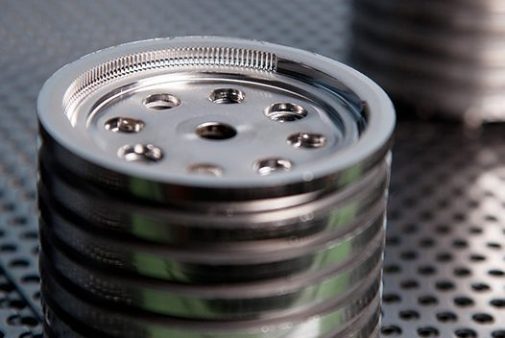
Precision fine-blanked brass and copper electrical contact components with bright finish

Planning a Copper or Brass Fine Blanking Project?

Send us your part drawing and target volume — our engineers will recommend the optimal alloy, tool material and process parameters for your application.

💬