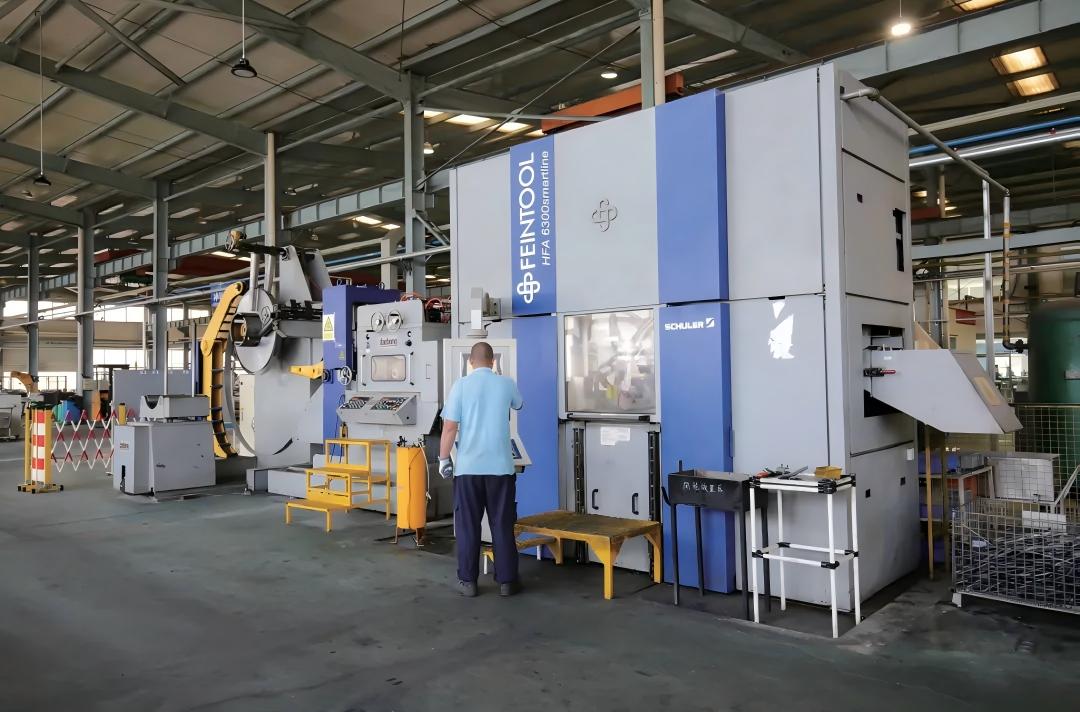
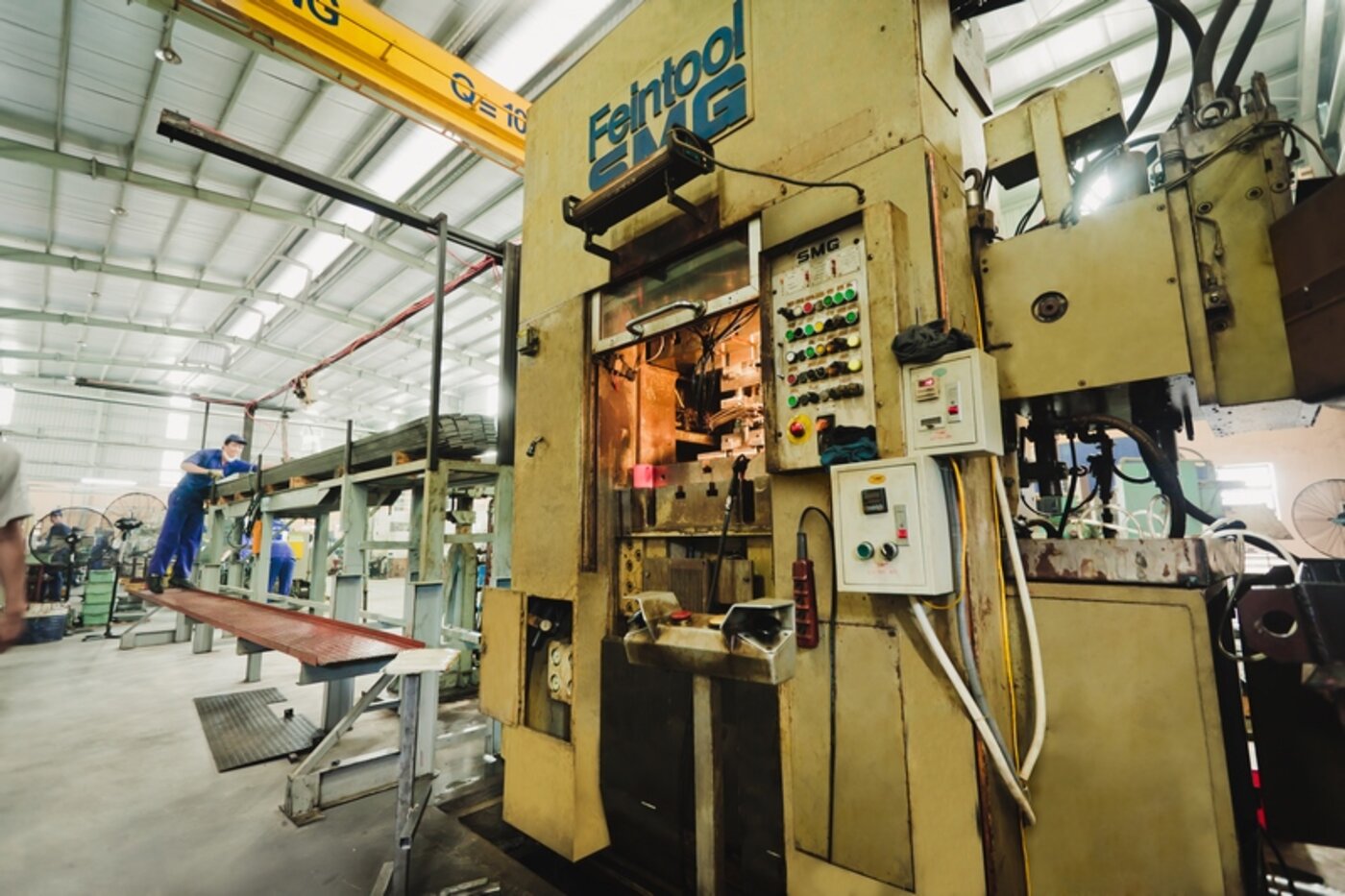
How HS-FINEB field service restored an 18-year-old Feintool GKP 320t fine blanking press to original specification — with edge quality, cycle rate and reliability fully recovered.
Customer: European automotive parts manufacturer operating a Feintool GKP 320t fine blanking press installed in 2008. The press produces seat adjuster ratchets and locking plates at 35 SPM in C45 and 16MnCr5 steels.
Challenge: After 18 years of continuous two-shift operation, the press exhibited declining edge quality (intermittent tear fractures on part edges), hydraulic oil leaks from multiple cylinder seals, accumulator pressure instability causing V-ring force variation, and an obsolete HMI that could no longer be repaired or supported. The customer needed to restore the press to original performance specification without replacing the machine — a full press replacement would have required capital expenditure of €800,000-1,200,000 and 6-8 weeks of production downtime for installation.
The refurbishment project was scoped to restore edge quality, eliminate hydraulic leaks, modernize the control system, and upgrade safety features — all within a 3-week shutdown window scheduled during the customer's annual maintenance period. HS-FINEB issued a 12-month warranty on all refurbished systems.

Ultrasonic testing of the cast frame confirmed no structural cracks or internal defects — the frame remained sound after 18 years of cyclic loading. Slide guideway inspection revealed 0.08 mm wear on the left guideway and 0.05 mm on the right, resulting in 0.03 mm ram parallelism error across the 400 mm die area. This parallelism error directly caused the intermittent edge quality issues: as the ram tilted, die clearance varied across the part, producing tear fractures where clearance exceeded the critical threshold. Acceptable parallelism for fine blanking is 0.01 mm or less across the die area.
Pressure-logger testing on all three hydraulic circuits revealed: (1) Blanking circuit proportional valve response time degraded from 25 ms (new) to 65 ms, causing force ramp instability during the critical shear phase; (2) V-ring circuit accumulator had lost 30% of nitrogen charge, resulting in V-ring force variation of ±8% during blanking — sufficient to cause intermittent material flow at the shear zone; (3) Counter-pressure cylinder showed external seal leakage and internal bypass, reducing effective counter-pressure by approximately 15%. Hydraulic oil analysis showed contamination at NAS 10 level (target: NAS 7), with elevated copper and silicon indicating wear debris and seal degradation.
The original PLC (a legacy controller no longer supported by the manufacturer) and HMI (CRT-based unit with failing backlight and intermittent touch response) were assessed as non-repairable. Spare parts were unavailable from the OEM. The control system had no data logging capability, no remote diagnostics, and no Ethernet connectivity — limiting the customer's ability to monitor process parameters or troubleshoot remotely. Safety relays were functional but did not meet current EN ISO 13849-1 Category 3 requirements.
Hydraulic die clamping showed uneven pressure distribution: clamping force varied by 15% across four clamping points, likely due to seal degradation in two of the four clamp cylinders. This variation risked die shifting under high blanking force, particularly during multi-station operation. The clamping system also lacked pressure monitoring — the operator could not verify clamping force without manual gauge checks.

1. Slide guideway re-scraping and fitting: The worn guideway surfaces were hand-scraped by HS-FINEB field engineers using precision scraping techniques — a labor-intensive process that restores the guideway surface to original flatness and contact pattern. After re-scraping, ram parallelism was restored to 0.01 mm across the full 400 mm die area, verified by electronic indicator measurement at four positions. Guideway clearance was re-set to 0.015 mm (within Feintool original specification of 0.01-0.02 mm).
2. Hydraulic cylinder seal replacement: All three hydraulic cylinders (blanking, V-ring, counter-pressure) were disassembled, inspected, and resealed with current-generation seal kits. Cylinder bore surfaces were honed to remove minor scoring. Rod surfaces were checked for chrome plating integrity — one counter-pressure rod required re-chroming due to pitting. All seals replaced: piston seals, rod seals, wiper seals and buffer seals.
3. Proportional valve replacement: All three proportional valves were replaced with current-generation Bosch Rexroth valves (same interface, improved response characteristics). New valve response time: 18 ms (improved from the original 25 ms specification). Valve amplifiers were replaced and tuned to the cylinder characteristics.
4. Accumulator bladder replacement: Both V-ring and counter-pressure accumulators were serviced: bladders replaced, nitrogen pre-charge set to specification (V-ring: 120 bar, counter-pressure: 90 bar), and leak-tested at operating pressure for 24 hours. Accumulator pressure stability verified at ±2% during simulated blanking cycles.
5. PLC upgrade to Siemens S7-1200: The legacy PLC was replaced with a Siemens S7-1200 controller with PROFINET communication, paired with a 10-inch touchscreen HMI. The control program was re-engineered to replicate the original force-profile logic while adding data logging (force, position, cycle count at 100 Hz), remote diagnostics via Ethernet, and recipe management for different part programs. Safety logic was upgraded to EN ISO 13849-1 Category 3 using a dedicated safety PLC (Siemens ET 200SP F).
6. Hydraulic oil system flush: The entire hydraulic system was flushed with cleaning oil for 8 hours, then filled with new ISO VG 46 hydraulic oil filtered to NAS 7 cleanliness. All return-line filters and pressure-line filters were replaced.
7. Safety system upgrade: New Type 4 light curtains (SICK deTec4) were installed at the front and rear operating positions, with a muting system for automated material handling. Two-hand operation devices were replaced with current EN 574 Type III C compliant units. Emergency stop circuits were rewired through the safety PLC with redundancy.

Production trials on the customer's standard part (seat adjuster ratchet in C45, 3.5 mm thickness) confirmed 100% shear edge with no tear fractures across 500 sample parts. Die-roll measured at 0.25 mm (7.1% of material thickness, below the 10% specification). Surface roughness Ra 0.35 µm — equivalent to new-press performance.
Production rate restored to original 35 SPM specification. The improved proportional valve response (18 ms vs 65 ms pre-refurbishment) enables faster force profile transitions, providing a margin that could support up to 38 SPM if the customer chooses to increase production rate in the future.
All hydraulic leaks eliminated. Post-refurbishment oil consumption monitoring over 30 days showed zero top-up required — compared to approximately 8 liters per month before refurbishment. Oil cleanliness maintained at NAS 7 after 30 days of operation, confirming effective filtration and sealing.
HS-FINEB issued a 12-month comprehensive warranty covering all refurbished systems: guideway parallelism, hydraulic cylinders, proportional valves, accumulators, PLC/HMI and safety system. Remote diagnostics via PROFINET/Ethernet enable HS-FINEB engineers to monitor press performance and troubleshoot without site visits. The customer reported payback on the refurbishment investment (€85,000) in less than 14 months, compared to the €800,000+ cost of press replacement.
Whether it's a Feintool, Mori, Schuler or any other brand — our field service team can assess, refurbish and restore your press to original specification. Contact us for a free condition assessment.