💬 WhatsApp Chat

Fine Blanked Pump Support Brackets

Oil pump and hydraulic pump support brackets combine multi-hole precision with mounting-face flatness in a single structural component — geometry that is straightforward to describe on a drawing but genuinely demanding to hold consistently at production volume.

Core Advantage

Why Fine Blanking for Pump Support Brackets

A pump support bracket serves three simultaneous functions: it locates the pump relative to the engine or housing with precise hole positioning, it provides a flat mounting face that distributes clamping load without leakage, and it carries structural load from pump weight and operating vibration. Conventional stamping can produce the outer profile but cannot simultaneously achieve the hole precision, flatness, and edge quality that the bracket’s functional requirements demand — resulting in secondary machining for hole finishing and surface flattening.

Fine blanking delivers all three requirements in a single stroke. The 100% shear edge provides a mounting-face surface that seals without secondary machining. The counter-pressure system holds flatness below 0.05 mm across the bracket face, preventing pump misalignment. And the die precision holds hole-to-hole position to ±0.02 mm, ensuring that every bolt aligns with its tapped hole on the mating surface without reaming.

The economic case is straightforward: a conventionally stamped pump bracket requires drilling, reaming, and surface milling after stamping — three secondary operations that add €0.15–€0.30 per part and create a production bottleneck. Fine blanking eliminates all three, and the per-part savings typically recover the higher tooling investment within 8–14 months at volumes above 20,000 brackets per month. Learn more about the fine blanking technology behind this capability.

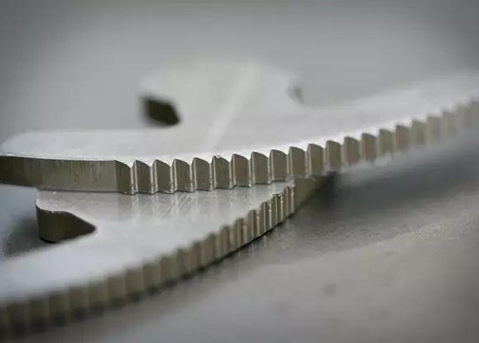
Fine blanked pump support brackets showing mounting holes, bearing bores, and reinforcing ribs with precision flatness
Materials & Geometry

Materials, Geometry & Load-Bearing Design

Pump bracket material selection is driven by the pump type, operating environment, and load requirements. The bracket geometry must accommodate mounting holes, bearing bores, and structural reinforcing within a single blanking operation.

C45 Carbon Steel

The most common bracket material for hydraulic and oil pump applications. Tensile strength 570–700 MPa, with good fine blanking behavior and excellent fatigue resistance after work-hardening at the shear edge. Thickness range 3–6 mm covers most automotive pump bracket designs. Die life on C45 brackets typically reaches 400K–600K hits per regrind with D2 tool steel dies.

S420MC High-Strength Steel

Used when weight reduction is a priority — the higher yield strength (420 MPa minimum) allows thinner gauge material for equivalent load capacity. Fine blanking S420MC requires increased V-ring force (30–40% of blanking force) and reduced cutting speed (5–10 mm/s) to prevent edge cracking on this higher-strength alloy.

QT500-7 Ductile Iron

For heavy-duty pump brackets in industrial and agricultural equipment where cast iron properties are specified. While not a traditional fine blanking material, thin-gauge QT500-7 plate (4–8 mm) can be fine blanked with specialized die geometry and carbide inserts. Die life is shorter (150K–250K hits) due to material abrasiveness.

Geometry requirements: A typical pump support bracket carries 4–8 mounting holes (Ø6–12 mm), one or two bearing bores (Ø20–50 mm, requiring secondary boring after blanking), and 2–4 reinforcing ribs or coined depressions for stiffness. The reinforcing features are formed in a progressive die forming station before the outer profile is blanked, ensuring the formed features are held flat during the final cutting stroke.
Tolerance Analysis

Hole-Pattern Accuracy & Tolerance Stack-Up

A pump support bracket typically carries multiple precision holes that must hold position relative to each other, not just relative to the part’s outer edge. This is where tolerance stack-up analysis becomes critical.

Stack-Up Analysis

Cumulative Feed Error vs Single-Reference Precision

On a progressive die, each station’s position relative to the previous station depends on the coil feeder’s advance accuracy. Even with ±0.02 mm feed precision and pilot hole registration, cumulative error across 5–7 stations can reach ±0.05–0.08 mm by the final station. For a bracket with a 4-bolt mounting pattern where true position must be held to ±0.03 mm, this cumulative error may exceed the tolerance budget.

The solution is to pierce all mounting holes in the final blanking station — the station where the V-ring engages and the outer profile is cut. This ensures all holes share the same die reference as the outer profile, eliminating cumulative feed error. The trade-off is increased tonnage at the final station, since all holes are punched simultaneously with the outer profile cut. This may push the part into a larger press class — see our HF-Series press range for tonnage options.

For brackets where hole-to-hole position is the binding tolerance — not hole-to-edge — a compound die may be the better architecture, since all features are produced from a single die reference with no feed error contribution.

Pump support bracket geometry showing mounting hole pattern, bearing bore, and tolerance stack-up analysis
Tolerance ParameterFine Blanking (Progressive, Final Station)Fine Blanking (Compound)Conventional Stamping
Hole-to-Edge Position±0.02 mm±0.01 mm±0.10 mm
Hole-to-Hole Position±0.03 mm (if pierced at final station)±0.02 mm±0.15 mm
Hole Diameter±0.02 mm±0.01 mm±0.05 mm
Mounting Face Flatness<0.05 mm<0.03 mm>0.2 mm
Edge Quality100% shear100% shear30–70% shear
Applications

Pump Types & Volume Economics

Fine blanked pump brackets serve across automotive, industrial, and agricultural applications where pump mounting precision directly affects system reliability.

Hydraulic Pumps

Hydraulic pump brackets in construction equipment, agricultural machinery, and industrial presses bear high dynamic loads and must maintain precise shaft alignment to prevent premature bearing failure. Fine blanked C45 brackets at 4–6 mm thickness deliver the required flatness and hole precision at 20,000–80,000 parts per month.

Engine Oil Pumps

Automotive engine oil pump brackets are high-volume parts (100K–500K per month per program) where per-part cost is extremely sensitive. Fine blanking’s elimination of secondary drilling and milling operations typically reduces per-part cost by €0.15–€0.25 compared to conventional stamping plus machining.

Water Pumps

Coolant pump brackets in automotive and HVAC systems require corrosion resistance combined with mounting precision. Fine blanked SUS 304 stainless brackets provide both, with the 100% shear edge creating a sealing surface against the pump housing gasket.

Fuel Transfer Pumps

Fuel pump mounting brackets in diesel injection systems combine precision hole patterns with structural ribs for vibration resistance. Progressive fine blanking dies with forming stations produce these at 30–50 strokes per minute, with the formed ribs integrated into the strip layout.

Volume economics: Most pump support brackets fall in the 200–500 ton press class. At monthly volumes above 20,000 parts, fine blanking’s total per-part cost (including tooling amortization) is lower than conventional stamping plus secondary machining. The break-even tooling investment recovery period is typically 8–14 months. Our production line capabilities and HF-Series press range cover the full tonnage spectrum from 200T to 1200T.

Ready to Engineer Your Pump Bracket Program?

Send us your bracket drawing, material specification, and target volume. We will evaluate whether progressive or compound tooling fits your geometry and tolerance requirements, and recommend the press tonnage class and die architecture to meet your cost and quality targets — with a transparent comparison against your current manufacturing process.

💬