💬 WhatsApp Chat

EV & Lightweighting: What Is Actually Changing for Fine Blanking

Two structural shifts in the automotive supply chain are changing what buyers ask us for — not the fine blanking process itself, but the materials and part families it is being asked to run. Motor laminations, battery structural components, and high-strength steel substitution are reshaping the fine blanking workload.

Structural Shift

What Has Changed — and What Hasn't

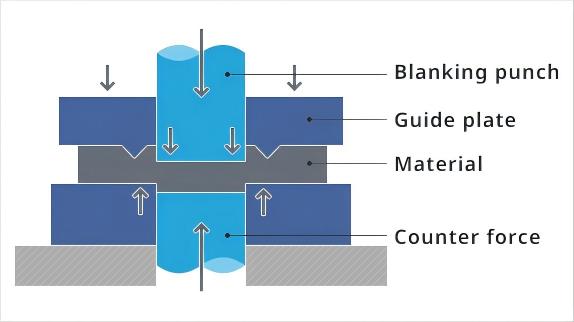
The underlying physics of fine blanking — three forces, near-zero die clearance, controlled compression through the cut — has not changed at all. What has changed is which part families are showing up in buyers' RFQs, and what material properties those parts demand from the die and press.

Two forces are driving this shift. First, vehicle electrification is creating entirely new high-volume part categories that did not exist at this scale in combustion-engine supply chains: motor stator and rotor laminations, battery enclosure brackets, busbar components, and power electronics structural parts. Second, lightweighting pressure — driven by EV range requirements and increasingly by ICE fuel-economy regulations — is pushing more programs toward higher-strength, thinner-gauge materials across all vehicle platforms, not just EVs.

For fine blanking, both shifts are net positive. EV motor laminations demand exactly the edge quality and dimensional precision that fine blanking delivers. Lightweighting materials (AHSS, PHS) are tougher on conventional stamping tooling, making fine blanking's controlled cutting process more competitive. The result: a growing segment of the market where fine blanking is not just an alternative to stamping — it is the enabling process.

Fine blanking press producing EV motor laminations and battery structural components with precision edge quality
New Volume Driver

EV Motor Laminations: A New High-Volume Application

Electric motor stators and rotors are stacks of thin electrical steel laminations — typically 0.2–0.5 mm thick, non-oriented silicon steel (NO steel) or grain-oriented steel (GO steel) depending on motor type. A single EV traction motor may contain 300–500 individual laminations, and annual EV production is scaling toward tens of millions of units. This is a genuinely new high-volume fine blanking application category.

Why Edge Quality Matters for Efficiency

A rough or burred lamination edge increases eddy current losses in the finished motor. Eddy currents flow across the lamination stack perpendicular to the sheet plane; burr on the lamination edge creates electrical shorts between adjacent laminations when the stack is compressed, increasing interlaminar loss. Fine blanking produces burr heights below 0.01 mm on 0.35 mm electrical steel — a level that keeps interlaminar resistance high and motor efficiency within specification.

Stacking Precision Requirements

Lamination stacks must maintain dimensional accuracy across 300–500 sheets to achieve the air gap tolerance the motor design requires. Each lamination must be blanked to within ±0.005 mm of nominal, with the stator OD and rotor ID concentric to within 0.01 mm. Fine blanking's ability to hold IT6–7 tolerance on thin material makes it the preferred process for high-efficiency motor laminations.

Die Life on Electrical Steel

Electrical steel (2–3.5% silicon) is abrasive on tooling due to its silicon content, but its low hardness (180–220 HV) means cutting forces are low. Die life per regrind typically reaches 500,000–1,000,000 hits — excellent by fine blanking standards. The challenge is not die wear but maintaining burr height below 0.01 mm across the full die life, requiring V-ring profile monitoring and periodic regrinding before burr exceeds specification.

Press selection for laminations: EV motor laminations are thin (0.2–0.5 mm) and small (50–200 mm OD), requiring modest tonnage (100–300T) but very high stroke rates (60–120 strokes/min for progressive dies). Our HF-200 and HF-320 presses, configured for high-speed progressive lamination tooling, are the typical specification for this application. CNC-controlled cutting speed is essential — it must be set high enough for throughput but controlled to prevent burr formation on thin gauge material.
Battery Components

Battery Pack Structural Components & Busbar Parts

Battery enclosure brackets, busbar components, and structural pack components often carry both a functional edge requirement (electrical contact surfaces, sealing faces) and a weight-sensitivity requirement that pushes toward thinner high-strength materials. This combination plays directly to fine blanking's strengths over conventional stamping, which struggles to hold edge quality as material strength increases.

ComponentMaterialThicknessFine Blanking Advantage
Battery enclosure bracketsAA 6082-T6, 500T-1400 MPa steel2–5 mmSealing surface flatness < 0.05 mm for gasket integrity; burr-free edges prevent cell damage during assembly
Busbar componentsC11000 copper, C26000 brass1–4 mmClean cut edges for consistent electrical contact; dimensional accuracy for automated assembly stacking
Cooling plate blanksAA 3003-O, AA 5052-H321–3 mmFlatness critical for thermal interface; hole patterns for coolant channels blanked to position
Module structural framesDP780, DP980 (AHSS)2–4 mmHigh-strength steel edge quality that conventional stamping cannot achieve; crash-energy management requires predictable edge behavior
BMS (battery management system) housings5052-H32 aluminum, 304 stainless0.5–2 mmPrecision cutouts for connectors and sensors; burr-free edges for PCB clearance and EMI shielding contact
Cell holder & separator platesFRP, 301 stainless0.3–1 mmThin-gauge precision blanking; hole pattern accuracy for cell positioning within ±0.02 mm
Aluminum fine blanking note: Aluminum alloys (5000/6000 series) are fine-blankable but require specific die parameters: larger die clearance (0.5–0.8% of thickness vs. 0.3–0.5% for steel), lower V-ring force (20–30% of F1 vs. 30–40%), and PVD-coated dies to prevent galling. Counter-pressure is critical for aluminum because the material's low modulus (70 GPa vs. 210 GPa for steel) makes it prone to die-roll. See our materials guide for aluminum-specific process parameters.
Material Substitution

Lightweighting: AHSS, PHS, and the Shift to Higher-Strength Steel

Advanced high-strength steel (AHSS) and press-hardened steel (PHS, also known as hot-stamped or boron steel) are showing up more often in part specifications across the board — not just in EV-specific components. General vehicle lightweighting pressure affects conventional and electric platforms alike.

Material ClassRepresentative GradesUTS (MPa)Fine Blanking Challenge
Dual-Phase (DP)DP590, DP780, DP980590–980Work-hardening at cut edge; die clearance must be reduced to 0.3–0.4% of thickness; V-ring force at 35–45% of F1
Transformation-Induced Plasticity (TRIP)TRIP 600, TRIP 800600–800Retained austenite transforms to martensite at cut edge, causing extreme local hardening; die wear 2–3x mild steel; carbide inserts recommended
Complex-Phase (CP)CP 800, CP 1000800–1000Uniform microstructure gives more predictable fine blanking response than DP/TRIP; good burr height control achievable
Press-Hardened Steel (PHS / 22MnB5)Usibor 1500, 22MnB51000–1500Typically hot-stamped, not fine blanked, in final condition. Fine blanked in annealed state (~500 MPa) before hot stamping; the blanked edge quality affects subsequent hot-stamping die fill
3rd-Gen AHSS980T, 1180T (Q&P steels)980–1200Newest grade family; fine blanking data still being accumulated; initial results suggest die life between DP980 and TRIP 800
What this means practically: If your part portfolio is shifting toward EV-specific components or higher-strength materials, it is worth re-evaluating whether parts previously produced by conventional stamping or machining are now better candidates for fine blanking. The calculus has shifted for some part families even where the part itself has not changed dramatically — a part that was borderline for fine blanking in DC04 mild steel may be clearly better served by fine blanking in DP780, because conventional stamping's edge quality degrades more steeply than fine blanking's as material strength increases.
New Geometries

New Part Geometries for EVs

Beyond material substitution, EVs introduce part geometries that did not exist in ICE vehicles — or existed at much lower volumes. These new geometries create fine blanking opportunities where the process was not previously considered.

Motor Housing & End Cap Components

EV motor housings require precision flatness on mounting faces for bearing seats and coolant channel sealing. Fine blanked end cap blanks eliminate secondary face milling on aluminum housing components, holding flatness below 0.05 mm directly off the press.

Inverter & Power Electronics Hardware

Power semiconductor modules in EV inverters require precision heat sink base plates, busbar connectors, and clamping hardware. Fine blanking produces these components with the dimensional accuracy and burr-free edges needed for automated assembly and thermal interface integrity.

Regenerative Braking Components

EV regenerative braking systems retain conventional friction braking hardware for safety redundancy. Brake caliper brackets, piston components, and pad backing plates remain fine blanked — often in higher-strength materials than ICE equivalents due to the combined regen/friction load profile. See our automotive braking solutions for braking component specifics.

Battery Crash Structure Components

EV battery packs are structural crash members. Side-impact reinforcement plates, cross-member brackets, and intrusion barriers in PHS or ultra-high-strength steel (UHSS) require fine blanking's controlled edge quality to ensure predictable crash-energy absorption. Conventional stamping's fracture-zone edges create unpredictable crack propagation paths in crash loading.

Press Capability

How Our Presses Meet EV Fine Blanking Demands

The shift toward EV components and lightweighting materials places new demands on fine blanking presses: higher V-ring force for high-strength steels, programmable cutting speed for thin-gauge lamination stock, and data-logged process parameters for automotive PPAP documentation.

Our HF-series presses address these demands through:

  • Programmable triple-action force control: F1, F2, and F3 independently settable as a percentage of total tonnage — essential for switching between material grades (e.g., DP780 one shift, 0.35 mm electrical steel the next) without mechanical die adjustments.
  • CNC cutting speed control (2–20 mm/s): For lamination production, cutting speed is set high (15–20 mm/s) for throughput. For AHSS, it is reduced to 5–10 mm/s to prevent adiabatic softening and burr formation. The CNC stores speed profiles per part number for repeatable setup.
  • High-speed stroking capability: HF-200 and HF-320 configured for lamination production achieve 60–90 strokes/min with progressive tooling — sufficient for annual lamination volumes in the millions.
  • Process data logging: Every stroke records F1/F2/F3 actual values, cutting speed, ram position, and die protection sensor status. This data supports automotive PPAP (Production Part Approval Process) submissions and ongoing SPC (Statistical Process Control) monitoring.
  • Quick die changeover: Hydraulic clamping systems reduce die changeover to under 20 minutes, enabling mixed-material production scheduling that matches EV supply chain demands.

For the full HF-series specifications, see our products page. For material-specific process parameters, consult our materials guide. The underlying fine blanking technology is explained in our technology overview.

HF-series fine blanking press with CNC control system configured for EV component and lamination production

Have an EV or Lightweighting Fine Blanking Project?

Send us your part drawing, material specification, and volume target. We will evaluate whether fine blanking is the right process for your EV component — and recommend the press, die, and feed line to match the material strength, thickness, and throughput your program requires.

💬