Schuler's mechanical-hydraulic hybrid presses demand specialized knowledge of toggle kinematics and servo-hydraulic synchronization. Our engineers have 15+ years maintaining Schuler installations.
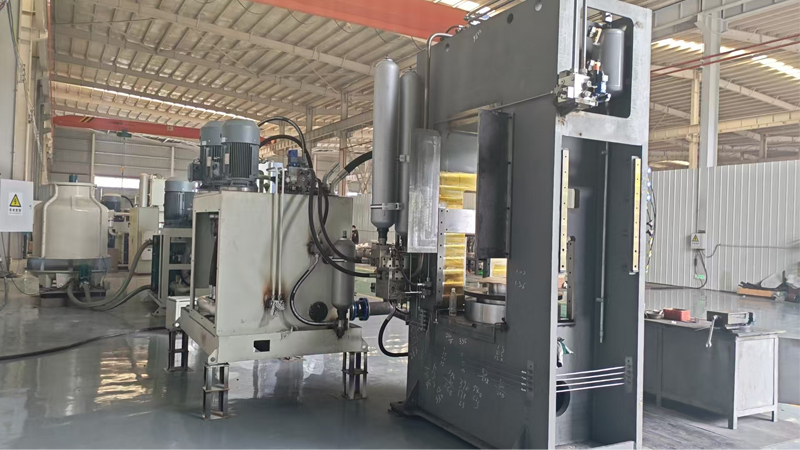
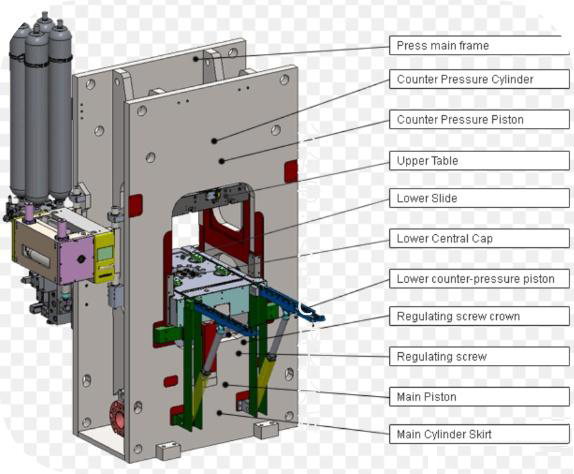
Schuler fine blanking presses occupy a unique position in the market. Unlike Feintool's pure hydraulic architecture or Mori's conventional mechanical-hydraulic design, Schuler employs a mechanical-hydraulic hybrid system where a crank-driven toggle mechanism provides the main blanking force, with hydraulic superposition for V-ring, counter-pressure, and force modulation. This hybrid architecture delivers superior energy efficiency and cycle speed — but it demands engineers who understand both the mechanical force transmission and the hydraulic control loop that modulates it.
Mechanical-hydraulic fine blanking press series with toggle-driven ram and hydraulic V-ring/counter-pressure. The MST platform is Schuler's workhorse for automotive components. Common service needs: toggle bearing wear at 8-12 years, flywheel coupling degradation, legacy HMI obsolescence.
Large-format fine blanking presses for heavy structural components. The FBA series combines high tonnage with extended die area. Hydraulic system complexity increases with tonnage — multiple proportional valves must be synchronized to maintain uniform counter-pressure across the large die face.
Servo-driven presses with hydraulic superposition. The servo motor replaces the flywheel and crank, providing programmable stroke profiles. Common issues: servo drive thermal trips, encoder feedback degradation, and synchronization loss between servo and hydraulic force modulation.
Schuler's current-generation servo mechanical presses with programmable slide motion curves, high-rigidity guidance, and overload protection. These platforms support fine blanking within a broader stamping capability. Service scope: ServoDirekt drive maintenance, motion curve optimization, and hydraulic superposition system calibration across the 630-3200 ton range.
Integrated multi-station stamping lines with fine blanking stations, using servo direct-drive technology at up to 23 SPM for automotive structural and motor lamination parts. Our service covers transfer system alignment, station-to-station synchronization, and die interface refurbishment across the complete line.
The defining feature of Schuler's fine blanking presses is the toggle mechanism — a mechanical linkage that converts rotary motion from the crank or servo motor into the linear ram motion with a force multiplication factor of 3-5x. At the bottom of the stroke, the toggle approaches its straightened position, where mechanical advantage is maximum and ram velocity approaches zero — the ideal kinematic profile for fine blanking, where high force at low speed during the shear phase produces clean fracture without die-roll.
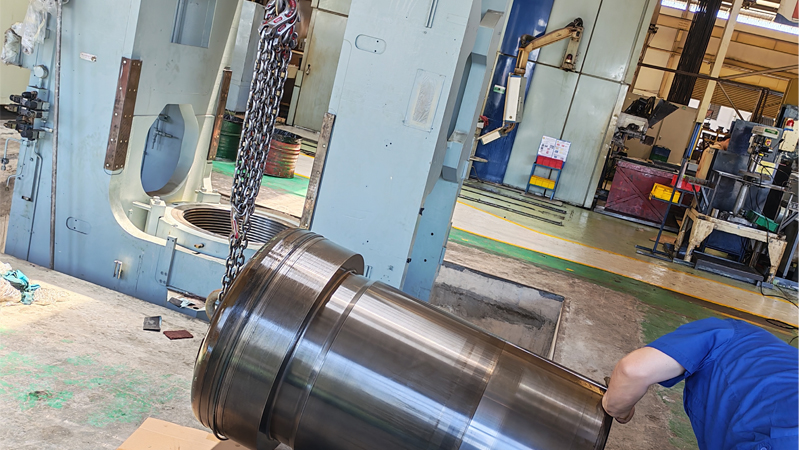
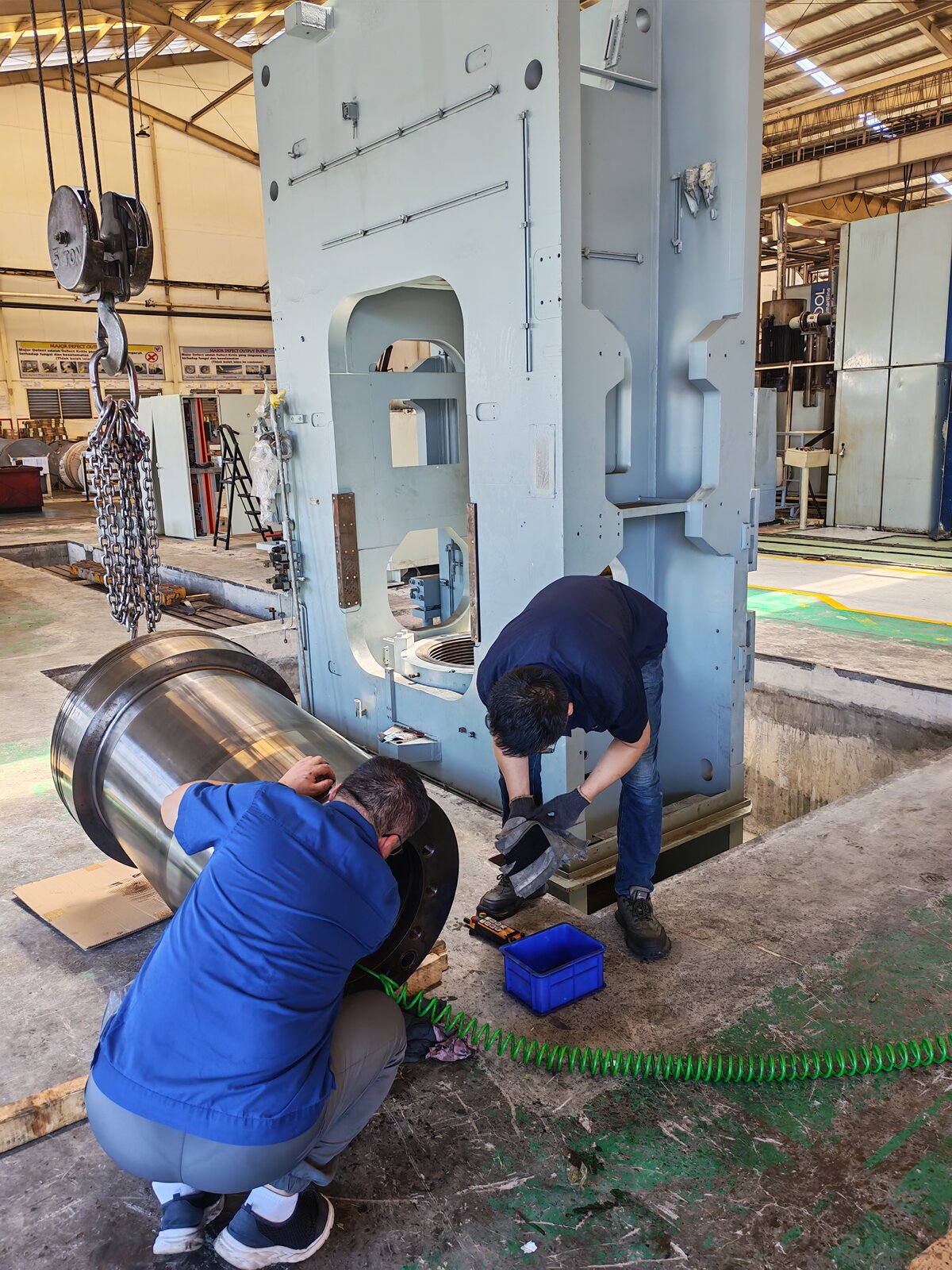
The toggle pivots carry the highest concentrated loads in the entire press — at 400 tons blanking force with a 4:1 toggle ratio, each pivot bearing sees 1,600 tons of reaction force. After 8-12 years of three-shift operation, bearing clearance increases to where BDC position varies by 0.1-0.2 mm stroke-to-stroke, producing inconsistent die-roll height and potential die interference.
Our toggle maintenance measures bearing clearance at each pivot using dial indicators under simulated load. Bearings exceeding Schuler-specified clearance (0.03-0.05 mm) are replaced with SKF or Schaeffler (FAG) equivalents for roller bearings, or machined bearing-grade bronze bushings. After replacement, toggle geometry is re-measured to verify BDC repeatability within 0.03 mm.


On Schuler's hybrid presses, the main blanking force comes from the mechanical toggle, while the V-ring and counter-pressure forces are hydraulic. The challenge is synchronization: the hydraulic forces must ramp up to their commanded values within the time window between the toggle approaching BDC and the punch engaging the material. If the V-ring engages too late, the material is not clamped before shearing begins, producing die-roll. If counter-pressure engages too late, the part is not supported during fracture, producing tear fracture at the edge.
Our synchronization service calibrates the timing relationship between the mechanical stroke position (measured by crank angle encoder or servo motor encoder) and the hydraulic force buildup (measured by pressure transducers in the V-ring and counter-pressure circuits). The calibration target is that V-ring force reaches 90% of commanded value within 50 ms of the toggle entering the BDC approach zone, and counter-pressure reaches 90% within 30 ms of V-ring confirmation.
When synchronization drifts — typically due to proportional valve response degradation or pressure transducer calibration shift — we perform gain tuning on the hydraulic control loops. The P-gain is adjusted to achieve the target rise time without overshoot, the I-gain eliminates steady-state error, and feed-forward compensation accounts for the known relationship between crank angle and required force. After tuning, the synchronization is verified with a production trial measuring V-ring engagement timing, counter-pressure stability during shear, and part quality over a 100-part sample.
Symptom: BDC position variation of 0.1-0.2 mm stroke-to-stroke, producing inconsistent die-roll height. Diagnosis: dial indicator measurement under simulated load at each toggle pivot. Solution: bearing replacement (SKF/FAG or machined bronze), toggle geometry re-measurement, BDC repeatability verification to 0.03 mm.
Symptom: torque fluctuation during the shear phase, audible knocking from the drive housing, increased motor current draw. Diagnosis: vibration spectrum analysis at the coupling, torque measurement during loaded stroke. Solution: coupling inspection, elastomer replacement (where applicable), or full coupling replacement with dynamically balanced assembly.
Symptom: press faults during sustained high-speed production, servo drive reports over-temperature alarm. Diagnosis: thermal imaging of servo motor and drive cabinet, cooling system inspection, duty cycle analysis against motor thermal limits. Solution: cooling system repair (fan, heat exchanger, air filter), duty cycle optimization in CNC program, or servo motor derating documentation.
Symptom: position following error alarms, stroke-to-stroke BDC variation, servo synchronization faults. Diagnosis: encoder signal oscilloscope analysis, cable continuity test, coupling backlash inspection. Solution: encoder replacement (Heidenhain or SICK equivalent), cable replacement, coupling inspection and replacement if backlash exceeds 0.01 mm.
Schuler presses from the 1990s and 2000s typically run Schuler's proprietary HMI and control system. While the mechanical and hydraulic architecture is robust, the control hardware has reached end of support — HMI displays fail, PLC processors reach obsolescence, and communication cards are no longer available. When a single HMI panel fails on a Schuler MST-400 and the replacement is a 6-month special order, production stops.
Our CNC retrofit replaces Schuler's legacy HMI and control hardware with a Beckhoff TwinCAT system running a fine blanking process library specifically developed for Schuler's mechanical-hydraulic hybrid architecture. The TwinCAT system provides:
The retrofit preserves all hydraulic safety interlocks and stroke sequence logic from the original Schuler control. We reverse-engineer the control program from existing documentation, PLC backup (where accessible), and functional testing of each sequence. The new HMI is installed in the original control panel footprint — no external additions.


Understanding Schuler's hybrid architecture means understanding how force is distributed between the mechanical toggle and the hydraulic systems at each phase of the fine blanking stroke. During the approach phase, the toggle drives the ram downward at high speed. As the toggle approaches BDC, mechanical advantage increases and velocity decreases — the V-ring must engage within this deceleration window. During shear, the toggle is near BDC — mechanical advantage is maximum, velocity is near zero, and the main blanking force is almost entirely mechanical while the hydraulic counter-pressure absorbs force fluctuation.
This means a problem diagnosed as "hydraulic" may actually be mechanical. A counter-pressure fluctuation during shear may be caused by a worn toggle bearing introducing ram velocity variation, not by a faulty proportional valve. Our diagnostic methodology measures both mechanical and hydraulic parameters simultaneously — crank angle, ram position, toggle bearing clearance, V-ring pressure, counter-pressure, and main cylinder pressure — to isolate the true root cause.
The slide (ram) adjustment mechanism on Schuler presses allows die height fine-tuning. After years of operation, the adjustment mechanism develops backlash from wear in the worm gear and elevation screw threads. We inspect the mechanism, replace worn components, and recalibrate the die height indicator to ensure the displayed position matches the actual ram position within 0.02 mm.
Schuler's hydraulic die clamping system eliminates manual clamping bolts, but the clamping cylinders and hydraulic lines are susceptible to seal degradation and internal leakage. We rebuild clamping cylinders, replace hydraulic lines, and verify clamping force at each clamping point using pressure transducers — ensuring uniform die retention across the entire die set.
The knock-out (ejector) system on Schuler presses uses hydraulic cylinders to eject the finished part and scrap from the die. Knock-out timing is critical — too early and the part is deformed, too late and it sticks in the die. We service knock-out cylinders, calibrate timing relative to ram return stroke, and verify ejection force is sufficient for the heaviest part in the production mix.
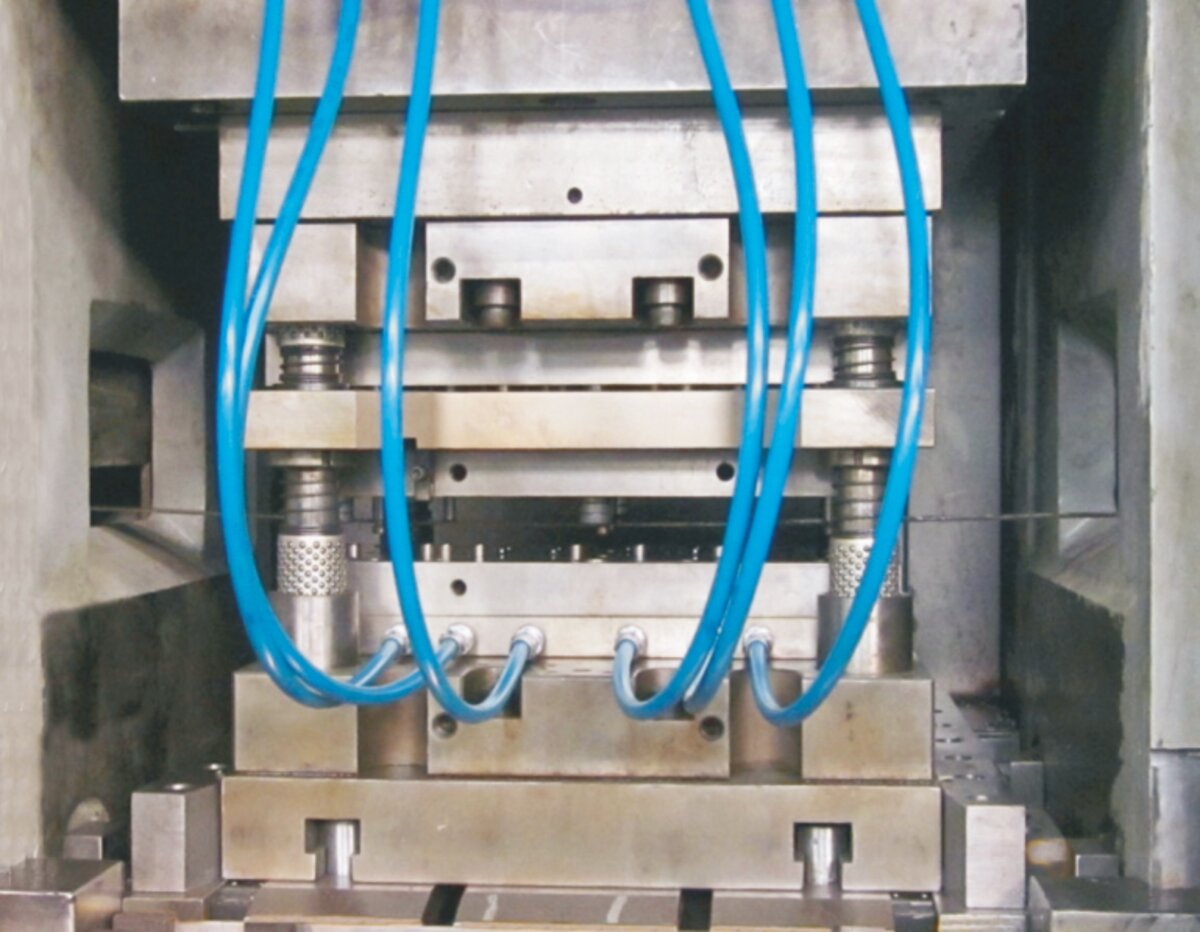
Our tooling protection sensor retrofit integrates with Schuler's existing control system — or with a retrofitted Beckhoff TwinCAT system — to detect misfeeds, slug pulling, and material thickness variations before they cause die damage. Misfeed detection via optical sensor at die entry catches strip position errors exceeding 0.05 mm. Overload monitoring via load cell detects force spikes and triggers stroke reversal before die contact.
For Schuler presses in continuous production, we offer preventive maintenance contracts designed to catch wear before it becomes failure. The contract structure is based on the understanding that Schuler's hybrid architecture has specific wear patterns that progress predictably over time — toggle bearings degrade at a measurable rate, proportional valve response drifts at a measurable rate, and seal integrity declines at a measurable rate.
Quarterly inspection (4 visits/year): Toggle bearing clearance measurement, hydraulic pressure curve recording, proportional valve response testing, seal inspection, and alarm log analysis with trend data from previous visits.
Annual calibration: Full tonnage verification with strain gauge calibration, servo-hydraulic synchronization tuning, encoder verification, BDC repeatability measurement, and CNC parameter audit.
Contract benefits: Priority dispatch (same-day domestic, 48-hour international), 15% discount on parts and labor, scheduled visits planned around your production calendar. The contract pays for itself by catching one bearing failure before it cascades into a toggle seizure — a $15,000 bearing replacement versus a $150,000 toggle rebuild.


We maintain a spare parts inventory for common Schuler wear components and manufacture replacement parts for discontinued Schuler OEM components. Our inventory includes proportional valves (Bosch Rexroth equivalents), hydraulic seals (NOK/Trelleborg kits for Schuler cylinder specifications), toggle bearings (SKF/FAG or machined bronze), encoders (Heidenhain/SICK equivalents), and PLC modules for retrofitted Beckhoff systems.
For components no longer available from Schuler's OEM catalog — including legacy HMI panels, proprietary communication cards, and model-specific hydraulic manifolds — we reverse-engineer and manufacture replacements in our Huangshi facility. Each part ships with material certification (EN 10204 3.1) and dimensional inspection report. Stocked parts ship within 3-5 business days; custom manufacturing from measurement requires 2-4 weeks.
Common Schuler replacement parts: Toggle bearings and bushings, proportional valves, hydraulic cylinder seal kits, flywheel coupling elastomers, crank angle encoders, HMI panels (retrofit), and hydraulic manifold blocks. All hydraulic components are traceable to named suppliers — no generic substitutions on critical-path parts.
Independent refurbishment for Feintool XTF, MJP, and GKP series presses. Full hydraulic circuit rebuild, CNC control retrofit (Siemens 840D or Beckhoff), guiding column regrinding, and ram parallelism restoration to 0.01 mm/100 mm. Reverse-engineered parts for discontinued Feintool OEM components.
Feintool press service →On-site repair and refurbishment for Mori Iron and Mori Seiki fine blanking presses. Hydraulic cylinder rebuild with chrome plating, 8-column guiding system restoration, and control retrofit for Mori MFB-series presses. Tonnage verification to ±1% accuracy.
Mori press service →Email your Schuler press model (MST-250/400/650, FBA-800/1200, or servo press series), serial number, year, current symptoms, and production requirements. Our service team will respond within one business day with an assessment plan and estimated service scope.