A comprehensive analysis of the forces reshaping the fine blanking industry in 2026 — from EV-driven demand shifts and lightweighting materials to automation integration, servo press adoption and the growing competitiveness of Chinese manufacturers.
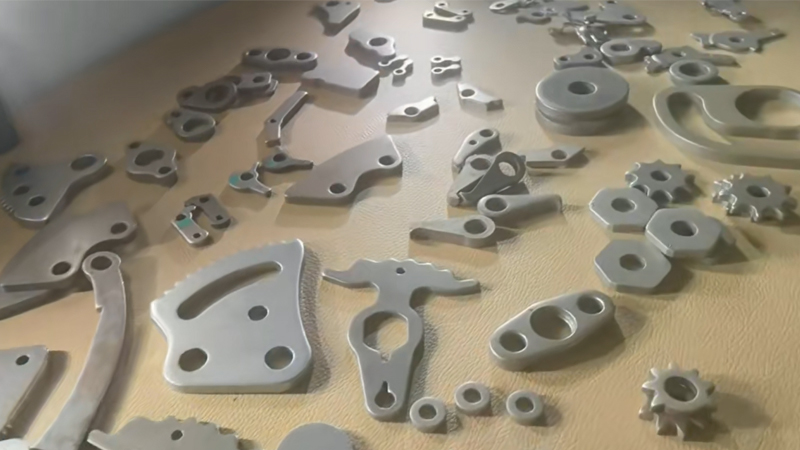
The transition from internal combustion engine (ICE) vehicles to electric vehicles (EVs) is the most significant demand driver for fine-blanked components in 2026. While ICE vehicles require approximately 8–12 fine-blanked parts per vehicle (primarily seat mechanisms, brake components and door hardware), EVs require 20–30% more fine-blanked components per vehicle. This increase comes from several EV-specific applications: motor stator and rotor laminations (electrical steel, fine-blanked for tight interlocking tolerances), battery pack structural connectors and busbar components (copper and aluminum, fine-blanked for edge quality and flatness), and structural body components replacing castings for weight reduction.
Motor laminations represent a particularly high-volume application. A typical EV traction motor uses 200–400 laminations per stator stack, and each lamination requires tight dimensional tolerances (IT6&nd;IT7) and a burr-free edge to minimize eddy current losses between laminations. While traditional motor lamination has used stamping or notching processes, the demand for higher motor efficiency is pushing manufacturers toward fine blanking for the interlocking features and tighter flatness requirements that improve stacking accuracy.

The automotive lightweighting imperative is driving fine blanking into material territory that was considered marginal five years ago. Two material categories are seeing rapid growth:
High-strength low-alloy steels at 700–950 MPa yield strength are increasingly specified for structural brackets, reinforcement plates and seat components where weight reduction requires thinner gauges at the same load rating. Fine blanking S700MC at 3–5 mm thickness is now routine, but S950MC at 4+ mm pushes die life down by 40–50% compared to mild steel, requiring die steel upgrades (PM steels like Vanadis 4 Extra) and optimized V-ring geometry to maintain acceptable tool life.
Aluminum alloys (5xxx and 6xxx series) are gaining ground in body and chassis components. Fine blanking aluminum requires higher counter-pressure ratios (to prevent tearing), sharper die edges (to avoid material buildup on the die), and specialized lubricants with EP additives to prevent galling. The market for aluminum fine blanking is growing 12–15% annually, driven by EV body structures and battery enclosures.

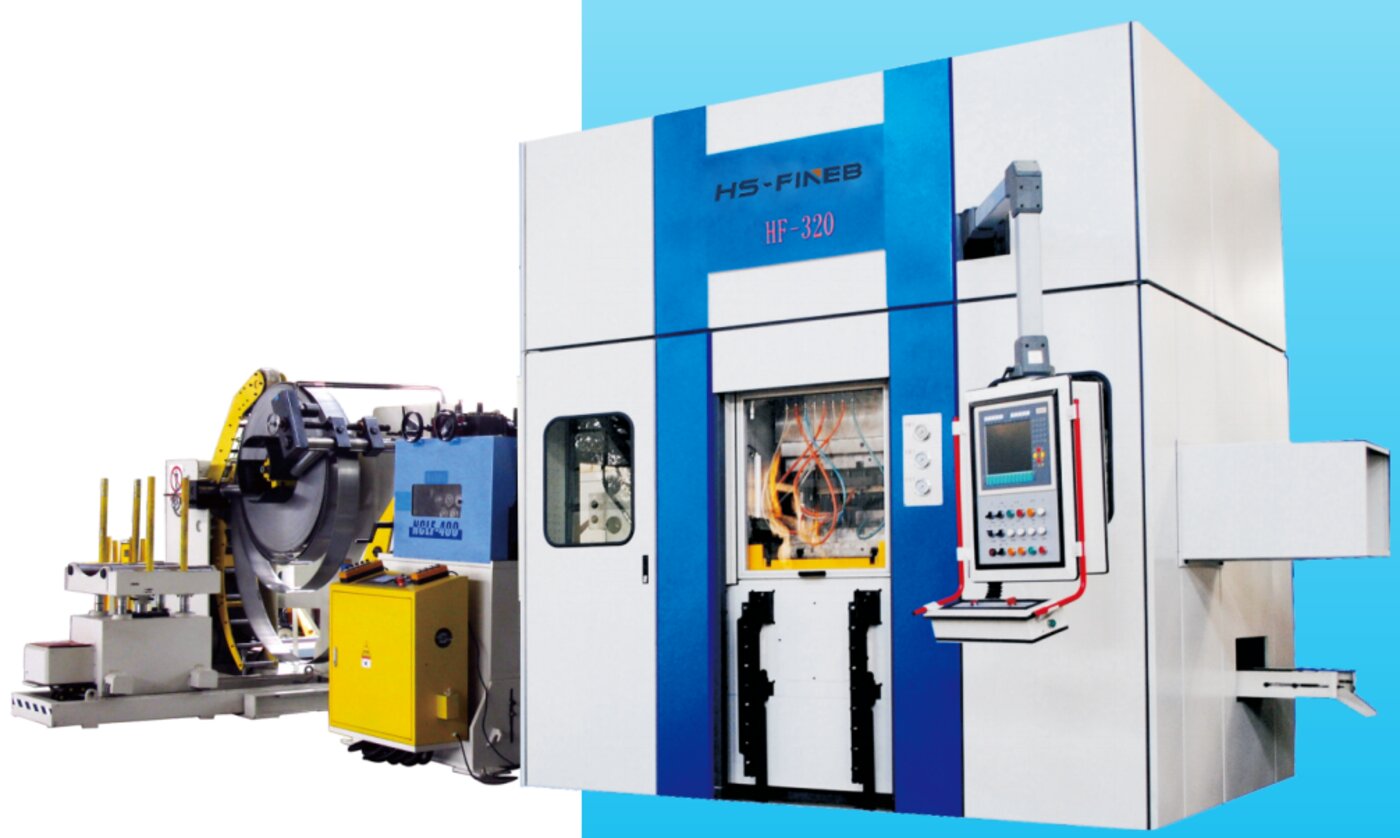
The most visible trend at equipment level is the shift from standalone press sales to complete production cells. Five years ago, a typical fine blanking equipment order was a press plus a feeding system. In 2026, the expectation is a turnkey cell: motorized decoiler with hydraulic expansion, servo feeder (Lenze or equivalent), fine blanking press, robotic part extraction (6-axis arm, 3–5 kg payload, 2–3 second cycle), automated scrap conveyor, inline thickness gauge, and die protection sensors — all coordinated by a master PLC with OPC UA interface to the factory MES.
HS-FINEB has positioned for this trend by designing and supplying complete cells rather than presses alone. Our engineering team configures the cell around the customer’s specific part, material and production volume, validating the integrated system on our factory floor before shipment.
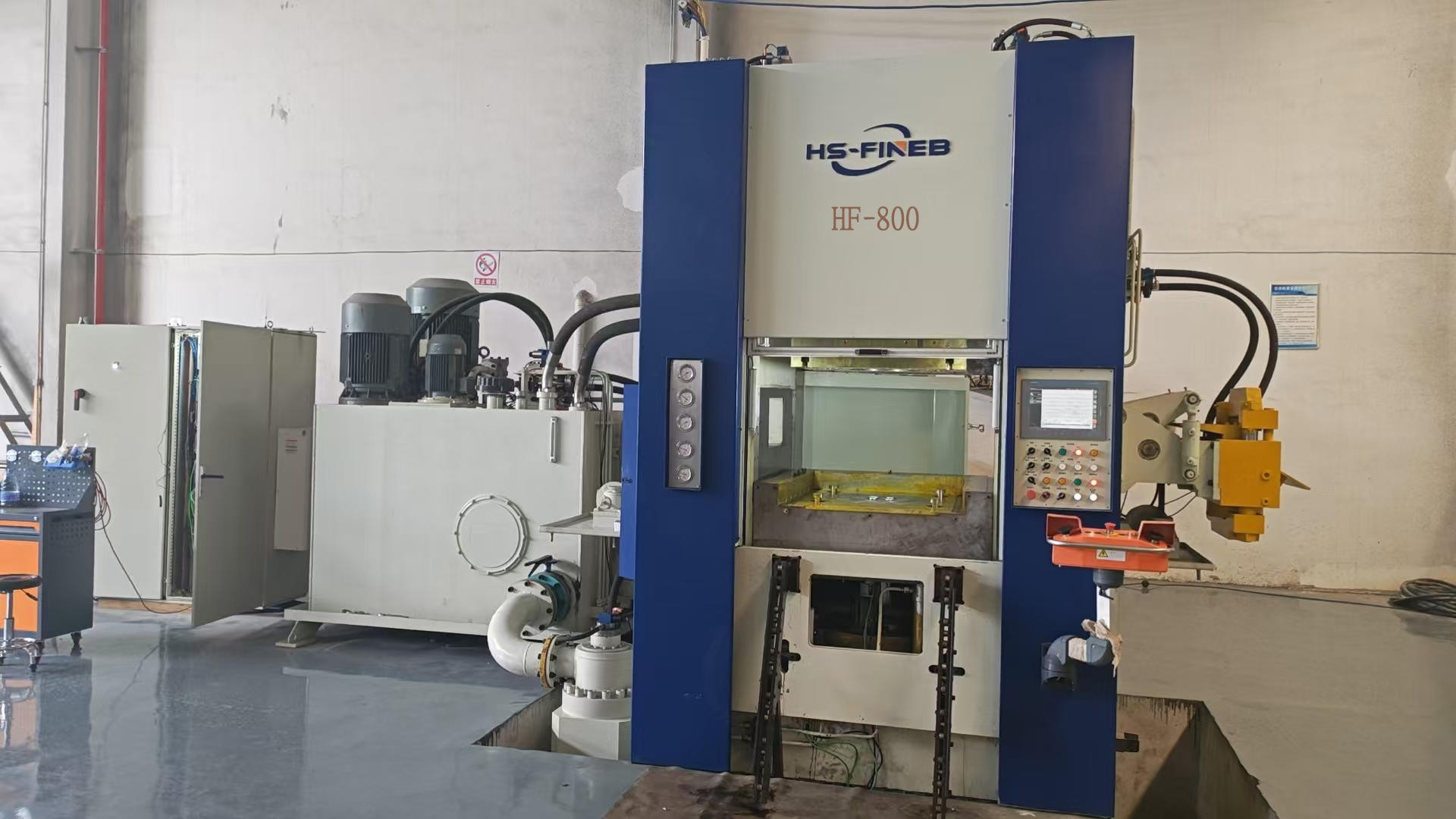
Servo-driven fine blanking presses — where the ram is driven by a direct-drive or toggle-linkage servo motor rather than hydraulic cylinders — are gaining market share, particularly in electronics and precision automotive applications. The servo press offers programmable motion profiles (constant speed through the shear zone), 10x faster force response (~5 ms vs ~50 ms for hydraulic), and significantly higher energy efficiency (80–90% vs 30–50% for hydraulic). However, servo presses remain limited in force capacity (practical maximum ~1600 tons) and are 20–40% more expensive than equivalent hydraulic presses. For thick material (>6 mm) and high-force applications, hydraulic presses will remain dominant for the foreseeable future.
China’s domestic fine blanking market is expanding as domestic brands replace imported presses. Chinese automotive and electronics manufacturers increasingly source fine blanking presses from domestic builders like HS-FINEB, attracted by 40–60% lower total cost of ownership, faster spare parts delivery, and local field service. The import share of fine blanking presses in China has fallen from 85% in 2015 to approximately 55% in 2026.
India is emerging as a significant fine blanking market, driven by automotive component manufacturing for both domestic consumption and export. Japanese and European tier-1 suppliers are establishing fine blanking operations in Pune, Chennai and Gurugram. HS-FINEB has field service customers in India operating presses from Feintool, Mori and our own HF series.
Nearshoring to Mexico for the US market is driving new fine blanking capacity investment in Queretaro, Monterrey and Puebla. Automotive suppliers are relocating stamping and fine blanking operations from Asia to Mexico to reduce supply chain risk and qualify for USMCA content rules. This creates demand for both new presses and refurbishment services for relocated used equipment.
Energy-efficient press designs are no longer optional. European buyers now require energy consumption data per cycle as part of equipment specifications. Hydraulic press builders are responding with accumulator-assisted systems that reduce main motor size by 30–40%, variable-speed drives that idle the motor between strokes, and oil mist collection systems that reduce lubricant consumption and workplace emissions. Scrap optimization — through nested layout design and tighter pitch control — is being driven both by material cost and sustainability metrics.
IoT-enabled presses with predictive maintenance capabilities are moving from premium option to industry standard. Modern fine blanking presses log cycle-by-cycle force profiles, hydraulic pressures, oil temperature and die tonnage data. Anomaly detection algorithms flag drift before it affects part quality — the same pressure transducer drift that caused the Mori case study in our field service records would have been caught by a trending system weeks before the reject rate climbed. OPC UA interfaces are becoming standard for data exchange with factory MES systems, enabling traceability per part and SPC integration.

Feintool maintains its premium position at the top of the market, particularly for ultra-high-precision applications, 24/7 unmanned production cells, and regulated markets where the Feintool brand name carries audit weight. However, Chinese manufacturers — including HS-FINEB — are steadily gaining market share in the mid-range segment (320–800 tons), where the total cost of ownership advantage of 40–60% over European presses is decisive for buyers producing commodity-grade fine-blanked parts. The quality gap has narrowed significantly: HS-FINEB presses now achieve the same IT7–IT8 dimensional tolerances and 100% shear edge quality that define fine blanking, with after-sale service that matches or exceeds what European suppliers offer outside their home markets.
Across the industry, experienced fine blanking engineers are retiring faster than they are being replaced. Die designers who learned the craft over 20–30 years are the bottleneck — V-ring geometry, die clearance, and counter-pressure optimization remain empirical skills honed through experience. This talent shortage is both a challenge and an opportunity: it drives demand for presses with more intelligent process assistance (pre-set force profiles, die protection systems), and it creates demand for refurbishment and service providers like HS-FINEB whose field engineers carry cross-brand expertise accumulated across hundreds of service engagements.
For procurement teams and production engineers evaluating fine blanking equipment in 2026, the market dynamics point to several practical conclusions:
First, the total cost of ownership gap between Chinese and European presses remains substantial, and the quality differential that once justified the premium has narrowed to the point where mid-range applications are well served by Chinese-built machines. Second, the shift to complete cells — press, feeding, automation, inspection — means buyers should evaluate suppliers on their integration capability, not just press specifications. Third, the talent shortage makes after-sale service and field engineering capability a critical selection criterion: the best press is the one whose problems get solved fastest when they occur. Fourth, digitalization capabilities (IoT data, predictive maintenance, MES integration) should be specified upfront, not added as an afterthought. Finally, sustainability metrics are becoming a procurement requirement, particularly for European and Japanese OEM supply chains — press buyers should request energy-per-cycle data and lubricant consumption specifications as part of the evaluation.
Contact HS-FINEB for press specifications, production cell design, and total cost of ownership analysis. Our engineers will help you evaluate the right configuration for your parts and production volume.