From robotic part extraction and automated scrap handling to inline inspection and die monitoring — a technical guide to building fully automated fine blanking production cells, including integration architecture, communication protocols and return on investment analysis.
The business case for automating fine blanking production cells rests on four pillars: labor cost reduction, consistent cycle time, 24/7 unattended operation capability, and operator safety. Fine blanking presses cycle at 15–40 SPM (strokes per minute) — at 25 SPM, a press produces a part every 2.4 seconds. A human operator cannot sustain this pace for an 8-hour shift without quality degradation, and the risk of hand injury in the die area makes manual part extraction increasingly unacceptable under modern safety standards.
Automation also delivers process consistency that manual operation cannot match. A robotic part extractor picks the part at the same point in every cycle, places it on the conveyor in the same orientation, and never gets distracted, fatigued, or rushed. This consistency directly translates to improved SPC (statistical process control) capability — the process variation from operator-dependent factors is eliminated, leaving only machine and material variation to manage.
The 24/7 unattended operation capability is the most compelling ROI driver. A fine blanking press running three shifts (168 hours/week) versus one shift (40 hours/week) produces 4.2x more parts from the same capital investment. The automation system cost ($30,000–$120,000 depending on complexity) is recovered in months, not years, when the third shift adds capacity without adding labor cost.

A 6-axis industrial robot (3–5 kg payload, e.g., Yamaha, Epson, or ABB) picks the finished part from the die area and places it on the output conveyor. The robot arm reaches into the die space during the press return stroke, gripping the part with a pneumatic or vacuum end-effector tailored to the part geometry. Typical cycle time is 2–3 seconds for pick-and-place, synchronized to the press cycle via the cell controller. The robot can also stack parts, orient them for downstream processing, or place them in trays for batch handling.
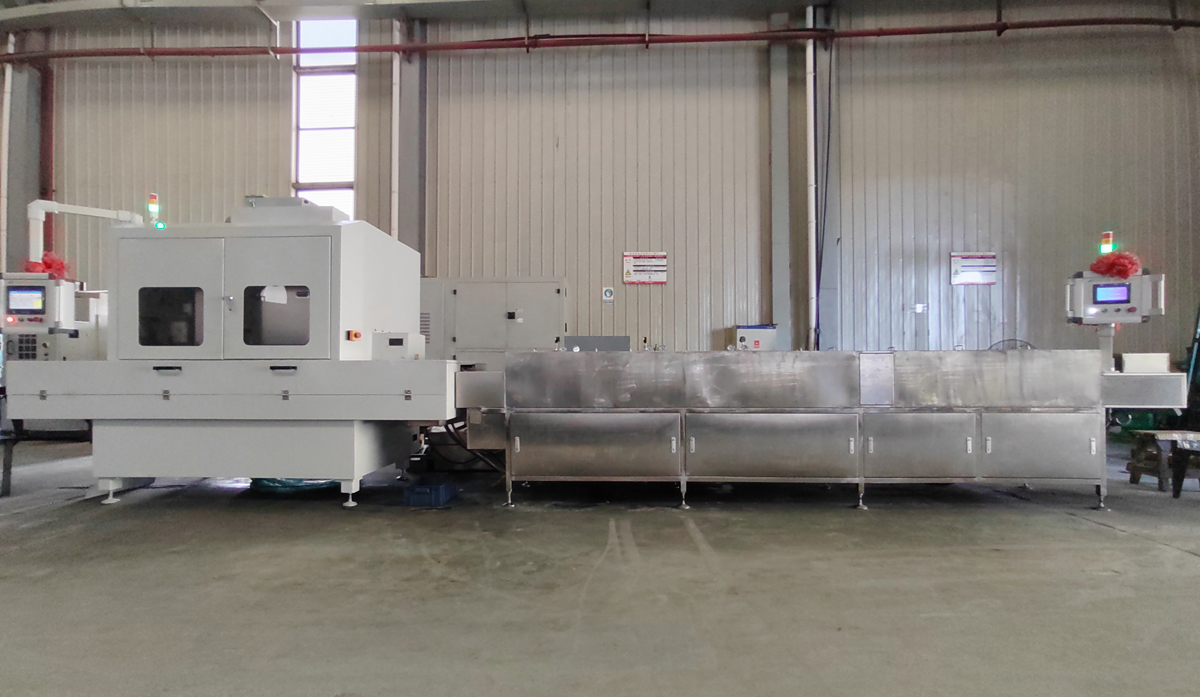
Automated scrap conveyor beneath the press removes skeleton (web material) and pierced slugs continuously during production. For ferrous materials, a magnetic conveyor lifts scrap up and out of the press bed to a collection bin. For non-ferrous (aluminum, copper, brass), a belt conveyor with cleats performs the same function. The conveyor runs at a speed matched to the production rate — too slow and scrap accumulates in the die area (risking die damage); too fast and the conveyor runs dry, wasting energy.
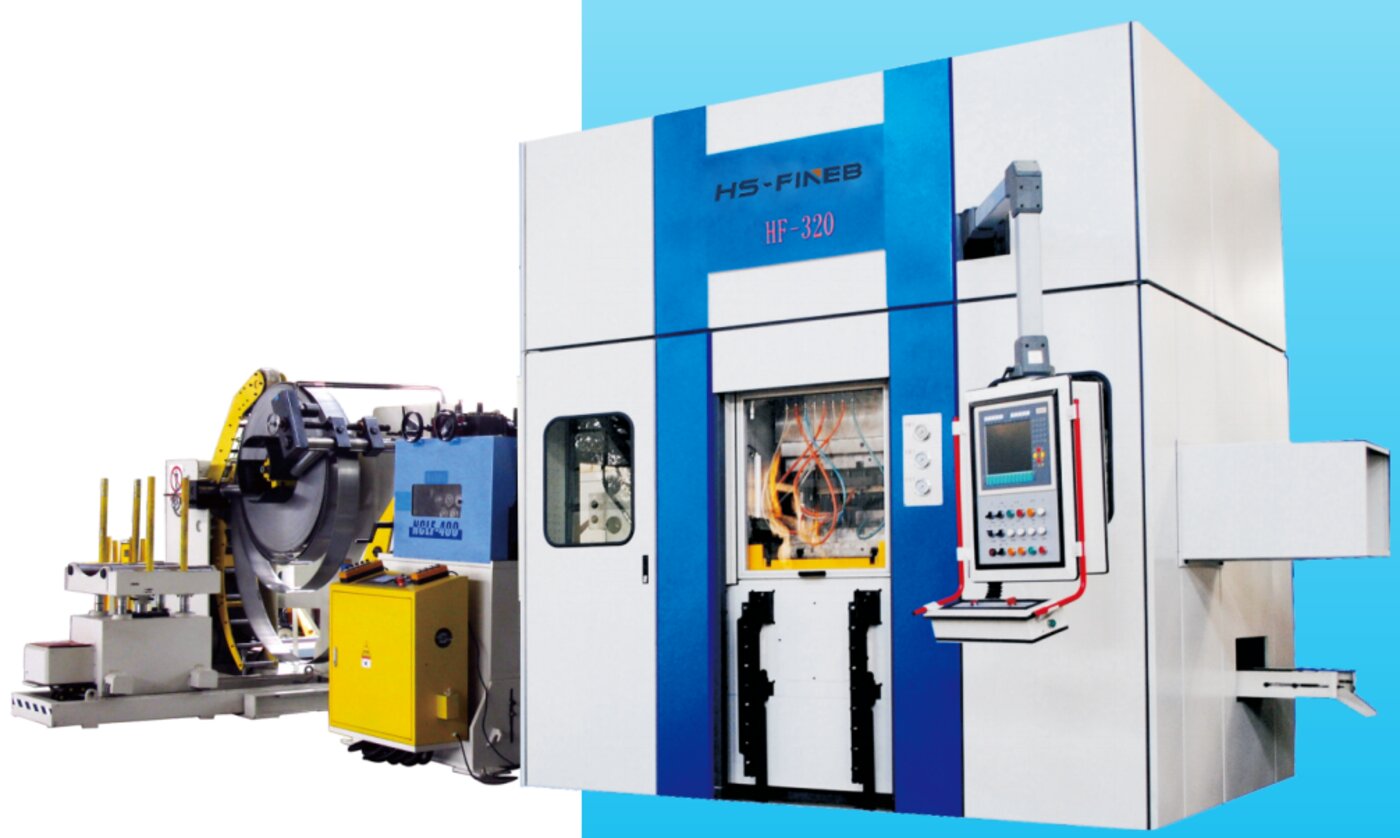
Motorized decoiler with hydraulic expansion mandrel (handles coils up to 5,000 kg), straightener (5–7 adjustable rolls to flatten strip curvature), lubricator (roller coater), and servo feeder (Lenze servo motor with absolute encoder, centi-mm positioning accuracy). The feeder advances the strip by the programmed pitch after each press cycle, and the pitch accuracy directly determines part-to-part dimensional consistency in progressive die applications.
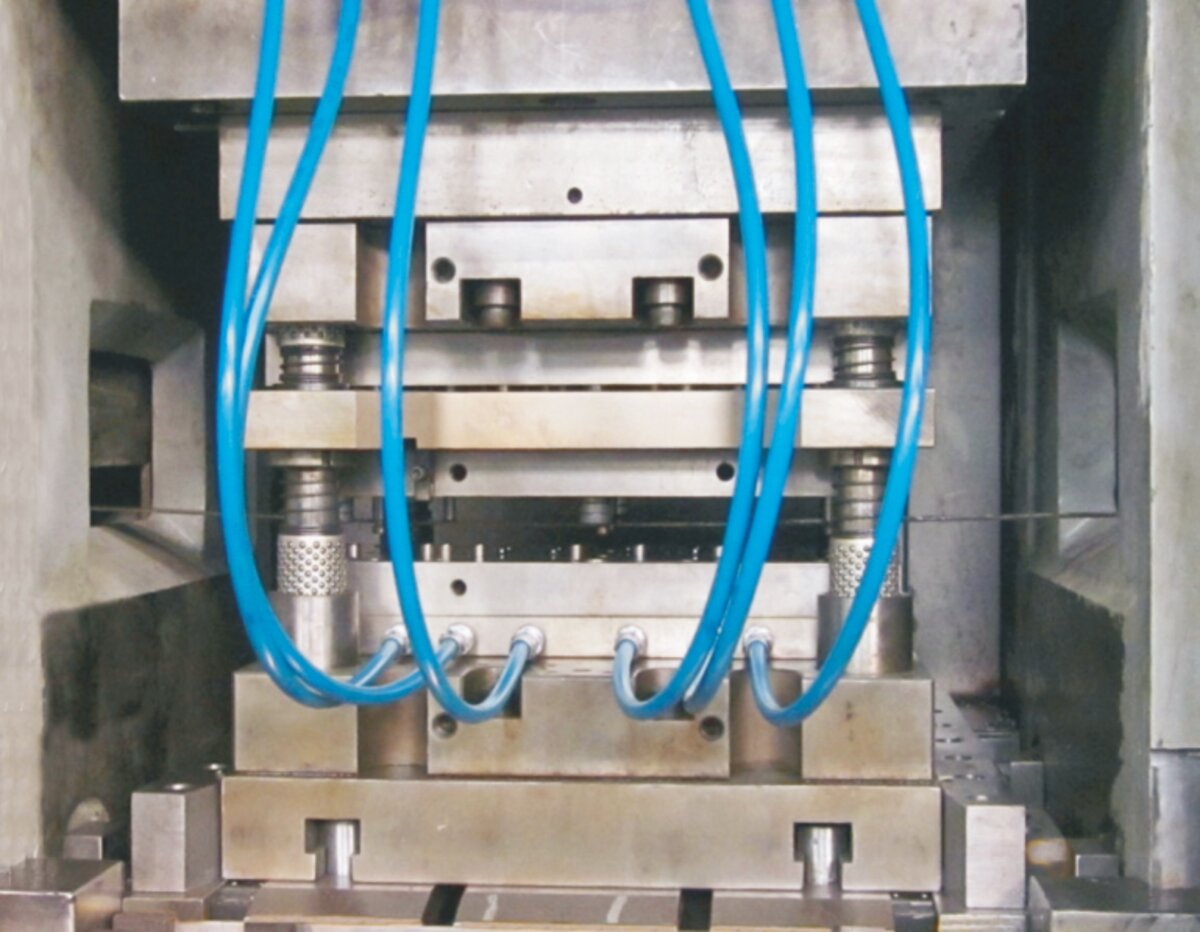
Inline thickness gauge (laser or contact) verifies part thickness on every cycle, feeding data to the SPC system. Vision system inspects edge quality (detecting tear zones or die-roll exceeding limits). Die protection sensors (optical through-beam) detect misfeed or short feed before the press cycles, preventing die crashes. Force sensors in each die station monitor tonnage per station, enabling detection of die wear or chipping through trend analysis.

The cell controller is a master PLC (typically Siemens S7-1500 or Beckhoff CX series) that coordinates all subsystems: the press CNC (force profiles, cycle timing), the robot (pick/place synchronization), the feeding system (pitch advance, coil end detection), the inspection systems (thickness gauge, vision), the scrap conveyor, and the safety system (light curtains, door interlocks, e-stop chain). The master PLC ensures that the press cannot cycle until the robot has cleared the die area, the feeder has advanced the correct pitch, and all safety conditions are met.
Internal cell communication uses PROFINET (real-time Ethernet at 1 ms cycle time) for the press CNC, robot controller, and servo drives. PROFIBUS may be used for legacy devices. For factory-level integration, OPC UA (Open Platform Communications Unified Architecture) provides a standardized data exchange interface to the factory Manufacturing Execution System (MES). The OPC UA interface exposes cycle count, tonnage data, alarm history, and OEE (Overall Equipment Effectiveness) metrics to the factory data layer, enabling traceability per part and predictive maintenance trending.
Safety is integrated at the cell controller level, not as an afterthought. The robot cannot enter the die area unless the press ram is above the safe position (verified by dual-channel absolute encoder). The press cannot cycle while the robot is in the die area (verified by light curtain and robot position feedback). The e-stop chain cuts power to the press hydraulic pump, robot servos, and feeding servo simultaneously — coordinated through a safety PLC (e.g., Siemens Failsafe) that meets SIL 3 / Performance Level e per ISO 13849.
HS-FINEB designs and supplies complete fine blanking production cells, not standalone presses. Our engineering team configures the cell around the customer’s specific part, material and production volume — selecting the press model, feeding system, robot payload and reach, inspection sensors, and scrap handling based on the application requirements. The integrated cell is validated on our factory floor before shipment: we run the press, feeder, robot and inspection system together on the customer’s material to verify cycle time, part quality, and system reliability before the cell ships.
This integrated approach eliminates the integration risk that buyers face when purchasing subsystems from separate vendors. When the press comes from one supplier, the robot from another, the feeder from a third, and the cell controller is written by yet another integrator, the hand-offs between subsystems become failure points — timing mismatches, communication protocol incompatibilities, and finger-pointing during commissioning. HS-FINEB’s single-source cell approach means one team owns the entire system, from first-article part to after-sale service.

A complete automation package for a 400–650 ton fine blanking cell — robot with end-effector, scrap conveyor, die protection sensors, inline thickness gauge, cell controller and safety system — typically adds $30,000–$120,000 to the press price, depending on the complexity of part handling and inspection requirements.
For a two-shift operation, the automation investment typically pays back in 18–30 months through labor savings (one operator manages the cell instead of two dedicated to loading/unloading), reduced reject rate (consistent handling eliminates operator-induced variation), and increased throughput (no pause between cycles for manual part removal).
The compelling case is adding a third (unmanned) shift. If the cell can run 4–6 hours unattended with buffer coils and automated scrap removal, the additional 1,200–1,800 production hours per year (at 25 SPM = 108–162 million additional parts) generates revenue that dwarfs the automation investment. The key enabler is die life — the die must be capable of running 50,000+ strokes between sharpening to make unattended third-shift production practical.
Successful automation projects start with clear requirements: What is the target cycle rate? How many part variants will the cell produce? What is the die life between sharpening (this limits unattended run time)? What are the downstream handling requirements (stacking, orienting, tray loading)? What quality data must be logged per part for traceability? Answering these questions before engaging the automation supplier ensures the cell is designed around your production reality, not a generic concept. HS-FINEB’s engineering team works through these requirements with each customer as part of the cell design process — before any equipment is ordered or built.
HS-FINEB designs and builds complete automated fine blanking cells — press, feeding, robot, inspection and cell controller as one integrated system. Contact our engineers to discuss your automation project.