💬 WhatsApp Chat

Fine Blanking Stainless Steel: Processing Guide

Processing guide for austenitic, ferritic, martensitic and duplex stainless steels — covering work hardening management, force parameters, tool material selection and lubrication requirements.

Stainless Steel

Challenges and Capabilities

Stainless steel presents the most demanding fine blanking challenge among commonly processed materials. Its high work-hardening rate — the material strengthens as it deforms during shearing — means the cutting zone progressively resists the punch as the stroke advances, requiring higher force, generating more heat, and accelerating tool wear. Yet the results justify the effort: properly fine-blanked stainless steel achieves 100% shear edge with surface roughness Ra below 0.4 µm and dimensional accuracy at IT7-8 tolerance, producing finished parts for medical, food, chemical and aerospace applications without secondary machining.

The key to successful stainless steel fine blanking lies in managing the work-hardening behavior through three levers: increased V-ring force (30-50% of blanking force vs 20-40% for carbon steel), tighter die clearance (0.3-0.5% of material thickness), and high-performance lubrication with extreme-pressure (EP) additives. Tool material selection is equally critical — premium tungsten carbide or powder metallurgy (PM) steel dies are required for volume production, as conventional D2 tool steel wears rapidly on stainless grades.

This guide covers four stainless steel families relevant to fine blanking: austenitic (304/316/316L), ferritic (430), martensitic (420/440C), and duplex (2205). Each family exhibits distinct fine blanking characteristics that determine process parameters, tool life and achievable edge quality.

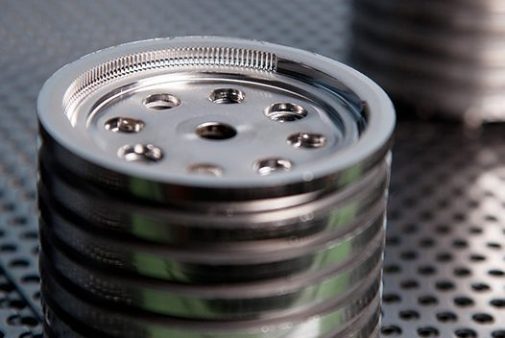
Fine-blanked stainless steel precision parts showing clean shear edge quality
Grade Comparison

Stainless Steel Fine Blanking Data

Grade FamilyTypical GradesFine BlankabilityV-Ring Force (%)Die Clearance (% t)Tool Life vs. Carbon Steel
Austenitic304, 316, 316LFair - Good35-50%0.3-0.4%40-60%
Ferritic430Good25-35%0.4-0.5%60-75%
Martensitic420, 440CFair (annealed)30-45%0.3-0.4%35-50%
Duplex2205Challenging40-50%0.3-0.4%30-45%
Stainless Families

Four Material Categories

Austenitic Grades (304 / 316 / 316L)

The most common stainless steels in fine blanking, widely used for medical devices, food processing equipment, chemical industry components and marine hardware. The face-centered cubic (FCC) crystal structure provides excellent ductility but also drives the highest work-hardening rate among stainless families — hardness at the shear zone can increase by 50-80% HV during blanking. This requires V-ring force at 35-50% of blanking force and counter-pressure at 25-30%. 316L (low carbon) is preferred for parts requiring post-blanking welding or corrosion resistance in chloride environments. Edge quality achieves 100% shear with Ra 0.3-0.4 µm when properly lubricated. Tool life on 304/316 is approximately 40-60% of that on carbon steel of equivalent thickness.

Ferritic Grades (430)

Easier to fine blank than austenitic grades due to lower work-hardening tendency in the body-centered cubic (BCC) crystal structure. V-ring force can be reduced to 25-35% of blanking force, and die clearance set at the standard 0.4-0.5% of material thickness. Edge quality achieves 100% shear with die-roll below 10% of material thickness. Grade 430 is commonly fine-blanked for cutlery components, decorative trim, appliance panels and automotive trim where moderate corrosion resistance is required without the cost of austenitic grades. Tool life is approximately 60-75% of carbon steel — better than austenitic but still requiring carbide tooling for volume production.

🔥

Martensitic Grades (420 / 440C)

Heat-treatable stainless steels used for surgical instruments, knife blades, bearings and valve components. In the annealed condition (HV 200-250), martensitic grades can be fine-blanked with V-ring force at 30-45% of blanking force and die clearance at 0.3-0.4% of material thickness. The higher annealed hardness compared to austenitic grades means higher blanking force per unit area. After fine blanking, parts are hardened by austenitizing (980-1050°C for 420, 1010-1065°C for 440C), quenching and tempering to HRC 50-58 (420) or HRC 58-62 (440C). Dimensional change during hardening must be accounted for in die design — the fine blanking process produces tight tolerances that can be maintained through heat treatment when the force profile is properly optimized.

Duplex Grades (2205)

The most challenging stainless steel for fine blanking. The mixed austenite-ferrite microstructure combines high strength (yield strength approximately double that of 304) with significant work-hardening, requiring maximum V-ring force (40-50% of blanking force) and tight die clearance (0.3-0.4% of material thickness). Tool life is only 30-45% of carbon steel. Duplex 2205 is fine-blanked for chemical processing equipment, oil and gas components, and heat exchanger plates where its superior stress corrosion cracking resistance justifies the processing difficulty. For these applications, the fine-blanked edge quality eliminates the need for machined surfaces that would otherwise be required in this difficult-to-machine material.

Work Hardening

The Core Challenge

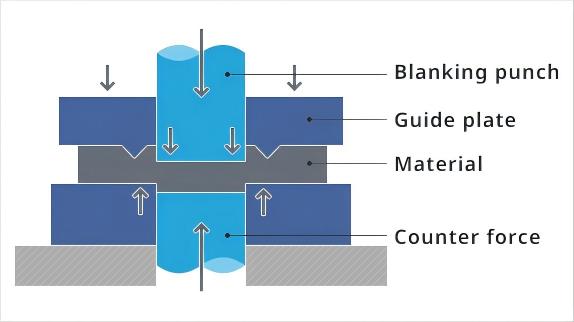
Fine blanking stainless steel showing triple-force hydraulic system managing work hardening at shear zone

Work hardening at the shear zone is the defining challenge of stainless steel fine blanking. As the punch penetrates the material, the austenitic structure transforms to strain-induced martensite at the deformation zone, progressively increasing hardness and shear resistance. This transformation begins at approximately 15-20% strain and accelerates as deformation continues — by the time the punch has penetrated 50% of material thickness, the shear zone hardness may have increased by 50-80% HV.

This hardening has three consequences. First, the required blanking force increases non-linearly through the stroke — unlike carbon steel where force builds linearly to a peak at approximately 30% penetration, stainless requires sustained high force through 60-70% penetration. Second, the hardened material at the shear zone accelerates tool wear on the punch and die cutting edges, particularly at the point of maximum contact. Third, the heat generated by the higher shear work must be managed through effective lubrication to prevent galling — the tendency of stainless steel to weld to the die surface under pressure and heat.

The V-ring plays a critical role in managing work hardening. By impinging the material before the punch contacts the surface, the V-ring creates a compressive stress state that constrains the material flow and limits the extent of the work-hardened zone. Higher V-ring force (30-50% of blanking force for austenitic grades) is required because the material's flow stress is higher and its work-hardening rate is steeper than carbon steel.

Tooling & Lubrication

Die Material and Process Requirements

Tool Material Selection

Premium tungsten carbide (ISO K20-K30 grade) is strongly recommended for volume production of stainless steel parts. Carbide achieves 3-4 times the tool life of D2 tool steel on austenitic grades. For applications requiring complex die geometry where carbide is impractical, powder metallurgy (PM) steels such as Vanadis 23 or Caldie offer a 50-70% tool life improvement over conventional D2. Die surfaces should be PVD-coated (TiCN or AlCrN) to reduce friction and prevent galling. Cutting edge preparation — honing to a radius of 0.01-0.02 mm — is critical for stainless to prevent edge chipping under the higher cutting forces.

💧

Lubrication Requirements

High-performance synthetic lubricants with extreme-pressure (EP) additives are essential for stainless steel fine blanking. The EP additives (typically sulfur or phosphorus compounds) react with the stainless surface under the high contact pressure and temperature at the shear zone, forming a protective film that prevents metal-to-metal contact and galling. Lubricant viscosity should be higher than for carbon steel (ISO VG 100-150 vs VG 46-68) to maintain film thickness under the elevated forces. For parts used in medical or food applications where lubricant residue is unacceptable, water-soluble synthetic lubricants can be used with an effective post-blanking cleaning process (ultrasonic cleaning with alkaline detergent).

🔎

Edge Quality Expectations

With properly optimized parameters — correct V-ring force, tight die clearance, premium tooling and effective lubrication — stainless steel achieves 100% shear edge with surface roughness Ra below 0.4 µm. Die-roll is typically 5-15% of material thickness depending on grade and thickness. Ferritic grades achieve the best edge quality (Ra 0.2-0.3 µm, die-roll below 10%), followed by austenitic (Ra 0.3-0.4 µm), martensitic in the annealed condition (Ra 0.3-0.4 µm), and duplex (Ra 0.4-0.5 µm). These values represent the achievable range with new or recently sharpened tooling; tool wear degrades edge quality progressively, requiring monitoring and scheduled sharpening to maintain specifications.

Shear Speed Optimization

Shear speed for stainless steel should be lower than for carbon steel — typically 2-4 mm/s vs 4-8 mm/s — to limit heat generation at the shear zone and allow the lubricant film to maintain integrity. On HS-FINEB presses, the CNC controller allows independent programming of approach speed (fast, 20-50 mm/s), shear speed (slow, 2-4 mm/s) and return speed (fast, 30-60 mm/s). This variable-speed capability is particularly valuable for stainless steel, where the slow shear phase directly determines edge quality and tool life. The production rate impact of slower shear speed is partially offset by the fast approach and return phases, maintaining acceptable cycle times of 20-35 SPM for most stainless applications.

Planning a Stainless Steel Fine Blanking Project?

Send us your part drawing, stainless grade and annual volume — our engineers will recommend the optimal press, die material, force parameters and lubrication strategy.

💬