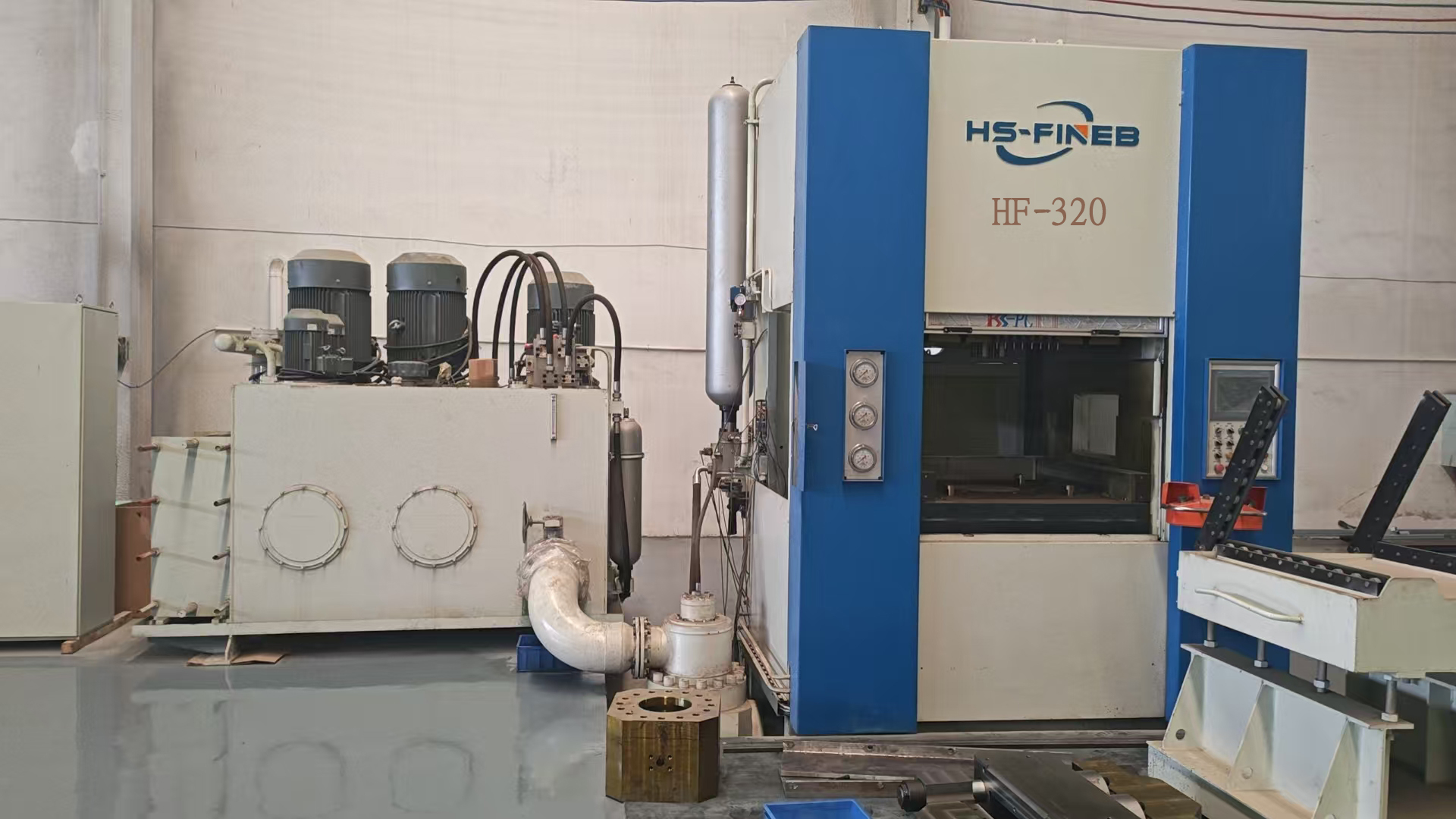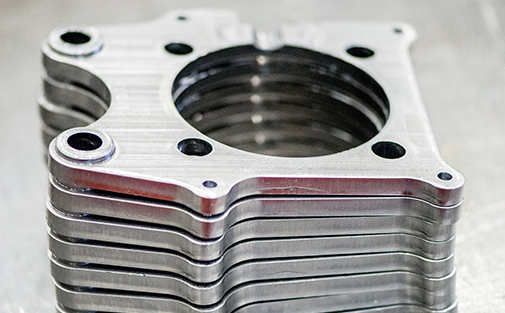
How a Mexican lock hardware manufacturer eliminated secondary machining and cut scrap by 80% with a single HS-FINEB HF-320 fine blanking press.
Customer: Lock and security hardware manufacturer in Mexico, producing door lock components for residential and commercial building markets. Product range includes lock plates, cams, latch plates and deadbolt components.
Challenge: The customer was using two conventional stamping presses with secondary machining (milling, drilling, deburring) to produce three primary part types: lock plates (40 mm × 30 mm × 3 mm in C45 steel), cams (25 mm radius × 4 mm in 16MnCr5), and latch plates (50 mm × 20 mm × 2.5 mm in C60). Monthly production was 50,000 parts across the three types, with a 15% scrap rate driven by edge quality inconsistency from the conventional stamping process. The secondary machining operations added $0.20 per part in processing cost and required three dedicated machining centers with operators.
The customer needed to increase production capacity (target: 60,000 parts/month), reduce scrap (target: below 5%), and eliminate secondary machining. After evaluating fine blanking presses from three suppliers, the customer selected the HS-FINEB HF-320 based on tonnage suitability, die area capacity, CNC control features and total cost of ownership.


Press: HS-FINEB HF-320 (320-ton triple-action hydraulic CNC fine blanking press). The HF-320 was selected based on force calculations across all three part types: the cam in 16MnCr5 (4 mm thickness) required the highest blanking force at 1,800 kN, with V-ring force 600 kN (33% of blanking) and counter-pressure 350 kN (19% of blanking). Total peak force: 2,750 kN — well within the HF-320 rated capacity of 3,200 kN, providing a 14% reserve.
Die: Compound fine blanking dies (one per part type) in D2 tool steel for the lock plate and latch plate (moderate volume), and tungsten carbide for the cam (highest volume and hardest material). Die area: 250 × 200 mm. The compound die architecture was chosen over progressive because the parts are relatively simple (one or two features each) and the customer's volume per part type (20,000-25,000/month) did not justify the progressive die cost premium.
Material Handling: Servo-driven coil feeding system (Lenze drive) with programmable pitch for each part type. Decoiler with 2-ton coil capacity. Hydraulic scrap shear for skeleton chopping. Quick die change system with hydraulic clamping — die changeover between part types takes approximately 45 minutes, including material coil change and CNC parameter recall via recipe management.
Part Details: Lock plate: 40 × 30 × 3 mm, C45 spheroidized annealed (HV 160), with pierced keyway 8 × 5 mm. Cam: 25 mm radius × 4 mm, 16MnCr5 annealed (HV 155), with pierced center bore 6 mm. Latch plate: 50 × 20 × 2.5 mm, C60 spheroidized annealed (HV 175), with two pierced mounting holes 4 mm diameter.
| Part Type | Material | Thickness (mm) | Blanking Force (kN) | V-Ring Force (kN) | Counter-Pressure (kN) | Shear Speed (mm/s) |
|---|---|---|---|---|---|---|
| Lock Plate | C45 | 3.0 | 1,200 | 400 | 250 | 4 |
| Cam | 16MnCr5 | 4.0 | 1,800 | 600 | 350 | 4 |
| Latch Plate | C60 | 2.5 | 950 | 350 | 200 | 5 |
All three part types run on the same HF-320 press with die-specific CNC parameter recipes. The operator selects the part type on the HMI, and the controller automatically recalls the force profile, motion profile, feed pitch and die protection settings. Recipe changeover takes less than 2 minutes; die changeover (including coil change) takes approximately 45 minutes.

Timeline: The project was completed in 12 weeks. Weeks 1-5: press manufacturing and factory acceptance test at HS-FINEB in Huangshi, including trial blanking of sample parts in all three materials (C45, 16MnCr5, C60). Weeks 6-7: shipment to Mexico, installation, and utility connection including electrical power, hydraulic oil fill and compressed air supply. Weeks 8-9: die installation, parameter optimization and first-article inspection for each part type. Weeks 10-11: operator training and production ramp from 20 SPM to full 40 SPM. Week 12: PPAP submission and full production release.
First-article results: During the initial die trial, the cam in 16MnCr5 showed die-roll of 0.45 mm (11.2% of 4 mm thickness), slightly above the 10% specification. The V-ring force was increased from the initial 550 kN to the final 600 kN, reducing die-roll to 0.38 mm (9.5%). The lock plate and latch plate met specifications on the first trial with no parameter adjustments needed, confirming the accuracy of the pre-engineering force calculations for those part types.
Operator training: Three operators and one maintenance technician received 8 days of on-site training. The curriculum covered CNC HMI operation, recipe management for part-type changeover, daily and weekly maintenance procedures, die sharpening scheduling, and troubleshooting for common issues such as mis-feed detection, die protection sensor response, and hydraulic pressure alarms. HS-FINEB also provided a bilingual operations manual and remote diagnostic support via the press data-logging system, allowing our engineers in Huangshi to review performance data and assist with troubleshooting without requiring an on-site visit.
Quality system integration: The HF-320 CNC controller was integrated with the customer's existing quality management system via PROFINET, enabling automatic logging of force profiles, stroke counts and alarm events for each production batch. This data feeds the customer's SPC system, providing real-time Cpk monitoring on critical dimensions and triggering automatic alerts when process capability drifts below the Cpk 1.33 threshold.
The fine blanking process eliminated all secondary machining operations (milling, drilling, deburring) for all three part types. The 100% shear edge quality and pierced hole accuracy (IT8 tolerance) met the customer's functional requirements directly from the press. This eliminated $0.20 per part in machining cost and freed three machining centers and their operators for other production. At 60,000 parts per month, the monthly savings from eliminated machining total $12,000 ($144,000 annually).
Edge quality: 100% shear edge across all three part types, with die-roll below 10% of material thickness on each. Surface roughness: Ra 0.35 µm — suitable for the lock mechanism's sliding contact surfaces without secondary polishing. Dimensional accuracy: IT8 tolerance grade achieved on all critical dimensions, including the cam radius (25 mm ±0.02 mm), lock plate keyway width (8 mm +0.02/0 mm), and latch plate hole positions (±0.03 mm true position).
Production rate: 40 SPM across all part types. Monthly output increased from 50,000 parts (two conventional presses, two shifts) to 60,000 parts (single HF-320, single shift). Scrap rate reduced from 15% to 3% — an 80% reduction — primarily due to the consistent edge quality and dimensional accuracy of the fine blanking process, which eliminated the stamping defects (tear fractures, burr formation, dimensional drift) that drove the previous scrap rate. At 60,000 parts per month with an average material cost of $0.30 per part, the scrap reduction saves approximately $2,160 monthly in material cost.
Die life between sharpenings: 80,000 strokes on the D2 tool steel dies (lock plate, latch plate) and 120,000 strokes on the tungsten carbide die (cam). Sharpening reduces die life by approximately 0.05 mm per grind, with total die life estimated at 1.5-2.0 million strokes before replacement. Total project cost (HF-320 press, three dies, coil feeding, installation, training): $285,000. Annual savings (eliminated machining $144,000 + scrap reduction $25,920 + reduced labor $35,000): approximately $205,000. ROI payback: 14 months.
Send us your part drawings, current process and monthly volume — our engineers will show you how fine blanking can reduce cost, improve quality and increase capacity.