💬 WhatsApp Chat

Fine Blanking Press Supplier for US Manufacturers

Fine blanking press export to the United States with UL and cUL electrical compliance, OSHA safety standards alignment, shipping to Long Beach and Norfolk, and field service logistics positioned as a cost-effective alternative to Feintool Equipment Corp.

US Market Focus

Fine Blanking Press Supply to the United States

The United States maintains a significant fine blanking press installed base across automotive, aerospace, medical device, and electronics manufacturing. US manufacturers evaluating new fine blanking capacity face a market where the primary domestic-brand option — Feintool Equipment Corp (based in Poland, Ohio, with engineering from the parent company in Lyss, Switzerland) — commands premium pricing and lead times of 12-18 months. HS-FINEB enters the US market as a new-press alternative for manufacturers who need fine blanking capability at a capital investment that supports competitive part pricing, or who need additional capacity beyond existing equipment.

Our HF-series presses deliver the same fine blanking process physics that determine part quality regardless of manufacturer: triple-action hydraulic force architecture with independently controlled V-ring impingement, counter-pressure, and blanking force. This produces 100% smooth-cut shear edges, die-roll below 15% of material thickness, and dimensional accuracy at IT7-IT9 tolerance grade. US buyers receive presses configured to UL-listed electrical standards, with OSHA-compliant safety architecture including interlocked guards, two-hand control devices, and light curtain protection at coil feed access points.

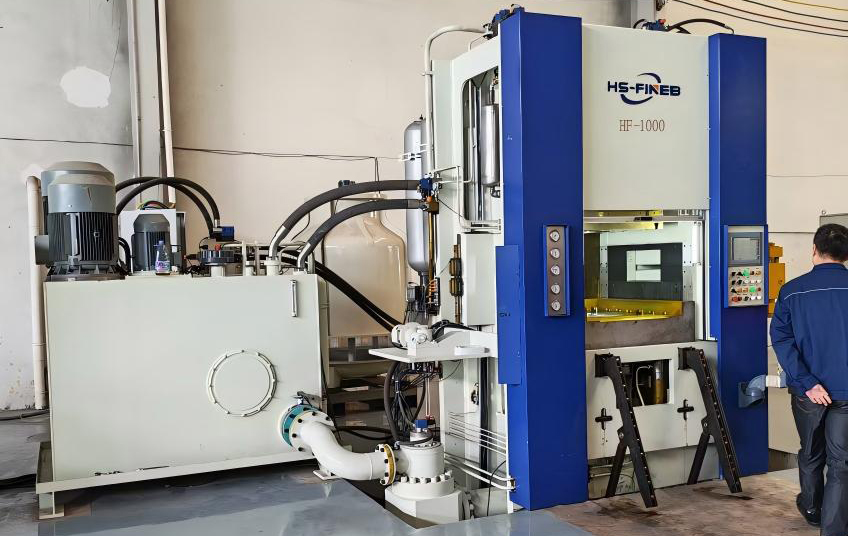
HF-1000 1000-ton fine blanking press for US manufacturing export
Compliance Architecture

UL, OSHA & ASTM Alignment

UL / cUL Electrical Compliance

Electrical systems for US-bound presses are specified with UL-listed components: Siemens or Allen-Bradley PLCs, Lenze or Baldor servo drives, and UL-listed motor starters, contactors, and circuit protection devices. Control panels are assembled to UL 508A standards, with documented wiring, component marking, and internal separation of power and control circuits. For Canadian buyers or US facilities requiring cUL certification, we coordinate with a NRTL (Nationally Recognized Testing Laboratory) for panel listing and labeling.

🛡

OSHA Safety Compliance

Safety architecture meets OSHA 29 CFR 1910.212 (machine guarding requirements) including point-of-operation guarding, two-hand control or two-hand trip devices per ANSI B11.4, and light curtains (Type 4 per ANSI/IEC 61496) at all operator access points. Emergency stop circuits meet ANSI B11.19 and ISO 13850 standards. Lockout/tagout (LOTO) provisions per OSHA 29 CFR 1910.147 include documented energy isolation points, and the press is delivered with a machine-specific LOTO procedure document.

📝

ASTM Standards Alignment

Material specifications for press components are documented against ASTM standards where applicable: ASTM A36 for structural frame members, ASTM A514 for high-stress platen areas, and ASTM D2000 for elastomeric seals. Material test reports (MTRs) are provided for all pressure-retaining components. Hydraulic oil specifications reference ASTM D6158 (mineral hydraulic oils) and are cross-referenced to ISO VG viscosity grades for international traceability.

Trade & Tariff Considerations

Section 301 Tariffs and Import Strategy

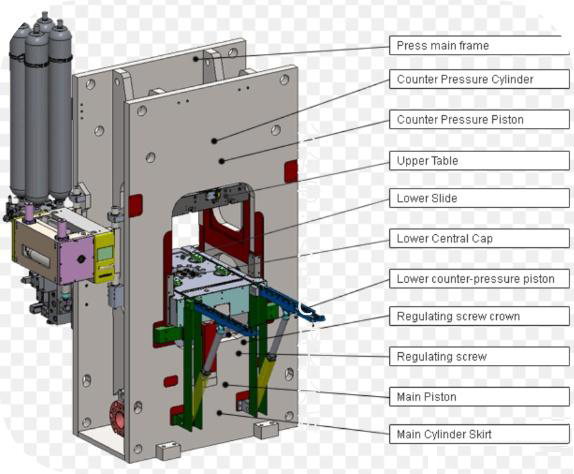
Fine blanking press internal structure for US export compliance

US imports of fine blanking presses from China are affected by Section 301 tariffs, which impose additional duty rates on Chinese-origin goods classified under Chapter 84 of the Harmonized Tariff Schedule (HTS). Fine blanking presses typically fall under HTS 8462.29.00 (hydraulic presses for metalworking), with the Section 301 rate layering on top of the normal trade relations (MFN) duty rate.

Importers should be aware of the following considerations:

Tariff exclusion process: The Office of the United States Trade Representative (USTR) has periodically opened and closed exclusion processes for specific HTS subheadings under Section 301. Fine blanking presses have been subject to these processes, and exclusions, when granted, apply retroactively to eligible entries. Importers should monitor USTR announcements and work with a licensed US customs broker to determine current applicability and exclusion eligibility.

Total landed cost analysis: Even with Section 301 tariffs applied, the total landed cost of an HS-FINEB press frequently remains below the price of a comparable new Feintool press. For a 500-ton application, the differential can exceed 30% in favor of the HS-FINEB press after accounting for all duty layers, freight, and insurance — particularly when the buyer considers the capital cost of the complete production cell (press + coil feeding + die) rather than the press in isolation.

Alternative structuring: Some US buyers explore structuring their import through Section 321 (de minimis entry for shipments valued under $800 — not applicable to capital equipment) or bonded warehouse entry for deferred duty payment. We support all legitimate import strategies and provide complete documentation for US customs compliance. The buyer's customs broker manages the entry process and duty assessment.

Shipping to US Ports

West Coast and East Coast Delivery

West Coast (Long Beach)

Long Beach, California, serves as the primary West Coast discharge port for presses destined for the Pacific Southwest (Los Angeles basin, Inland Empire), the Mountain West (Arizona, Nevada, Utah), and the Pacific Northwest via rail connection. Ocean transit from Shanghai: 14-18 days. Containerized presses (HF-200 through HF-650) ship in 40-foot flat rack containers; larger units ship as breakbulk. Port congestion at Long Beach has been a periodic concern — we recommend buyers confirm current port conditions and consider Oakland or Seattle-Tacoma as alternative West Coast ports during congestion periods.

East Coast (Norfolk)

Norfolk, Virginia, serves presses destined for the Southeast automotive corridor (Alabama, Georgia, Tennessee, the Carolinas) and the Midwest (Ohio, Michigan, Indiana) via inland rail. Ocean transit from Shanghai via Panama Canal: 28-35 days. Norfolk's heavy-lift handling capabilities and unconstrained draft make it suitable for large breakbulk press shipments (HF-800 through HF-1200). For Great Lakes destinations, the port of Cleveland is an alternative during navigation season (April-December).

After-Sales in the USA

Field Service & Spare Parts Logistics

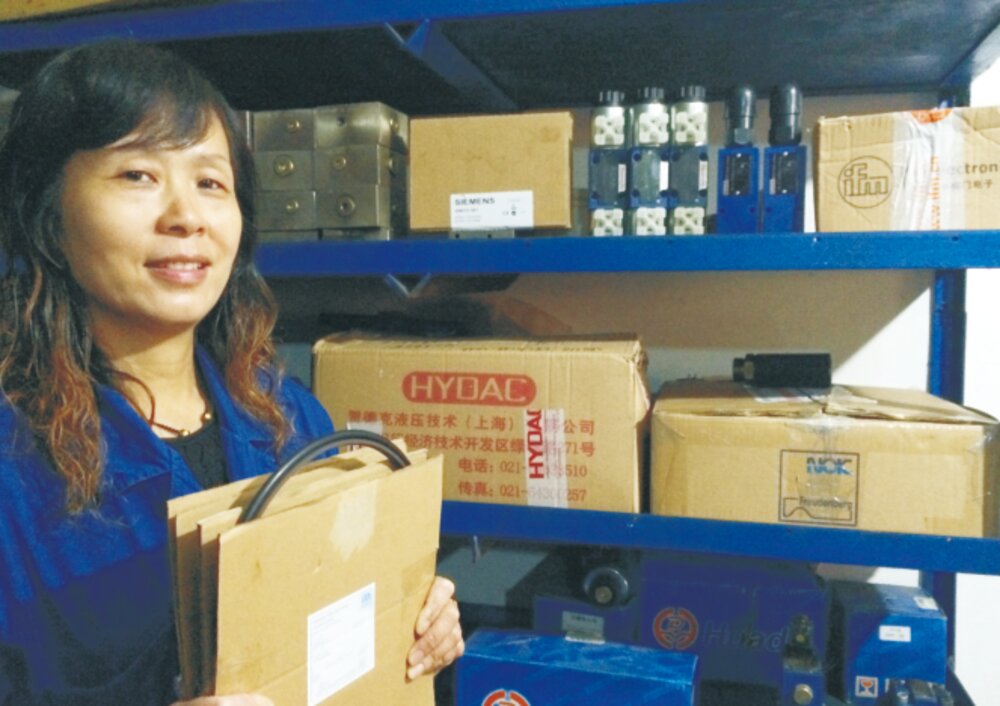
Fine blanking press spare parts inventory for US field service

US buyers receive structured after-sales support designed for the geographic and regulatory realities of cross-Pacific equipment sourcing:

Remote diagnostics: The CNC controller supports remote access via VPN tunnel, with the connection established through a US-side gateway to maintain network security compliance. Our engineers in Huangshi can connect to the press during Beijing business hours (which overlap with US evening hours) for fault diagnosis, parameter adjustment, and process optimization. English-language communication throughout.

Spare parts logistics: Critical spare parts are stocked in Huangshi and air-freighted to US international airports (LAX, ORD, ATL, JFK depending on destination). Typical delivery: 5-7 working days door-to-door via expedited air freight. For production-critical operations, we strongly recommend the buyer maintain on-site stock of components with long lead times — particularly proprietary hydraulic valve cartridges and servo encoder modules, which may have 4-8 week procurement cycles from their European manufacturers (Bosch Rexroth, Lenze, SICK).

On-site field service: Our engineers travel to US facilities for commissioning, FAT follow-up, annual inspections, and fault resolution requiring physical intervention. B1/B2 visa processing for Chinese-passport holders adds 2-4 weeks to response time depending on US embassy appointment availability. We recommend buyers with production-critical presses pre-establish a relationship with a local hydraulic press service company for routine maintenance (seal replacement, oil changes, mechanical adjustments), reserving our field engineers for fine blanking-specific interventions.

US Industry Segments

Fine Blanking Applications Across America

Midwest Automotive Corridor

The traditional US automotive belt — Michigan, Ohio, Indiana, Kentucky, Tennessee — hosts the densest concentration of fine blanking press installations in the United States. Tier-1 suppliers in this region produce brake caliper components, seat mechanisms, transmission gears, and clutch plates requiring IT7-IT9 tolerance and 100% smooth-cut edges. HS-FINEB presses in the 500T-800T range serve tier-2 suppliers adding fine blanking capability or replacing aging equipment. The region's deep manufacturing engineering talent pool supports effective operator training and process development during commissioning, while Norfolk and Cleveland ports provide Atlantic and Great Lakes shipping access.

Southeast Manufacturing Growth

Alabama, Georgia, South Carolina, and Tennessee have attracted major automotive and aerospace investment — Mercedes-Benz (Vance, AL), Hyundai (Montgomery, AL), Kia (West Point, GA), BMW (Spartanburg, SC), and Boeing (Charleston, SC). Fine blanking applications in this growing region include seat components, brake system parts, and aerospace structural brackets. HS-FINEB serves Southeast buyers via Norfolk port (Atlantic routing, 28-35 days from Shanghai) or Savannah port, with inland transport to the facility. The region's relatively lower labor costs and favorable business climate align with the capital-efficiency proposition of HS-FINEB presses.

📝

Reshoring & Capacity Expansion

The US reshoring trend — driven by supply chain risk reassessment, government incentives (CHIPS Act, IRA), and labor cost convergence — creates demand for new fine blanking capacity. Manufacturers bringing fine-blanked part production back from overseas suppliers need presses, dies, and process engineering. HS-FINEB's complete cell approach (press + coil feeding + die configuration + operator training) supports this transition more effectively than purchasing a bare press and sourcing ancillary equipment separately. For reshoring projects with time-sensitive production start dates, our 6-8 month lead time (vs 12-18 months for European brands) can be the difference between meeting and missing a production launch deadline.

Ready to Discuss Your Fine Blanking Project?

Contact Helen today for a detailed quotation, technical consultation, or factory tour arrangement. Our engineering team responds within 24 hours.

💬