💬 WhatsApp Chat

Agricultural Machinery Fine Blanking Solutions

Components that survive years of vibration, dirt, and load cycling in the field — chain sprockets, gear segments, harvesting blade segments, and coupler parts fine blanked from C45, 16MnCr5, and boron steel for a cost-precision balance that conventional stamping cannot match on wear-critical edges.

The Honest Value Case

Where Fine Blanking Earns Its Place in Agriculture

For a lot of agricultural components, conventional stamping is genuinely a viable, cheaper alternative — and we say so if that is true for your part. Fine blanking earns its place here specifically when the part has a load-bearing or wear-critical edge: a gearbox mounting face, a pivot point on a hitch assembly, a sprocket tooth profile, or a harvesting blade segment edge. On these parts, the burr and micro-cracking from conventional blanking becomes a real field-failure risk over years of use — not just a cosmetic issue.

Where that is the case, the cost of fine blanking's more expensive tooling is offset over the life of the part by fewer warranty failures and less secondary machining. This is usually the argument that actually justifies the process change to a purchasing team focused on landed cost per unit — not the technical edge-quality specification, but the reduction in field returns and the elimination of a secondary deburring or milling operation.

The value calculation is straightforward: if your current part has a warranty failure rate above 0.5% attributable to edge-related issues (crack initiation at stamped edges, burr detachment causing bearing damage, dimensional drift on wear surfaces), fine blanking's higher tooling cost is recovered within the first production year at volumes above 5,000 parts per month.

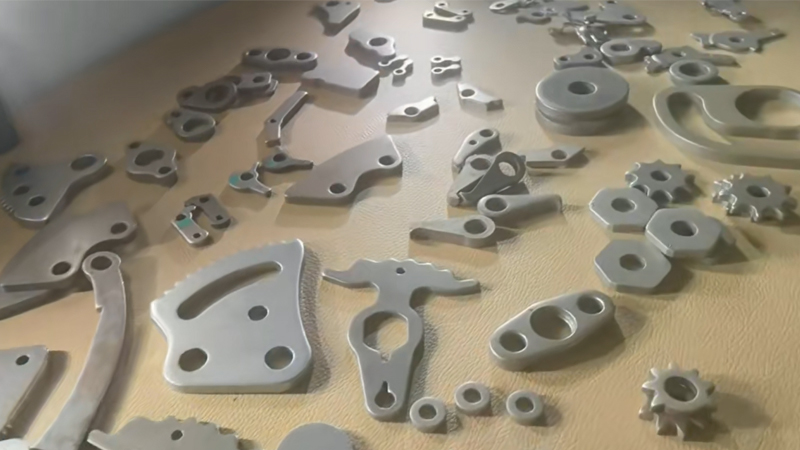
Agricultural machinery fine blanked components including sprockets, gear segments, and blade segments with clean wear-resistant edges
Material Engineering

Agricultural Materials & Processing Parameters

Agricultural machinery components are typically specified in medium-carbon steels, case-hardening steels, and boron-alloyed steels — materials chosen for their balance of cost, toughness, and wear resistance after heat treatment.

MaterialSpecificationThicknessTypical ApplicationFine Blanking Notes
C45EN 10083-2, medium carbon steel3–8 mmSprockets, gear segments, mounting bracketsGood fine blanking response in normalized condition; V-ring force at 30–40% of F1; post-blanking quench-and-temper to 45–50 HRC for wear surfaces
16MnCr5EN 10084, case-hardening steel2–6 mmTransmission gears, PTO components, coupler partsFine blanked in annealed condition; case-hardened after blanking to 58–62 HRC surface; die clearance must account for case-hardening growth (~0.05%)
28MnB5 (Boron steel)EN 10083-3, boron-alloyed4–10 mmHarvesting blade segments, wear plates, cutting edgesBlanked annealed (180–220 HB), then quenched and tempered to 48–52 HRC; excellent wear resistance after heat treatment
S355J2EN 10025-2, structural steel4–12 mmHitch components, structural brackets, frame reinforcementsLower strength than C45 but excellent weldability; fine blanked for edge quality on bolt patterns and mating surfaces
51CrV4EN 10089, spring steel2–5 mmSpring steel components, clutch segments, tensioner armsFine blanked in annealed condition; heat-treated to 45–50 HRC after blanking; edge quality critical for fatigue performance
Heat treatment interaction: Most agricultural components are fine blanked in a soft (annealed or normalized) condition and heat-treated afterward. The fine blanked edge responds uniformly to heat treatment because the work-hardened shear zone transforms predictably during austenitizing. However, case-hardening steels like 16MnCr5 experience dimensional growth of approximately 0.03–0.08% during carburizing — the die must be designed to compensate for this growth so the heat-treated part meets final dimensional tolerance. See our materials guide for heat-treatment-allowance data by material grade.
Typical Parts

Agricultural Components Produced by Fine Blanking

The part families below represent the core of agricultural fine blanking work — components where edge quality, dimensional precision, and wear resistance directly affect field performance and service life.

Part CategoryMaterial & ThicknessCritical Fine Blanking FeatureTypical Press
Chain sprockets (roller chain)C45, 4–8 mmTooth profile at IT8 tolerance with work-hardened tooth faces; eliminates gear hobbing for low-tooth-count sprocketsHF-320 or HF-500
Gear segments (partial gears)16MnCr5, 3–6 mmTooth geometry blanked clean for case-hardening; pivot bore concentric with pitch diameterHF-400 or HF-500
Harvesting blade segments28MnB5, 3–6 mmCutting edge produced with 100% shear surface; burr-free for self-sharpening during field useHF-320 or HF-400
Coupler & hitch componentsS355J2 or C45, 5–10 mmPin bore mating surfaces flat to 0.05 mm; eliminates secondary milling of hitch faceHF-500 or HF-650
PTO yoke & universal joint componentsC45, 4–8 mmBearing surfaces and cross-pin holes produced in single stroke; heat-treated after blankingHF-400 or HF-500
Gearbox mounting platesS355J2, 6–10 mmBolt pattern flatness under vibration load; perpendicular edges for gasket sealingHF-500 or HF-650
Clutch & tensioner segments51CrV4, 2–4 mmEdge quality critical for fatigue life under cyclic spring loading; flatness below 0.05 mmHF-200 or HF-320
Sprocket economics: A roller chain sprocket with 12–25 teeth, fine blanked from 6 mm C45, eliminates gear hobbing entirely — the tooth profile comes off the press at IT8 with a work-hardened tooth face that is subsequently quench-and-tempered. At volumes above 3,000 sprockets per month, the fine blanking die cost is recovered within 6–8 months compared to the hobbing operation it replaces. See our gear fine blanking solutions for detailed sprocket and gear processing.
Production Strategy

Seasonal Production Requirements & Flexible Scheduling

Agricultural equipment manufacturing has a distinctive demand pattern: production peaks before planting and harvest seasons, with quieter periods in between. This seasonality affects how fine blanking programs are planned and how press capacity is utilized.

Peak Season Capacity Planning

Agricultural OEMs typically require 60–70% of annual component volume delivered within two 3-month windows (pre-planting: February–April; pre-harvest: July–September). Fine blanking press capacity must be sized for peak demand, not average — a 500T press running 20,000 strokes/day during peak season has 40% idle capacity during off-season. Our HF-series presses support rapid die changeover (under 30 minutes with quick-clamp systems) to switch between part families during peak demand.

Off-Season Die Maintenance

The seasonal cycle creates a natural die maintenance window. During off-peak months (May–June, November–January), dies are reground, V-ring inserts replaced, and tooling rebuilt to peak condition for the next production surge. This maintenance rhythm is ideal for fine blanking dies, which benefit from preventive regrinding every 80,000–150,000 hits (depending on material and part complexity).

Inventory Buffer Strategy

Unlike automotive just-in-time delivery, agricultural supply chains typically carry 2–4 months of component inventory to bridge seasonal demand spikes. Fine blanked components — with their work-hardened, burr-free edges — store better than conventionally stamped parts, which are prone to edge corrosion at micro-crack sites. Properly oiled and packaged, fine blanked agricultural components can be stored for 6–12 months without surface degradation.

Multi-Part Die Strategy

For lower-volume part families (under 5,000 parts/month), a multi-cavity compound die producing 2–4 different part numbers per stroke maximizes press utilization during peak season. This approach requires careful nesting of part geometries within the strip layout but reduces the number of die changeovers — critical when production windows are compressed.

Wear & Cost Balance

Cost-Precision Balance: Matching Process to Part Requirements

Agricultural components occupy a unique position in the cost-precision spectrum: they require better edge quality and dimensional accuracy than construction steelwork, but not the aerospace-level tolerances or documentation burden. The key is matching the fine blanking process parameters — and the die investment — to the specific requirements of each part.

Requirement LevelTypical ToleranceEdge QualityFine Blanking InvestmentWhen to Choose
Wear-critical (cutting edges, tooth profiles)IT7–8 (±0.01–0.02 mm)100% shear, Ra < 0.4 μmFull fine blanking die with V-ring, carbide insertsHarvesting blades, sprocket teeth, gear segments
Load-bearing (pivot points, bearing surfaces)IT8–9 (±0.02–0.05 mm)90%+ shear, Ra < 0.8 μmStandard fine blanking die, D2 tool steelHitch components, PTO yokes, mounting brackets
Structural (non-functional edges, bolt patterns)IT10–11 (±0.05–0.1 mm)80%+ shear acceptableSimplified die, reduced V-ring forceFrame reinforcements, non-critical brackets
Non-critical (hidden, welded, or secondary operations)IT12+ (±0.1 mm+)Conventional stamping acceptableConventional stamping die — not fine blankingInternal frame members, weld prep blanks
Wear resistance insight: The work-hardened shear edge of a fine blanked C45 sprocket tooth (surface hardness ~220–250 HV vs. bulk 170–190 HV) provides 30–40% longer wear life than a conventionally stamped and hobbed tooth of the same material — before heat treatment. After quench-and-temper to 48 HRC, the fine blanked edge's uniform microstructure responds more consistently to heat treatment, producing a more uniform hardness profile across the tooth face. This translates to 15–20% longer field service life on sprockets subject to abrasive soil contact.
Program Scoping

Getting a Straight Answer on Fit

Send us your current part (fine blanked or conventionally stamped) and any failure history you have seen in the field. If fine blanking is a genuine upgrade for your application, we will tell you why specifically — and if it is not, we will tell you that too rather than push a quote that does not hold up.

The evaluation process:

  1. Part drawing and material spec review: We assess whether the geometry, material, and tolerance requirements justify fine blanking over conventional stamping.
  2. Failure history analysis: If you have field failure data (warranty returns, edge-related failures, wear life data), we map the failure modes to fine blanking's edge-quality advantages to quantify the expected improvement.
  3. Volume and seasonality assessment: We size the press, die, and production plan to match your seasonal demand pattern — not just average monthly volume.
  4. Cost comparison: We provide a transparent cost-per-part comparison between your current process and fine blanking, including tooling amortization, eliminated secondary operations, and expected warranty savings.

For sprocket and gear-specific processing, see our gear fine blanking solutions. For press specifications across the HF-series range, visit our products page. The underlying fine blanking technology is explained in our technology overview.

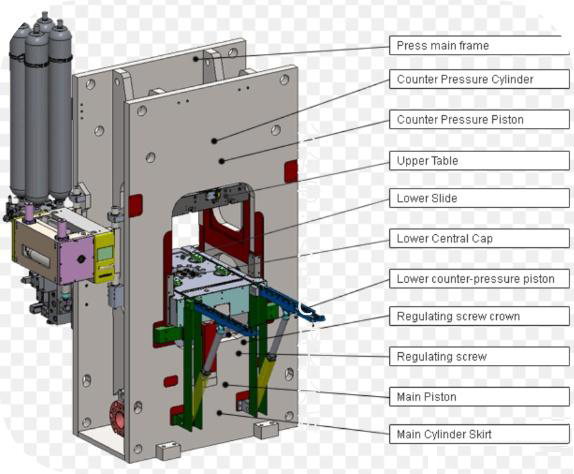
Fine blanking press configured for agricultural machinery component production with automated feed line

Have an Agricultural Machinery Fine Blanking Project?

Send us your part drawing, material specification, and field failure history. We will tell you whether fine blanking is the right process for your agricultural component — and if it is, scope the die, press, and production plan to match your seasonal demand and cost-precision balance.

💬