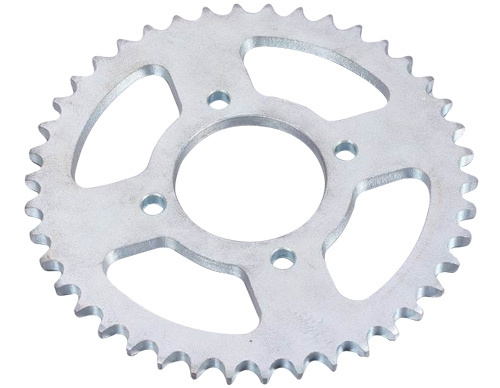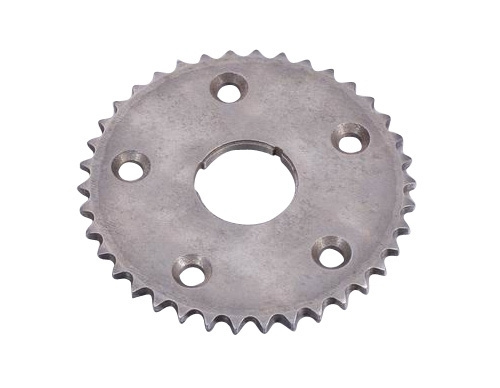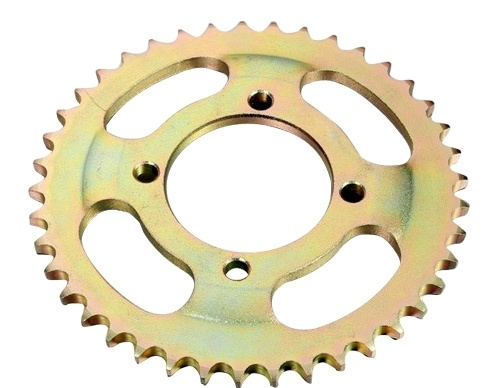
Precision power transmission components manufactured by fine blanking to net-shape tolerances, eliminating secondary machining while delivering plus or minus 0.05 mm tooth pitch accuracy and 90%+ clean shear zone for motorcycle, industrial, and agricultural chain drive systems.
A sprocket gear is a toothed wheel that engages with a chain to transmit rotary motion and torque between shafts in motorcycles, industrial conveyors, and agricultural machinery. Conventional sprocket manufacturing stamps a rough blank and then machines tooth profiles via broaching or hobbing-a multi-step process inflating cycle time, tooling cost, and work-in-progress inventory.
Fine blanking converts sprocket production into a single-stroke, net-shape operation. A V-ring clamps the sheet around the punch, applying compressive hydrostatic stress that suppresses fracture during shear. Counter-pressure supports the material from below, yielding tooth profiles accurate to ±0.05 mm on pitch diameter, surface finish Ra 1.6 um, and a clean shear zone exceeding 90% of material thickness. This quality permits direct assembly into Honda, Yamaha, and Kawasaki drive systems without secondary broaching or gear shaving.

Conventional stamping produces fracture zones extending 30-40% through material thickness, requiring broaching to achieve functional teeth. Fine blanking delivers a clean shear zone exceeding 90% with fracture under 10%, meaning the as-blanked tooth is functionally complete. Pitch accuracy of ±0.05 mm on HS-FINEB presses compares to ±0.15 mm for precision stamping. This eliminates the broaching station, cutting tooling investment 40-60% and reducing cycle time from 45 seconds to 1.2 seconds per part on a HF-320 running at 40 strokes per minute.
The sheared tooth flank exhibits a burnished surface at Ra 1.6-3.2 um, comparable to machining. Absence of torn edges and burrs means smooth chain roller engagement, reducing noise and wear. On motorcycle rear sprockets for 420-pitch chains, this surface quality extends chain life 15-20% versus stamped sprockets requiring deburring. Face flatness is held to 0.05 mm per 100 mm diameter, ensuring uniform load distribution across engaged teeth.
Because fine blanking produces net-shape tooth profiles, sprockets proceed directly to heat treatment and surface finishing without intermediate machining. For mass-market motorcycle sprockets, eliminating broaching reduces piece cost $0.80-1.20 per part at volumes above 500,000 units annually. For industrial conveyor sprockets, fine blanking produces hub bore, keyway, and tooth profile in a single die station, removing three secondary operations.
Fine blanking permits narrower web widths between teeth (0.8x material thickness versus 1.5x for stamping) because V-ring clamping prevents material pull-in. This increases yield 8-12% on multi-tooth layouts. For a 40-tooth sprocket from 3.0 mm coil, savings are 15 grams per part, or 9 metric tons of steel annually at 600,000 parts, worth $7,200-9,000 at current S355MC prices.

Steel grade selection depends on load, wear resistance, and heat treatment. HS-FINEB presses handle sprocket materials from 1.5 mm to 8.0 mm thickness.
16MnCr5 (1.7131) and 20CrMnTi: Low-alloy case-hardening steels standard for motorcycle and automotive sprockets requiring 58-62 HRC surface hardness with tough 30-35 HRC core. 16MnCr5 offers excellent fine blanking formability from its moderate carbon (0.14-0.19%) and fine grain. After blanking, parts carburize at 920C for 4-6 hours, achieving 0.6-1.0 mm case depth, then oil-quench and temper.
SCM415 (JIS G4105): Chromium-molybdenum case-hardening steel with superior hardenability for heavy-duty industrial and agricultural sprockets under impact loading. Fine blanking at 4-6 mm requires 280-400 tons, suited to the HF-500.
C45 (1.0503): Medium-carbon steel for general-purpose sprockets in light-load conveyors where induction hardening suffices. The most economical non-carburized option. See our materials guide for property tables.

Pitch accuracy is the most critical dimension for chain engagement and wear life. On HS-FINEB presses with compound dies, ±0.05 mm pitch is consistent on sprockets up to 200 mm pitch diameter, versus ±0.03 mm for hobbed and ±0.15 mm for stamped. For ISO 606 roller chains (04B through 32B), this ensures proper chain wrap and load sharing across 120 degrees of engagement.
The ideal tooth has a fully burnished flank from tip to root. Fine blanking achieves 90-100% shear zone on thicknesses up to 6 mm in carbon and low-alloy steels. On 6-8 mm sections, shear zone exceeds 80% with optimized force parameters. Any fracture zone is confined to the bottom 10-20% below the pitch line, not affecting functional chain roller contact.
Counter-pressure ejection maintains flatness of 0.02-0.05 mm across diameters up to 250 mm per ISO 1101. Parallelism between faces is held to 0.03 mm per 100 mm. This eliminates face-grinding required on stamped sprockets where springback produces 0.15-0.30 mm variation.
The motorcycle industry is the largest consumer of fine blanked sprockets. Front drive sprockets (12-16 teeth) and rear driven sprockets (36-52 teeth) for 420, 428, 520, and 530 pitch chains exceed 50 million units annually. Honda, Yamaha, Kawasaki, and Suzuki specify fine blanked sprockets for OEM fitment on 125cc through 1000cc models, requiring ±0.05 mm pitch accuracy and 30,000 km chain life. Aftermarket brands JT Sprockets and Sunstar source fine blanked blanks from Asian manufacturers on HS-FINEB-class presses at 35-45 strokes per minute.
Conveyor systems, packaging lines, and material handling equipment use fine blanked sprockets in ANSI 35, 40, 50, and 60 roller chain sizes. Flatness and bore accuracy reduce bearing misalignment and extend reducer gearbox life. In automated warehouses for Amazon, DHL, and Alibaba, fine blanked sprockets with consistent wear profiles enable accurate replacement interval prediction, minimizing unplanned downtime.
Combine harvesters, tractors, and irrigation systems operate in abrasive environments. Fine blanked sprockets for agricultural chain (CA550, CA555, CA620) use 16MnCr5 or SCM415 with 0.8-1.2 mm carburized cases. Uniform case depth on fine blanked surfaces improves wear resistance 20-25% over stamped alternatives in field testing. John Deere and Claas specify fine blanked sprockets for combine header drives.
Engine timing systems using silent chains require sprockets with tight pitch control for 300,000 km valve timing accuracy. Fine blanked timing sprockets from 20CrMnTi achieve ±0.03 mm pitch variation and Ra 1.6 um. BMW, Volkswagen, and Toyota use them in 1.0L-2.0L gasoline engines where space constraints prohibit larger machined sprockets.
Press selection depends on material thickness, sprocket diameter, annual volume, and die layout. HS-FINEB offers presses from 200 to 1200 tons, with the HF-320 and HF-500 most common for sprockets.
Optimal for motorcycle and light industrial sprockets up to 200 mm pitch diameter from 1.5-4.0 mm material. With 320-ton blanking force, 80-ton V-ring, and 40-ton counter-pressure, the HF-320 achieves clean shear on 16MnCr5 and C45 at 35-45 strokes per minute. The 700x550 mm bolster accommodates 4-up or 6-up layouts, producing 8,000-12,000 parts per shift. Capital cost is approximately $280,000 FOB Shanghai.
For heavy-duty industrial and agricultural sprockets from 4.0-8.0 mm, including large-diameter conveyor sprockets up to 400 mm. The 500-ton force shears SCM415 and 42CrMo4 at full thickness. The 900x650 mm bolster accommodates progressive dies blanking profile, hub bore, and keyway in one feed. At 25-35 strokes per minute, output is 5,000-7,000 parts per shift. Investment is approximately $420,000 FOB Shanghai.
Both presses feature closed-loop hydraulic control, programmable stroke profiles, and automatic lubrication. See our products page for full specifications.
HS-FINEB engineers will analyze your sprocket specifications - pitch, teeth count, material, and annual volume - and recommend the optimal press model, die design, and heat treatment sequence. Contact us for a sample production run and dimensional report.