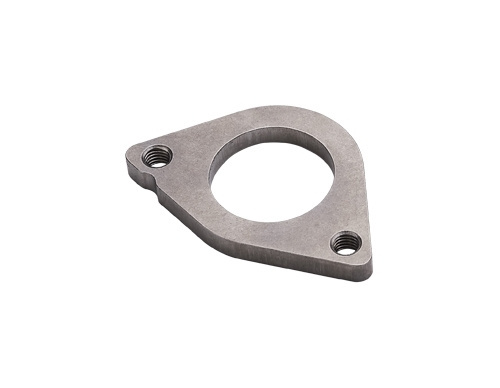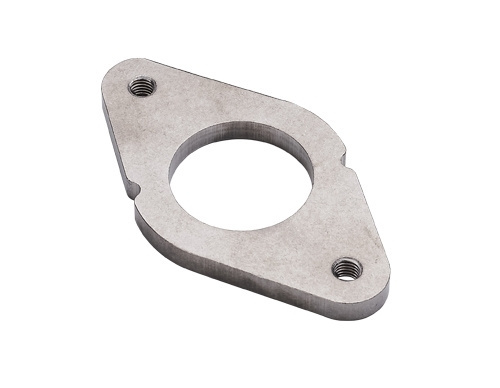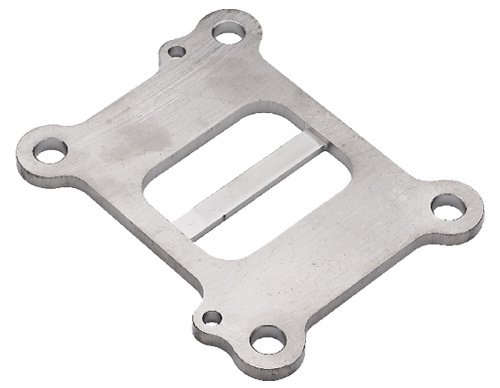
High-strength structural fasteners manufactured by fine blanking with plus or minus 0.03 mm hole positional accuracy, 0.02-0.05 mm flatness, and burr-free edges. Materials: S355MC, DC04, SPCC from 2 to 8 mm thickness for automotive, industrial, and equipment mounting applications.
Mounting brackets are structural fasteners that secure components to frames, chassis, or housings in automotive, industrial machinery, and equipment assembly. Traditional stamped brackets suffer from burr formation, edge rollover, and hole distortion, requiring secondary deburring, flattening, and reaming to achieve functional tolerances. Fine blanking eliminates these problems by producing brackets with clean sheared edges, flat surfaces, and precisely located holes in a single press stroke.
The fine blanking process clamps the sheet with a V-ring around the part perimeter, applying compressive stress that prevents fracture and material flow during punching. Counter-pressure from the ejector supports the bracket during shear, maintaining flatness within 0.05 mm without secondary flattening. Hole positions are held to ±0.03 mm because the compound die pierces all holes simultaneously with the outer profile, eliminating the cumulative tolerance error of progressive stamping where each station adds positional variation.

Mounting brackets rely on precise hole patterns for bolt alignment with mating components. Conventional progressive stamping accumulates positional error across die stations, typically ±0.15-0.20 mm. Fine blanking using compound dies pierces all holes in the same stroke as the profile, holding positions to ±0.03 mm. For automotive engine mount brackets with four M8 bolt holes on a 60 mm pattern, this accuracy eliminates the reaming operation and reduces assembly time at the OEM plant.
Bracket flatness is critical for proper load transfer and gasket sealing. Fine blanking with counter-pressure maintains flatness of 0.02-0.05 mm per 100 mm, compared to 0.15-0.30 mm for stamped brackets that require press flattening. The sheared edge surface at Ra 1.6-3.2 um is suitable for direct painting or zinc plating without surface preparation, reducing processing cost $0.15-0.25 per part.
Fine blanked holes have clean, burnished walls that accept thread-forming screws and self-tapping fasteners without cracking or tear-out. For brackets in electrical equipment enclosures using M4-M6 thread-forming screws, the hole quality eliminates tapping operations. The material around the hole remains work-hardened from the punching process, providing 15-20% higher pull-out strength compared to drilled holes in the same material.
HS-FINEB presses produce brackets from 2.0 mm to 8.0 mm thickness, covering the full range from light-duty equipment mounts to heavy structural brackets. At 2-3 mm, the process produces clean edges on DC04 deep-drawing steel for automotive body brackets. At 6-8 mm, S355MC structural steel brackets for engine mounts and chassis components achieve 90%+ shear zone with proper V-ring and counter-pressure settings on the HF-500 press.

S355MC (EN 10149-2): A high-strength low-alloy structural steel with 355 MPa minimum yield strength, S355MC is the primary material for automotive chassis and engine mount brackets. Its fine-grain microstructure and controlled carbon content (0.12% max) provide excellent fine blanking formability while delivering the strength needed for structural fastener applications. After blanking, brackets may be e-coated or zinc-nickel plated for corrosion protection to ISO 9227 salt spray requirements of 480-720 hours.
DC04 (EN 10130): A deep-drawing quality cold-rolled steel with low carbon (0.08% max) and high elongation (min 38%), DC04 is used for thinner brackets (2-4 mm) in non-structural applications such as equipment enclosures, interior trim mounts, and electrical bracketry. Its excellent formability permits complex bracket geometries with bends, flanges, and embossed reinforcements in progressive fine blanking layouts.
SPCC (JIS G3141): Commercial quality cold-rolled steel for general-purpose brackets in appliances and light machinery. See our materials guide for detailed mechanical properties.

Compound fine blanking dies pierce all holes simultaneously with the outer profile, holding hole-to-hole spacing to ±0.03 mm. This is five times more accurate than progressive stamping (±0.15 mm) where each station adds positional error. For a four-hole engine mount bracket on a 80x60 mm pattern, this means all four M8 bolts engage without binding, eliminating assembly force issues at the OEM plant.
Fine blanked bracket edges exhibit 90-100% shear zone with burnished surface at Ra 1.6 um. Burr height is controlled to under 0.05 mm, compared to 0.3-0.5 mm on stamped brackets. This eliminates the deburring operation, which typically adds $0.10-0.20 per part and can damage the bracket surface. The die design controls burr formation through punch-die clearance of 0.5% of material thickness.
Counter-pressure during ejection maintains bracket flatness to 0.02-0.05 mm per 100 mm, measured per ISO 1101. Perpendicularity of hole axes to the bracket face is held to 0.05 mm per 50 mm, ensuring proper bolt engagement without cross-threading. These tolerances meet automotive PPAP requirements; see our PPAP guide for documentation details.
Engine mount brackets, suspension control arm brackets, and chassis mounting points require high strength with precise hole patterns. Fine blanked brackets from S355MC at 4-6 mm thickness meet VW TL 945 and GM GMW3032 standards for structural fasteners. BMW, Daimler, and Toyota use fine blanked engine mount brackets on 2.0L-3.0L engines where four M10 bolts must align within ±0.05 mm to the subframe.
Equipment mounting brackets for motors, pumps, and gearboxes require flatness for proper alignment and vibration damping. Fine blanked brackets from C45 at 5-8 mm are used in Bosch Rexroth hydraulic pump mounts, SEW-Eurodrive gearbox brackets, and Siemens motor foot mounts. The flat surface and precise holes eliminate shimming during installation, reducing assembly time by 30%.
Mounting brackets for electrical enclosures, control panels, and switchgear use DC04 or SPCC at 2-3 mm. Clean holes accept self-clinching fasteners (PEM CLS series) without distortion. Rittal and Schneider Electric specify fine blanked brackets for modular enclosure systems where brackets must interchange without adjustment.
Seat belt anchor brackets and airbag mounting brackets are safety-critical components requiring zero-defect manufacturing. Fine blanking produces these from 22MnB5 boron steel at 3-4 mm, achieving the hole accuracy and edge quality mandated by ECE R14 and FMVSS 210 standards. The process traceability of fine blanking presses supports automotive PPAP Level 3 documentation.
Ideal for automotive and equipment brackets from 2-5 mm material. The 320-ton blanking force handles S355MC and DC04 at 40-50 strokes per minute. The 700x550 mm bolster accommodates 6-up to 10-up layouts for high-volume bracket production, yielding 10,000-15,000 parts per shift. Price: approximately $280,000 FOB Shanghai.
For heavy structural brackets from 5-8 mm, including engine mounts and safety-critical components. The 500-ton force shears S355MC and 22MnB5 at full thickness with 90%+ shear zone. The 900x650 mm bolster supports large-die layouts for chassis brackets up to 200 mm length. Output: 5,000-7,000 parts per shift at 25-35 strokes per minute. Price: approximately $420,000 FOB Shanghai.
See our products page for full press specifications and tonnage selection guide.
HS-FINEB engineers will evaluate your bracket specifications - material, thickness, hole pattern, and annual volume - and recommend the optimal press model and die design. Contact us for a dimensional report on sample parts.