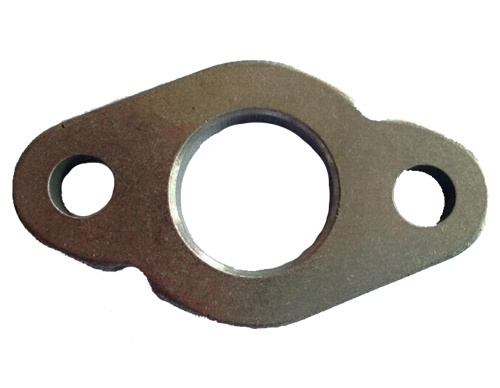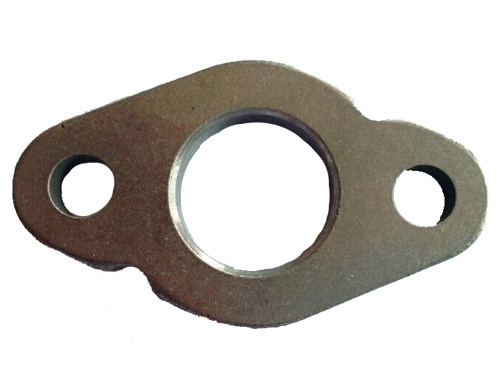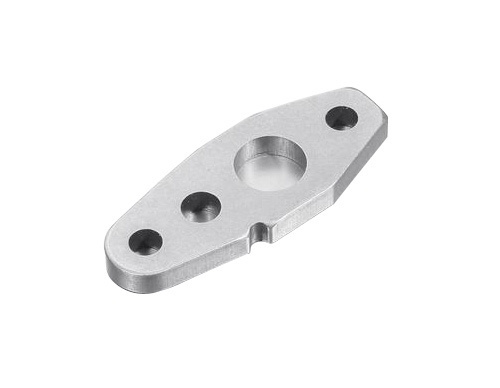
Precision sealing and connection components manufactured by fine blanking with 0.02 mm flatness for gasket seating, plus or minus 0.03 mm hole pattern accuracy, and Ra 1.6 um surface finish. Materials: SS304 stainless, carbon steel with zinc coating, aluminum for automotive exhaust, hydraulic systems, and HVAC.
Flange plates are flat sealing and connection components used in fluid systems, exhaust systems, and piping to join pipes, hoses, and ducts. A flange plate must provide a flat gasket seating surface, accurately positioned bolt holes, and a clean edge to ensure leak-free sealing under pressure. Conventional stamped flanges suffer from edge waviness, hole burrs, and surface irregularities that compromise gasket sealing, requiring secondary machining to achieve functional flatness.
Fine blanking produces flange plates with surface flatness of 0.02 mm per 100 mm, hole positions accurate to ±0.03 mm, and burnished edge surfaces at Ra 1.6 um. The V-ring clamping and counter-pressure ejection eliminate the springback and distortion that plague stamped flanges. For oval and elongated flange geometries used in automotive exhaust and hydraulic systems, fine blanking produces the complete profile-including bolt holes, center bore, and outer contour-in a single die station, eliminating the multi-step machining of conventional production.

Flange plate flatness is the most critical parameter for leak-free sealing. Fine blanking with counter-pressure maintains flatness of 0.02 mm per 100 mm, compared to 0.10-0.20 mm for stamped flanges. For automotive exhaust flanges using graphite gaskets, this flatness eliminates the surface grinding operation ($0.30-0.50 per part) and ensures uniform gasket compression. The flatness meets ASME B16.5 requirements for 150# and 300# pressure class flanges.
Flange bolt holes must align with mating flanges within ±0.10 mm for proper bolt engagement. Fine blanking with compound dies holds hole positions to ±0.03 mm by piercing all holes simultaneously with the outer profile. For a 4-bolt oval flange on a 90 mm bolt circle, this means all bolts engage without binding, reducing assembly time and preventing cross-threading in high-volume automotive production.
The gasket seating surface of a fine blanked flange exhibits Ra 1.6 um, within the 1.6-6.3 um range recommended by ASME B16.21 for compressed gaskets. The smooth, burnished surface provides uniform gasket contact without the machining marks and surface tears of stamped flanges. This surface quality reduces gasket leakage rates by 40-60% in hydraulic system testing.
The 90%+ shear zone on fine blanked flange edges provides a smooth, work-hardened surface that accepts zinc plating and electrophoretic coating uniformly. Stamped flange edges with fracture zones and burrs create coating thin spots that initiate corrosion. Fine blanked automotive exhaust flanges with zinc-nickel plating achieve 720 hours salt spray per ISO 9227, compared to 480 hours for stamped alternatives.

Stainless Steel 304 (AISI 304 / SUS304): The primary material for flange plates in corrosive fluid systems, food processing, and pharmaceutical equipment. SS304 provides excellent corrosion resistance, good formability for fine blanking at 2-6 mm thickness, and does not require additional surface coating. The fine blanked surface at Ra 1.6 um meets 3A sanitary standards for food-grade flange connections. Fine blanking SS304 requires 30-40% higher force than carbon steel, requiring the HF-500 for flanges over 4 mm thick. See our stainless steel fine blanking guide for details.
Carbon Steel with Zinc Coating (SPCC + Zn): For automotive exhaust and HVAC applications where cost is critical. SPCC at 3-5 mm is fine blanked, then zinc-plated or zinc-nickel plated to ISO 2081. The fine blanked edge accepts plating uniformly, achieving 480-720 hours salt spray resistance. This is the standard material for catalytic converter inlet and outlet flanges on Volkswagen, GM, and Hyundai vehicles.
Aluminum 5052-H32: For lightweight flange plates in HVAC ductwork and aerospace fluid systems. See our materials guide for the full material list.

Sealing flatness for gasket applications requires 0.02 mm/m or better. Fine blanking achieves 0.02 mm per 100 mm, measured per ISO 1101 with a CMM. For exhaust flanges at 400-600C operating temperature, the fine blanked surface maintains dimensional stability because the work-hardened surface resists thermal creep better than machined surfaces.
Bolt circle diameter tolerance is ±0.05 mm, with individual hole positions at ±0.03 mm. The fine blanking die pierces all bolt holes and the center bore in one stroke, eliminating cumulative tolerance. Hole diameter tolerance is H13 (±0.01 mm for 8 mm holes), providing proper clearance for M8 bolts per ISO 273.
The gasket seating surface is held to Ra 1.6 um, with no surface defects deeper than 0.05 mm. The sheared edge is burnished to Ra 1.6 um on 90%+ of thickness. These parameters meet ASME B16.21, DIN 2690, and JIS B2204 flange standards for raised-face and full-face gasket seating.
Catalytic converter inlet and outlet flanges, exhaust manifold flanges, and EGR cooler flanges require flatness for high-temperature gasket sealing. Fine blanked flanges from SPCC at 4-5 mm with zinc-nickel plating serve Volkswagen, GM, Hyundai, and Ford vehicles. The flatness eliminates exhaust leaks that trigger OBD-II check engine codes, and the precise bolt holes speed assembly line installation.
Hydraulic pump and valve flanges from SS304 at 4-6 mm handle 200-350 bar pressure. The fine blanked flatness ensures gasket compression uniformity, eliminating leakage in Bosch Rexroth and Parker Hannifin hydraulic manifolds. Hole accuracy permits direct bolt-up to SAE standard ports without port alignment adjustment.
Flange plates for duct connections, damper actuators, and fan housing mounts use aluminum 5052 or galvanized steel at 2-3 mm. Fine blanked flanges provide flat mating surfaces for gasket or tape sealing. Carrier, Trane, and Daikin specify fine blanked flanges for modular HVAC units where field assembly must be tool-less and leak-free.
Sanitary flange connections in food processing use SS304 fine blanked flanges with Ra 1.6 um surface finish per 3A standards. The smooth, defect-free surface prevents bacterial contamination and permits CIP (clean-in-place) cleaning. Alfa Laval and SPX Flow specify fine blanked sanitary flanges for dairy and beverage processing lines.
Ideal for automotive exhaust flanges and HVAC flanges from 2-4 mm carbon steel and aluminum. At 35-45 strokes per minute with 6-up layouts, the HF-320 produces 15,000-20,000 flanges per shift. Price: approximately $280,000 FOB Shanghai. See our products page.
For stainless steel flanges from 4-6 mm and large-diameter industrial flanges. The 500-ton force handles SS304 and 316 at full thickness with 90%+ shear zone. The 900x650 mm bolster accommodates large flange layouts up to 250 mm diameter. Output: 8,000-10,000 parts per shift at 25-35 strokes per minute. Price: approximately $420,000 FOB Shanghai.
HS-FINEB engineers will review your flange specifications - size, pressure class, material, and gasket type - and recommend the optimal press model and die design. Contact us for sample flange plates with flatness and dimensional report.