💬 WhatsApp Chat

Fine Blanked Chain Links

Industrial conveyor and drive chain components manufactured by fine blanking with plus or minus 0.02 mm pitch accuracy, H7 hole tolerance, and 90%+ shear zone. Materials: 40Cr, 45# steel for roller chains, conveyor systems, and lifting equipment with 30-40% improved fatigue life.

Product Overview

What Are Fine Blanked Chain Links?

Chain link plates are the flat side plates that form the backbone of roller chains, conveyor chains, and lifting chains. Each link plate contains two precision holes for pin and bushing press-fit, and the accuracy of hole-to-hole spacing directly determines chain pitch, articulation smoothness, and fatigue life. Conventional chain link manufacturing uses stamping followed by coining and hole sizing, a three-step process with cumulative tolerance errors.

Fine blanking produces chain link plates in a single stroke with all holes pierced simultaneously with the outer profile. The V-ring clamping prevents hole distortion during punching, while counter-pressure maintains plate flatness within 0.02 mm. The sheared edge at Ra 1.6 um provides a smooth surface that reduces stress concentration at the plate edge, extending fatigue life by 30-40% compared to stamped plates with torn edges.

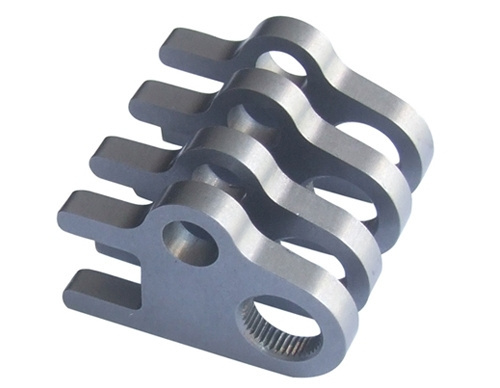
Fine blanked chain link plates with precise holes for pin and bushing press fit
Manufacturing Excellence

Advantages of Fine Blanking for Chain Links

Hole-to-Hole Spacing Accuracy

Chain pitch accuracy depends on the distance between pin and bushing holes in each link plate. Fine blanking with compound dies holds this spacing to ±0.02 mm, compared to ±0.10 mm for stamped plates. For a 5/8-inch pitch roller chain (ANSI 50), this means the actual pitch varies by less than 0.03 mm across 100 links, ensuring smooth sprocket engagement and uniform load distribution.

Hole Quality for Press-Fit

Pin and bushing holes in chain links require a press-fit tolerance of H7-p6, typically 0.02-0.04 mm interference. Fine blanked holes have burnished walls with 90%+ shear zone, providing uniform interference fit without the hourglass distortion common in stamped holes. This eliminates the hole-sizing (coin straightening) operation and ensures consistent press-in force of 2-4 kN for 5 mm diameter pins.

Edge Quality and Fatigue Life

The sheared edge of fine blanked link plates is free of tears, micro-cracks, and burrs that serve as fatigue initiation sites. Testing per ISO 15654 shows fine blanked link plates achieve 2-3 million cycles at 30% of breaking load, compared to 1.5-2 million for stamped plates. The 30-40% fatigue life improvement is critical for conveyor chains in continuous-duty applications.

Plate Flatness

Counter-pressure during fine blanking maintains link plate flatness to 0.02 mm, critical for proper chain tracking and sprocket engagement. Stamped plates typically exhibit 0.10-0.20 mm flatness variation from punching springback, requiring a flattening operation. Fine blanked plates proceed directly to pin insertion without flattening, reducing process steps and cost.

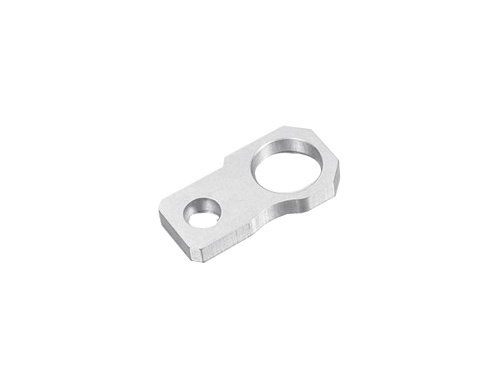
Connector link plate with clean sheared edges and precise hole positioning from fine blanking
Materials Engineering

Material Selection for Fine Blanked Chain Links

40Cr (DIN 41Cr4): A medium-carbon chromium alloy steel with 0.37-0.44% carbon, 40Cr is the standard for roller chain link plates requiring high tensile strength (980+ MPa after quenching and tempering) and good wear resistance. The chromium addition improves hardenability, allowing through-hardening of plates up to 5 mm thickness. Fine blanking 40Cr at 3-4 mm requires 200-320 tons, suited to the HF-320. After blanking, plates are quenched at 850C in oil and tempered at 520C to achieve 38-42 HRC.

45# Steel (AISI 1045): A medium-carbon steel with 0.42-0.50% carbon, widely used for conveyor chain links and general-purpose drive chain plates. After quenching and tempering, 45# achieves 55-60 HRC surface hardness with a tough core. It is the most economical choice for ANSI 40-60 chain sizes in material handling and packaging machinery. See carbon steel fine blanking for detailed processing parameters.

SUS440C stainless: For corrosion-resistant chains in food processing and pharmaceutical equipment. See our materials guide for more options.

Precision Specifications

Tolerances and Quality Standards for Chain Links

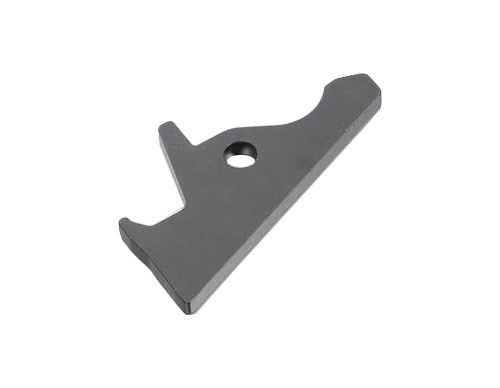
Hexagonal connector link plate showing precise geometry and clean edges from fine blanking process

Pitch Accuracy

Chain pitch-the distance between pin centers-determines sprocket engagement quality. Fine blanked link plates achieve pitch accuracy of ±0.02 mm on standard pitches from 1/4 inch (6.35 mm) to 1 inch (25.4 mm). For ANSI 40 roller chain (1/2 inch pitch), the actual pitch variation across 100 links is under 0.03 mm, meeting ANSI B29.1 Class A precision requirements.

Hole Diameter and Tolerance

Pin and bushing holes are held to H7 tolerance (±0.005 mm for 5 mm holes) using fine blanking dies with tungsten carbide punches. The burnished hole wall provides a uniform bearing surface for press-fit pins, with pull-out force of 3.5-5.0 kN for 5 mm pins in 40Cr plates, exceeding ANSI B29.1 requirements.

Surface Finish and Edge Quality

Link plate edges exhibit 90-100% shear zone at Ra 1.6 um, free of burrs and tears. Plate surfaces are flat to 0.02 mm per 25 mm. This quality eliminates shot peening for fatigue improvement in standard-duty chains and provides a uniform surface for nickel plating or zinc plating in corrosion-resistant applications.

Industry Applications

Applications of Fine Blanked Chain Links

📥

Conveyor Systems

Fine blanked chain links drive conveyor systems in food processing, packaging, and logistics. ANSI 40 and 50 conveyor chains with fine blanked plates operate in Amazon fulfillment centers, Nestle packaging lines, and DHL sorting conveyors at 24/7 duty cycles. The 30-40% fatigue life improvement of fine blanked plates extends chain replacement intervals from 12 to 18 months, reducing maintenance cost.

🚲

Motorcycle and Bicycle Chains

Roller chains for motorcycles (420, 428, 520, 530 pitch) and bicycles (1/2x3/32, 1/2x1/8) use fine blanked link plates for pitch accuracy and fatigue strength. DID, Tsubaki, and KMC source fine blanked plates from manufacturers running HS-FINEB-class presses. The ±0.02 mm pitch accuracy ensures smooth sprocket engagement at 10,000+ RPM on 600cc sport motorcycles.

🚨

Lifting and Hoisting Equipment

Leaf chains for forklift masts (BL series) and lifting chains for cranes use fine blanked link plates from 40Cr at 4-6 mm thickness. The 2-3 million cycle fatigue life meets ISO 4347 safety requirements for lifting equipment. Komatsu and Toyota Material Handling specify fine blanked leaf chain plates for 2-5 ton forklifts.

Industrial Drive Chains

Power transmission chains in ANSI 60-80 sizes drive pumps, compressors, and machine tools. Fine blanked plates from 45# steel at 5-8 mm provide the strength and pitch accuracy for 15-50 kW drive applications. Siemens and ABB use fine blanked chain drives in industrial motor-pump couplings.

Press Recommendations

HS-FINEB Press Models for Chain Link Production

HF-320 (320 Tons)

Optimal for roller chain link plates from 2-4 mm material (ANSI 40-50). At 40-50 strokes per minute with 10-up layouts, the HF-320 produces 20,000-25,000 plates per shift. The 320-ton force handles 40Cr and 45# at full thickness with 90%+ shear zone. Price: approximately $280,000 FOB Shanghai.

HF-500 (500 Tons)

For heavy-duty chain links from 5-8 mm (ANSI 60-80 and leaf chains). The 500-ton force shears 40Cr and 42CrMo4 at full thickness. The 900x650 mm bolster accommodates 6-up layouts for large plates. Output: 12,000-15,000 plates per shift at 30-40 strokes per minute. Price: approximately $420,000 FOB Shanghai. See all models.

Need Fine Blanked Chain Links for Your Production?

HS-FINEB engineers will analyze your chain specifications - pitch, plate thickness, material, and annual volume - and recommend the optimal press model, die layout, and heat treatment. Contact us for sample link plates with dimensional report.

💬