From initial design consultation through manufacturing, production support, preventive maintenance, resharpening, and planned retirement. HS-FINEB provides full-lifecycle die management that maximizes tool life, minimizes downtime, and optimizes cost per part across the entire production program.
A fine blanking die is a precision capital asset with a productive life of 5 to 15 years depending on material hardness, part complexity, and production volume. HS-FINEB's die lifecycle management program provides structured support at every phase, from initial DfFB consultation through final retirement and material recovery.
DfFB consulting, simulation, prototype dies
HS-FINEB die production, quality control
First article inspection, parameter optimization
Spare inserts, quick-change, on-site support
Preventive schedules, condition monitoring
Economic analysis, grinding, reassembly
Criteria assessment, recovery, data archiving
The total cost of ownership for a fine blanking die includes initial acquisition (15-30% of lifetime cost), maintenance and resharpening (40-50%), downtime from die stoppages (10-20%), and end-of-life recovery value (-5-10%). Effective lifecycle management shifts cost from reactive breakdowns to planned maintenance, reducing total cost per part by 15-25%.
The design phase determines 70-80% of the die's lifetime performance. Decisions made during design ~material selection, insert geometry, V-ring placement, and cooling channel layout have permanent consequences for tool life and part quality. HS-FINEB provides Design for Fine Blanking (DfFB) consulting to optimize part design, die design, and process parameters before manufacturing begins.
Our design services include finite element simulation using Abaqus and Deform software. We model material flow, stress distribution, and temperature evolution to predict edge quality metrics for different clearance values, V-ring geometries, and force ratios. For complex parts with tight radii, simulation is essential for predicting corner cracking risk.
HS-FINEB also manufactures prototype dies from pre-hardened tool steel (1.2379/D2 at 58-60 HRC) for new part development. Prototype dies cost 30-50% of a production die and produce 1,000-5,000 sample parts for dimensional validation over a 4-8 week phase.

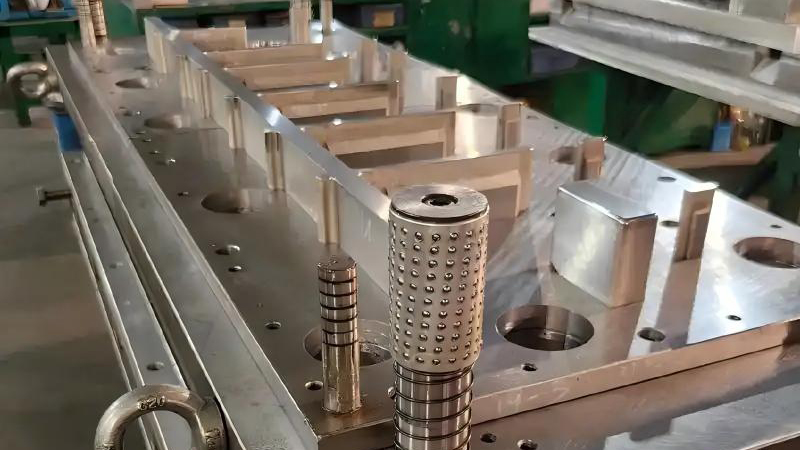
HS-FINEB manufactures fine blanking dies in our Jingzhou facility using CNC machining, wire EDM, surface grinding, and jig grinding. Die manufacturing requires 8-16 weeks depending on complexity, coordinated with press delivery timelines.
Die inserts are manufactured from powder metallurgy high-speed steel (ASP 2023, ASP 2053) or cold-work tool steel (1.2379/D2, 1.2436) heat-treated to 60-64 HRC. Die sets and holders use pre-hardened alloy steel (1.2312/P20 at 28-32 HRC) for dimensional stability.
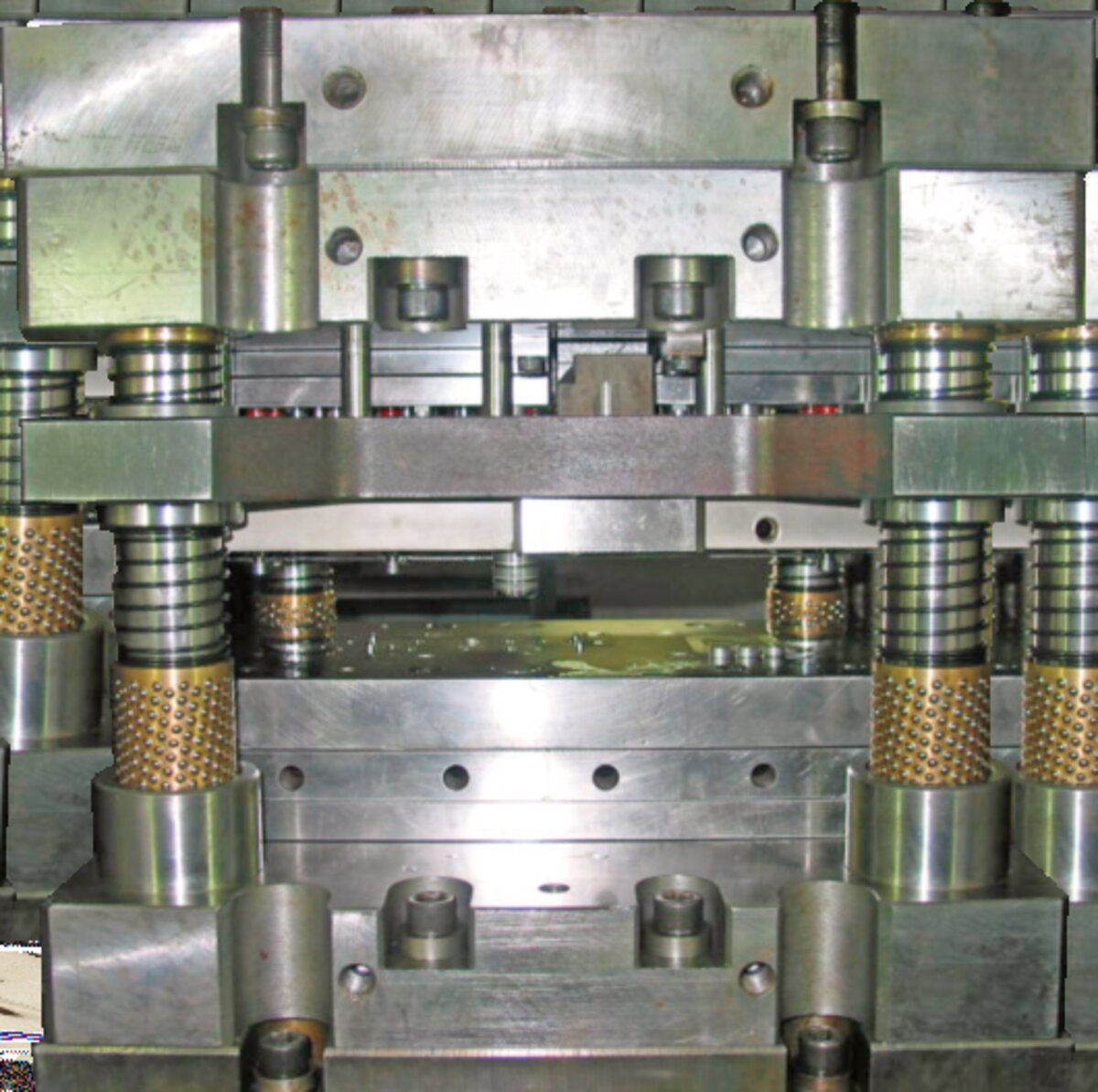
Punch-to-die clearance is achieved by grinding punch and die inserts separately, then lapping mating surfaces to 0.5-1.0% clearance per side. Final die assembly is verified on a CMM with 0.001 mm resolution.
Each die undergoes dimensional inspection at three stages: after rough machining, after heat treatment, and after final grinding. Hardness is verified on each insert using Rockwell C testing. The assembled die is run on our in-house test press to verify force requirements, ejection behavior, and initial edge quality before shipment.
Dies are shipped in custom wooden crates with humidity control and shock protection. Each die is delivered with a complete documentation package: assembly drawings, part drawings, material certificates, heat treatment records, maintenance schedule, recommended spare parts list, and process parameter recommendation sheet.
HS-FINEB maintains a library of proven die designs for common part families (gear blanks, lock cylinders, chain links) that can be adapted to customer-specific dimensions, reducing design time by 30-50%. For new applications, our design team works from customer CAD files (STEP, IGES, SolidWorks/Catia) to develop optimized die geometry.
After die installation, the tryout phase begins with first article inspection (FAI). HS-FINEB field engineers supervise initial press runs, measuring critical dimensions on the first 50-100 parts. FAI includes dimensional measurement, edge quality assessment, burr height measurement, and flatness verification.
Process parameters (clearance, V-ring force, counter-pressure, punch speed, lubrication) are adjusted during tryout over 2-5 days, running 500-2,000 parts. The optimal parameter set is documented in the die passport. HS-FINEB engineers also verify press-die compatibility, completing any required press modifications before production handover.

Once the die is in production, HS-FINEB provides ongoing support. The production phase accounts for 60-70% of the die's total lifetime, making support during this phase critical to cost per part.
HS-FINEB recommends maintaining a spare insert set (punch, die, V-ring plate) for each production die. Spare inserts allow worn components to be replaced during shift changeover rather than sending the die out for resharpening, reducing die-related downtime by 60-80%.
For customers running multiple dies on shared presses, HS-FINEB supplies quick-change die clamping systems that reduce changeover from 2-4 hours to 15-30 minutes using hydraulic clamping rails and standardized die shoes.
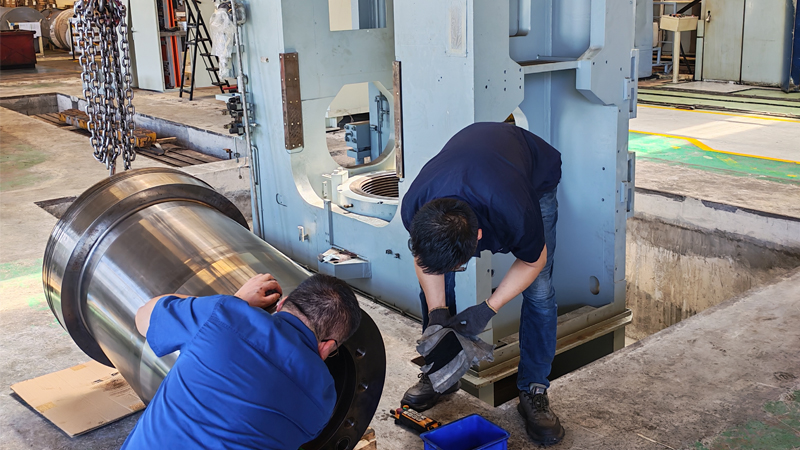
HS-FINEB maintains a team of die technicians who can be dispatched to customer facilities worldwide for emergency troubleshooting, die repair, or process parameter re-optimization. Common on-site services include: correcting edge quality degradation, adjusting V-ring force for material lot variations, repairing damaged inserts after crash events, and regrinding punches and dies without removing the die from the press.
HS-FINEB offers optional die monitoring packages that track stroke count, force signatures, and part quality metrics over time. This data provides early warning of die wear trends, allowing maintenance to be scheduled before quality degradation becomes apparent in the parts. Force signature monitoring can detect punch chipping, die cracking, and V-ring wear before they affect part quality.
Preventive maintenance and resharpening are the largest cost items after initial purchase. A well-managed maintenance program extends die life, maintains part quality, and prevents catastrophic failures.
HS-FINEB provides a recommended maintenance schedule with each die, based on material hardness and production volume.
Preventive maintenance intervals are adjusted based on actual wear rates observed in production. Harder materials (stainless steel, pre-hardened alloy steels) require more frequent inspection and earlier resharpening. Higher production volumes accelerate wear linearly with stroke count. HS-FINEB works with customers to establish maintenance intervals that balance production uptime against maintenance labor costs.
A fine blanking die can be resharpened 8-15 times. Each resharpening removes 0.1-0.3 mm from punch and die edges, gradually increasing clearance. Resharpening costs 15-25% of a new die, while replacement costs 100%. As the die is resharpened multiple times, edge quality gradually degrades and scrap rates increase.
HS-FINEB provides an economic model calculating the optimal resharpening point based on die condition, resharpening cost, replacement cost, scrap rate trend, and remaining production volume.

Every die reaches end of life when dimensions can no longer be maintained within tolerance, or when maintenance cost exceeds replacement cost. Planning for retirement prevents production disruption.
HS-FINEB establishes clear retirement criteria at die delivery: minimum punch diameter, maximum die opening increase, minimum V-ring height, and maximum burr height. When any criterion is exceeded, the die is flagged for retirement evaluation.
Retired dies contain significant value in tool steel that can be recovered. HS-FINEB offers a die buyback program where we reclaim usable tool steel from retired dies, credit the material value against future die purchases, and recycle remaining steel through certified scrap processors. Typical recovery value is 5-10% of the original die cost.
HS-FINEB maintains a digital archive of all die documentation including design files, process parameter history, maintenance records, and quality data. This archive is valuable for designing replacement dies, resolving quality disputes, and regulatory compliance.
HS-FINEB recommends initiating replacement die design 6-9 months before the predicted retirement date, accounting for design review, manufacturing, tryout, and production qualification.
The total cost of ownership (TCO) for a fine blanking die is the sum of all costs from acquisition through retirement, divided by total parts produced. Understanding TCO helps customers make informed decisions ~die investment, maintenance intensity, and replacement timing.
| Cost Category | Typical Range | % of TCO | Optimization Strategy |
|---|---|---|---|
| Initial die acquisition | $15,000 - $150,000 | 15-30% | Spare insert program reduces need for duplicate dies |
| Preventive maintenance | $2,000 - $8,000/year | 20-30% | Condition monitoring shifts from time-based to condition-based |
| Resharpening (8-15 cycles) | $2,500 - $15,000 each | 25-40% | Optimal resharpening timing minimizes cost per part |
| Downtime from die issues | $500 - $5,000/event | 10-20% | Spare inserts and quick-change reduce downtime |
| Quality degradation (scrap) | 0.5-3% of production value | 5-15% | Early resharpening before quality threshold |
| End-of-life recovery | -$1,000 to -$15,000 | -5 to -10% | Die buyback program maximizes recovery |
HS-FINEB provides a TCO calculator during die quotation, accepting inputs for part complexity, material, annual volume, press rate, labor cost, scrap rate, and desired lifetime. It outputs maintenance schedule, resharpening intervals, expected lifetime, and cost per part.
For low-volume applications (under 100,000 parts per year), a simpler die with less maintenance is more economical.
HS-FINEB's die lifecycle management program helps you extend tool life, reduce cost per part, and eliminate unplanned downtime. Contact us to develop a lifecycle plan for your fine blanking dies, from initial design through planned retirement.