💬 WhatsApp Chat

Stroke-Count Maintenance Model: Predictive Die Care in Fine Blanking

Reactive maintenance fixes dies when they break. Calendar-based maintenance services them every month regardless of need. Stroke-count maintenance tracks the number of press cycles since last service — the most accurate predictor of die condition. This guide covers die life prediction models, condition monitoring sensors, resharpening trigger criteria, and the data-driven approach that extends die life by 30% while cutting unplanned downtime by 50%.

Predictive Maintenance

What Is Stroke-Count Maintenance?

Die wear in fine blanking is proportional to parts produced — each stroke cycles the cutting edge through one abrasive, high-force contact. Unlike general machinery where wear depends on running hours, die wear depends on stroke count. A die producing 30 parts per minute accumulates wear 60 times faster than one at 0.5 per minute over the same hours. Stroke count is the most accurate die condition predictor.

Stroke-count maintenance replaces two inferior approaches. Reactive maintenance waits for quality degradation before acting — by then, hundreds of defective parts have been produced. Calendar-based maintenance services dies on a fixed schedule regardless of usage — over-servicing lightly-used dies or under-servicing heavily-used ones.

The system works as follows: the PLC counts each stroke and displays the count alongside the target resharpening count. At 80% of predicted die life, the system schedules resharpening at the next production break. At 90%, it escalates to a mandatory stop — the press will not run until the die is serviced. This prevents catastrophic failure and ensures resharpening while the cutting edge is still serviceable.

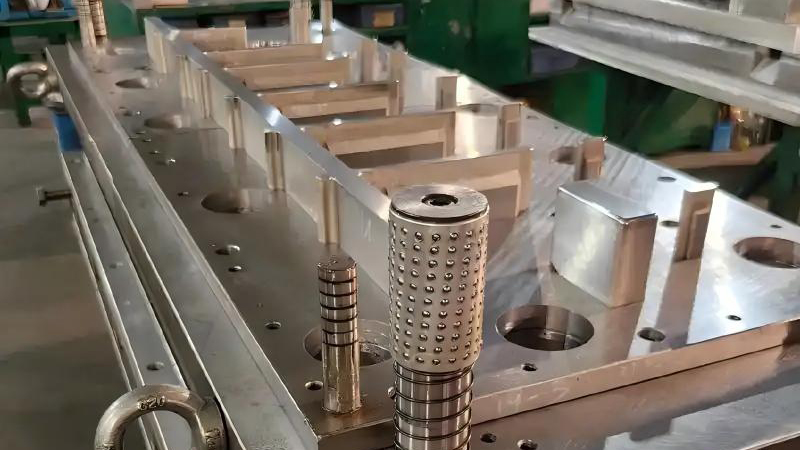
Fine blanking die installed in press with stroke counter monitoring system
Die Life Prediction

Prediction Models: How Many Strokes Between Resharpening?

Base Model Formula

The base model: material thickness × complexity factor = expected strokes. The complexity factor accounts for features that accelerate wear: narrow webs, sharp corners, small holes, and high force density. A simple part rates 1.0; a complex gear may rate 0.5–0.7, meaning 30–50% fewer strokes.

📑

Material-Specific Baselines

Carbon steel 1–3 mm: 15,000–30,000 strokes between resharpening — the most favorable material for die life due to moderate hardness and good lubrication response. Stainless steel 1–3 mm: 8,000–15,000 strokes — stainless work-hardens during shearing, increasing cutting edge load. High-strength steel 3–6 mm: 5,000–10,000 strokes — the combination of high hardness and thick gauge dramatically accelerates cutting edge wear. These baselines assume sharp die steel (60–62 HRC), optimal clearance, and adequate lubrication.

Adjustment Factors

The baseline stroke count is adjusted by factors that increase or decrease die life. Material hardness: +20% die life reduction per HB hardness step above baseline (e.g., HB200 steel vs HB150 steel reduces die life by approximately 20%). Part complexity: −20% for narrow webs below 1.5× material thickness, −15% for sharp internal corners without radii. Lubrication quality: +30% die life for optimal lubrication (correct viscosity, adequate flow rate, proper coating) vs. marginal lubrication. These factors compound multiplicatively.

📊

Calibration Over Time

The prediction model is calibrated using actual data from the first 2–3 resharpening cycles of each die. After the first cycle, the actual stroke count at the resharpening trigger is compared to the predicted count, and the model is adjusted. By the third cycle, the prediction is typically within ±10% of actual die life for that specific die and material combination. This calibration accounts for die-specific factors (steel batch variation, heat treatment quality, die maker fitting precision) that the general model cannot predict.

Condition Monitoring

Sensors: Real-Time Die Health Monitoring

Press control panel showing die health monitoring dashboard with stroke count and sensor data

Force Monitoring

A load cell on the main ram measures blanking force on every stroke. As the cutting edge dulls, the force required to shear the material increases — a sharp die may blank 3 mm steel at 80% of rated force, while a dull die on the same material may require 95% of rated force. Trend analysis of force data predicts the resharpening need 1,000–2,000 strokes in advance, giving the maintenance team time to schedule changeover before quality degrades. A sudden force spike indicates cutting edge chipping — an immediate stop condition.

Vibration Sensor

An accelerometer on the die plate detects vibration signature changes. A healthy die produces a characteristic profile from punch impact, shear fracture, and ejection. As the die wears, the profile shifts: worn edges change impact frequencies, chipped edges add broadband content, and loose components create resonance peaks. The system compares each stroke to the baseline.

Temperature Sensor

A thermocouple in the die plate monitors temperature. Normal fine blanking raises temperature 5–10°C above ambient. As edges wear, friction increases — a 15–20°C rise indicates significant wear. Temperature spikes also detect lubrication failures that can cause galling.

Data Integration

All sensor data feeds to the PLC, which calculates a composite die health score (0–100). The score combines stroke count, force trend, vibration deviation, and temperature rise. A score of 90–100 is healthy; 70–89 means schedule maintenance; below 70 means stop and service. This integrated approach avoids false alarms while catching deterioration early.

Trigger Criteria

When to Resharpen: Multi-Criteria Decision

Resharpening is triggered by multiple criteria in combination. The system evaluates all indicators and triggers maintenance when any one reaches its threshold or when multiple trend toward their limits.

Stroke count threshold: at 80% of predicted die life, the system schedules resharpening at the next production break. At 90%, the stop is mandatory — the press will not begin a new production run. This is the primary trigger and the most reliable predictor, but it is calibrated by the other criteria below.

Force increase: when force rises 10% above baseline, the system schedules inspection. At 15%, the press stops for resharpening. Force increase indicates edge dulling — the edge is pushing rather than shearing, degrading quality and accelerating wear.

Burr height: measured every 500 strokes. When burr exceeds 0.08 mm, the die is resharpened immediately regardless of stroke count. Burr height is the most direct quality measure — it determines lot acceptance or rejection.

Edge quality: visual inspection checks for tear zone appearance. A good part has 80–100% shear zone. When tear zone appears, the edge is losing sharpness. Experienced operators detect this 1,000–2,000 strokes before burr height reaches the limit.

Combined criteria: any single trigger initiates maintenance. When multiple trigger simultaneously (80% stroke count AND 10% force increase AND burr at 0.06 mm), resharpening is urgent. When only one triggers, the system still schedules maintenance to avoid running to failure.

Benefits & Implementation

Results and How to Implement

30% die life extension: resharpening at 80% of predicted life means the edge has worn 0.03–0.05 mm — removing 0.05–0.08 mm restores it. Running to failure may wear the edge 0.15–0.20 mm, requiring 0.20–0.25 mm removal — 3–5 times more material. Since total die life is limited by cumulative removal (5–8 mm before the punch is too short), conserving material extends total life.

50% reduction in unplanned downtime: predictive scheduling means resharpening during planned breaks. The team prepares spares in advance, so changeover takes 24 minutes rather than hours of unplanned scramble. Mid-production die failures that take 4–8 hours to resolve are virtually eliminated.

20% reduction in reject parts: resharpening before quality degrades reduces out-of-tolerance parts. With reactive maintenance, 500–2,000 defective parts may be produced before detection. With stroke-count maintenance, reject rates fall from 1–2% to 0.2–0.4%.

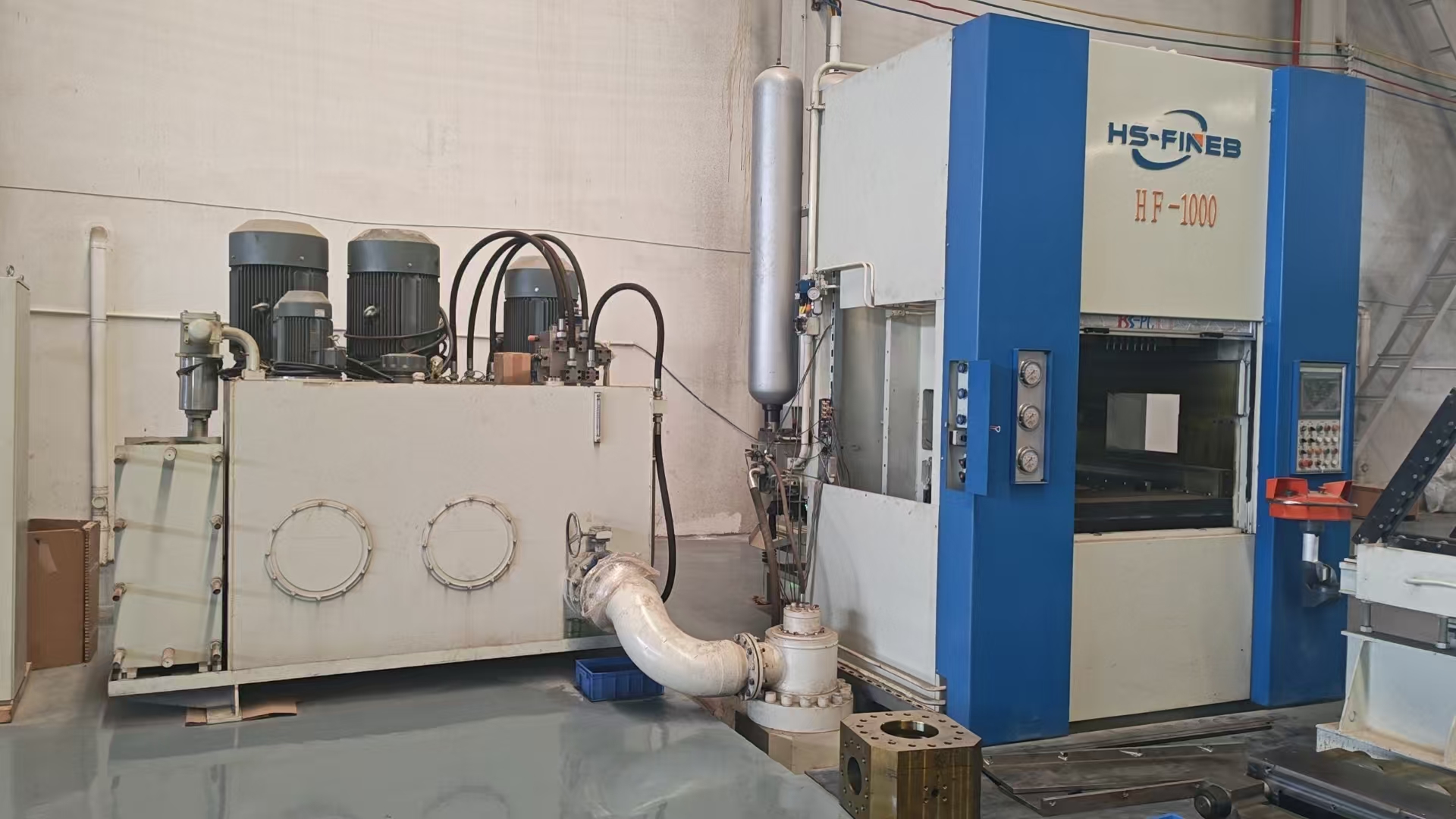
Implementation: the PLC stroke counter is standard on all HS-FINEB presses (HF-200 through HF-1200). Force monitoring is an optional add-on ($3,000–$5,000 depending on tonnage). Vibration and temperature sensors can be retrofitted or specified on new dies. For MES integration, stroke data outputs via Ethernet/IP or Profinet to dashboards and mobile alerts.

HS-FINEB presses support stroke-count tracking and optional force monitoring as standard or add-on features. Contact Helen at sales@fineblankingmachine.com for predictive maintenance system configuration on new presses or retrofit of existing equipment.

Ready to Implement Predictive Die Maintenance?

HS-FINEB presses come with stroke-count tracking as standard, with optional force monitoring and sensor integration. Our engineers will help you configure a predictive maintenance system tailored to your materials, die types, and production volume.

💬