Ram parallelism — the perpendicularity of the moving upper die to the fixed lower bolster — is one of the most critical mechanical parameters in fine blanking. A deviation of just 0.05mm from parallel can reduce die life by up to 40%, cause inconsistent edge quality, and produce dimensional variation between parts. This guide covers the measurement methods, tolerance bands, adjustment procedures, and monitoring practices that keep a fine blanking press producing at full quality.
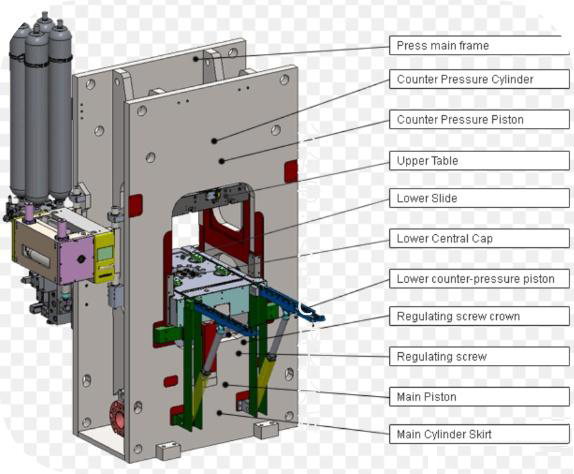
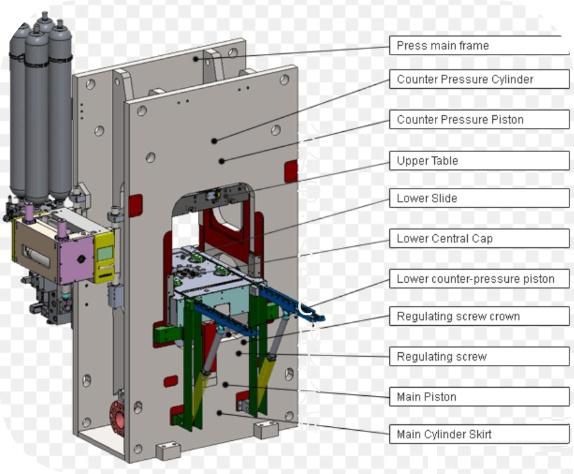
In a fine blanking press, the ram — also called the slide — is the moving element that carries the upper die (punch holder). The bolster is the fixed lower plate that holds the lower die (die block). Ram parallelism refers to the condition where the ram face remains perfectly parallel to the bolster face throughout its stroke, from top dead center to bottom dead center and back. At any point in the stroke, the gap between the ram and bolster must be equal at all four corners.
Fine blanking demands tighter parallelism than conventional stamping. While a conventional stamping press may operate acceptably at ±0.05mm parallelism deviation, fine blanking requires ±0.02mm or better. This tighter tolerance is necessary because the fine blanking process depends on precise die clearance — typically 0.5% of material thickness — between the punch and die cutting edges. Even a 0.03mm parallelism error creates a clearance variation that shifts the cutting force distribution, producing uneven die roll, inconsistent edge quality, and accelerated die wear on the high-load side.
Poor parallelism manifests in several ways: uneven die wear (one side of the die shows more wear or chipping than the other), part dimensional variation (parts measure differently depending on their orientation in the die), die roll variation (one side of the part has more die roll than the other), and premature die failure (punch edge chipping, die cracking, or insert fracturing). These symptoms develop gradually as parallelism drifts, making regular measurement essential to catch degradation before it affects production quality.

Mount four dial indicators (0.01mm resolution minimum, 0.001mm preferred) on magnetic bases attached to the four corners of the ram: front-left, front-right, rear-left, rear-right. Position each indicator tip against the bolster face, preloaded by 1–2mm. Zero all four indicators at top dead center. The indicators must be mounted on the ram, not the bolster, so they measure ram-to-bolster gap at each corner as the ram moves.
Stroke the ram through bottom dead center at slow speed (typically 5–10 strokes/min). Record each indicator reading at four positions: 0° (start), 90° (quarter stroke), 180° (bottom dead center), and 360° (return to start). The maximum difference between any two indicators at the same stroke position is the parallelism deviation. For fine blanking, this max-min reading must be under 0.04mm total (equivalent to ±0.02mm from nominal).
For fine blanking presses, a max-min reading under 0.04mm is acceptable. Readings of 0.04–0.06mm require monitoring and may need adjustment at the next die change. Readings above 0.06mm require immediate gib adjustment before continued production. Readings above 0.10mm indicate a mechanical problem — gib liner wear, frame distortion, or guide failure — that requires engineering investigation, not just adjustment.
Measure parallelism monthly for production presses running at full capacity. Measure after every die change, as die weight and clamping force can shift the ram slightly. Measure after any gib adjustment to verify the correction. Measure after major maintenance events such as seal replacement, hydraulic cylinder service, or frame leveling. A baseline measurement should be recorded at press commissioning for future comparison.

HS-FINEB presses use an eight-point gib system — four gibs on the front face and four on the rear face of the ram, each with an adjustable screw. The gibs are adjusted in pairs diagonally: when tightening the front-left gib, also tighten the rear-right gib. This diagonal pairing prevents introducing a twist while correcting a tilt.
The adjustment procedure begins with measurement to identify which corner is out of parallel. Loosen the gib on the high side (the corner with the smallest gap) by one-quarter turn, and tighten the opposite diagonal gib by one-quarter turn. Re-stroke the press and re-measure. Repeat in small increments — never more than one-quarter turn per adjustment — until all four indicators read within 0.04mm of each other.
Some larger presses (HF-800 and above) are equipped with hydraulic leveling cylinders that can adjust ram tilt without manual gib adjustment. These cylinders apply a controlled side force to level the ram, with the position monitored by LVDT sensors. This hydraulic leveling is faster than manual gib adjustment but requires the same post-adjustment verification.
After any adjustment, run 100 strokes at production speed and re-measure. Gib adjustments can shift during the first few dozen strokes as the gib liners seat. If the reading drifts more than 0.02mm after 100 strokes, re-adjust and repeat the verification. Also recheck parallelism whenever the die weight changes significantly — a die that is 20% heavier or lighter than the previous setup will alter the deflection characteristics and may require gib readjustment.
The relationship between ram parallelism and die life is direct and quantifiable. When parallelism is within specification (±0.02mm), the cutting force distributes evenly across the entire cutting perimeter, and the die wears uniformly. When parallelism deviates, one side of the die takes a disproportionate share of the cutting load, accelerating wear on that side while the other side is under-stressed.
At a parallelism deviation of ±0.05mm — still within the tolerance band for conventional stamping but unacceptable for fine blanking — die life is typically reduced by 30–40%. The mechanism is progressive: the high-load side experiences accelerated cutting edge wear, which increases the clearance on that side, which further concentrates the load on the remaining sharp edge, creating a feedback loop that ends in premature edge chipping or die cracking.
A documented case illustrates the impact. A 320-ton fine blanking press producing automotive seat recliner gears was running with ±0.08mm parallelism — a condition that had developed gradually over years without regular measurement. The die required resharpening every 8,000 strokes, and part quality was marginal on the high-load side. After a full gib reconditioning and adjustment to ±0.02mm, the resharpening interval extended to 15,000 strokes — an 87% improvement in die life — and part dimensional consistency improved measurably. The cost of the gib work was recovered within two months through reduced die maintenance and reduced scrap.
The lesson is clear: parallelism is not a setup-and-forget parameter. It drifts with thermal cycling, die weight changes, mechanical wear, and frame stress. Regular measurement and prompt adjustment are the lowest-cost actions a press operator can take to protect die life and part quality.
While manual measurement with dial indicators remains the verification standard, modern fine blanking presses can be equipped with proximity sensors mounted at the four ram corners for continuous parallelism monitoring. These sensors feed real-time position data to the press PLC, which calculates parallelism deviation on every stroke and logs the trend. The system can trigger an alert when parallelism exceeds ±0.03mm, prompting scheduled gib inspection before the tolerance band is exceeded and before die life is affected.
Preventive maintenance for the gib system should follow a structured schedule. Gib inspection should be performed every 6 months for presses running at full capacity, checking for liner wear, screw condition, and lubrication. Gib liner replacement is scheduled when clearance between the gib and ram guide exceeds the manufacturer’s specification (typically 0.03–0.05mm for fine blanking presses). Operating with worn gib liners accelerates parallelism drift and can introduce ram vibration that degrades part quality.
Gib lubrication is critical: manual lubrication points should be greased weekly, and automatic lubrication systems (standard on HS-FINEB HF-650 and above) should be checked for proper flow at each maintenance interval. Dry gibs cause rapid liner wear and can gall the ram guide surfaces, requiring expensive grinding repairs.
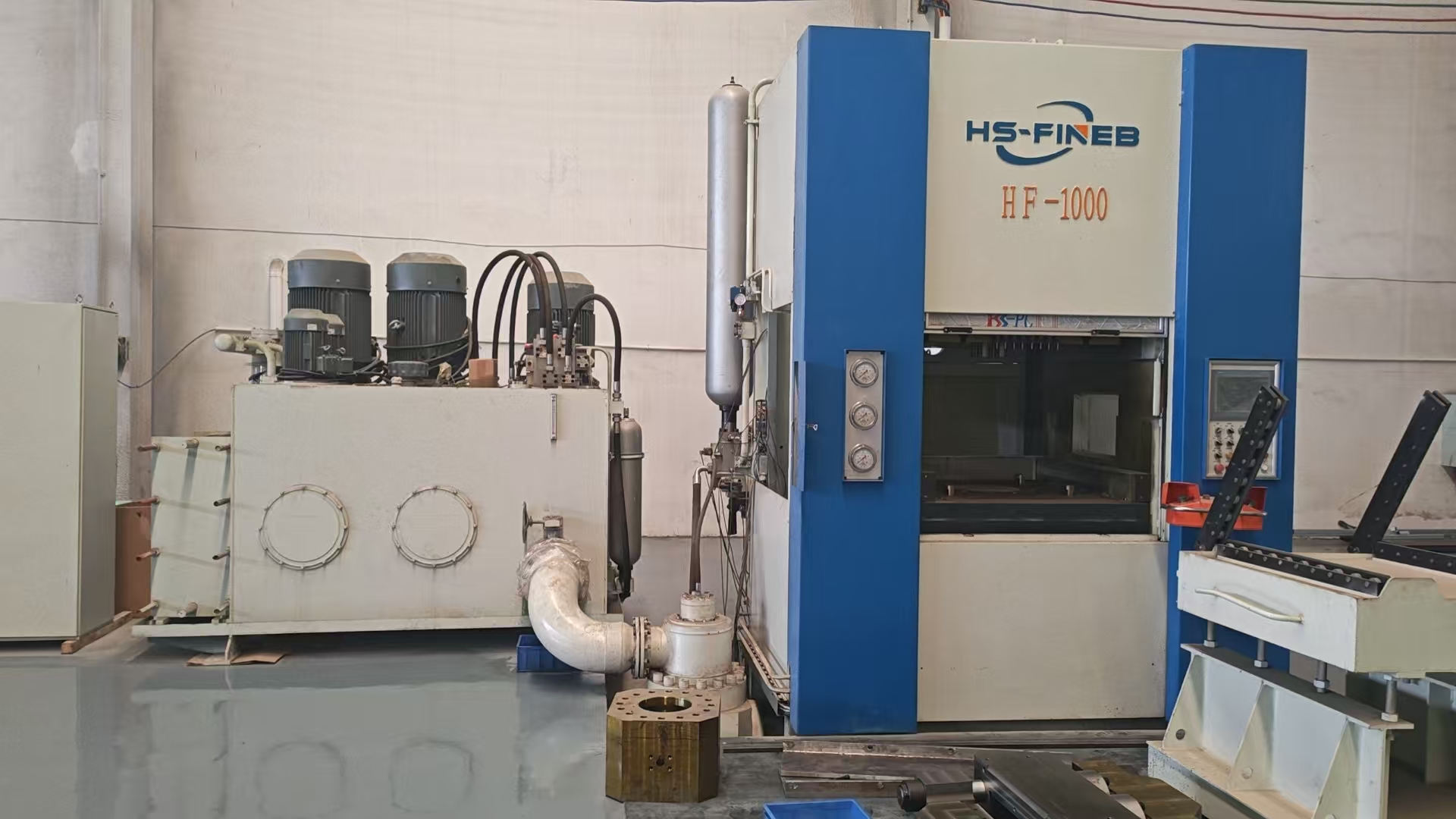
HS-FINEB presses feature eight-point adjustable gibs with digital parallelism display on the HMI, showing real-time readings from all four corners. This eliminates the need for manual dial indicator setup during routine checks and enables the operator to monitor parallelism continuously during production. When combined with proximity sensors and PLC logging, the system provides a complete parallelism management tool that protects die life and part quality without the labor of frequent manual measurement.

Our engineers at HS-FINEB bring over 40 years of fine blanking expertise to every project. Whether you need a new press, refurbishment of an existing machine, or technical consultation, we are ready to help.