💬 WhatsApp Chat

Microalloyed Steel in Fine Blanking: 16MnCr5 and 20CrMnTi Processing Guide

A comprehensive technical guide to fine blanking microalloyed steels including Nb-V-Ti alloyed grades, with specific processing parameters for 16MnCr5 and 20CrMnTi gear steels used in automotive transmission and axle components.

Material Science

What Is Microalloyed Steel?

Microalloyed steels are carbon-manganese steels strengthened by small additions of carbide- and nitride-forming elements, typically niobium (Nb), vanadium (V), and titanium (Ti) below 0.1 percent each. These microadditions improve strength and toughness through grain refinement and precipitation hardening. During thermomechanical processing, microalloying elements retard recrystallization and austenite grain growth, producing a finer ferrite grain size that simultaneously increases yield strength and toughness.

The precipitation of carbonitrides (NbC, VN, TiN) during controlled cooling provides additional dispersion strengthening. Microalloyed steels achieve tensile strengths of 600 to 1000 MPa while maintaining good formability. For fine blanking, this class of materials is particularly important in the automotive sector, where gear blanks, transmission components, and axle parts require high strength, precise geometry, and subsequent heat-treatability.

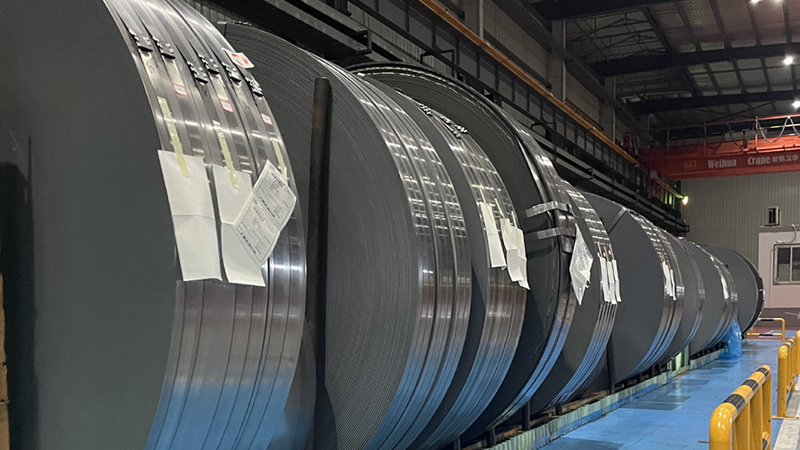
Microalloyed steel material sample showing fine grain structure for precision blanking
Material Properties

16MnCr5 Properties and Fine Blanking Parameters

Material Specification

16MnCr5 (European grade 1.7131) contains approximately 0.14 to 0.19 percent carbon, 1.00 to 1.30 percent manganese, and 0.80 to 1.10 percent chromium. In the normalized condition, it exhibits tensile strength of 780 to 980 MPa and yield strength of 550 to 700 MPa. Elongation ranges from 9 to 12 percent. These properties place 16MnCr5 at the upper boundary of fine blanking suitability, requiring careful parameter selection to achieve clean sheared edges without excessive die wear.

Optimal Blanking Force

Blanking force for 16MnCr5 follows F equals L times t times Rm times k, where L is perimeter, t is thickness, Rm is tensile strength, and k is 0.8 to 1.2. For a gear blank with 200 mm perimeter and 4 mm thickness, the force requirement is approximately 780 to 940 kN. The V-ring impingement force should be 25 to 30 percent of blanking force, and counter-pressure 10 to 15 percent. Total press force approaches 1000 to 1200 kN for typical automotive gear dimensions.

Die Clearance Requirements

Die clearance for 16MnCr5 should be 6 to 8 percent of material thickness per side, higher than the 4 to 6 percent for softer steels. The increased clearance accommodates greater elastic recovery and reduces secondary shearing risk. For 4 mm thickness, this translates to 0.24 to 0.32 mm per side. Clearance must be uniform around the entire perimeter to maintain consistent edge quality.

🛠

Process Considerations

Shear speed for 16MnCr5 should be 10 to 20 mm per second through the cutting zone. Higher speeds generate excessive heat, accelerating tool wear and potentially altering edge microstructure. Lubrication with high-performance fine blanking oil containing extreme pressure additives should be applied at 5 to 10 liters per minute. Material should be supplied normalized or soft-annealed (Hardness 180 to 220 HV). Cold-rolled and spheroidized 16MnCr5 provides even better blanking characteristics, with hardness below 190 HV.

Carburizing Steel

20CrMnTi for Carburized Gear Applications

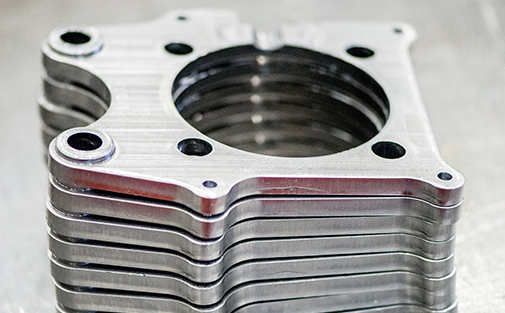
Fine blanked gear component made from 20CrMnTi steel showing precision edge quality

Material Characteristics

20CrMnTi (Chinese standard GB/T 3077) is the most widely used carburizing steel for automotive gears in China and Asia. The composition includes 0.17 to 0.23 percent carbon, 0.80 to 1.10 percent chromium, 0.80 to 1.10 percent manganese, and 0.04 to 0.10 percent titanium. The titanium addition ensures nitrogen fixation as TiN, preventing strain aging and improving toughness. In the normalized condition, 20CrMnTi exhibits tensile strength of 750 to 900 MPa and yield strength of 500 to 650 MPa, with elongation of 10 to 14 percent.

Fine blanking of 20CrMnTi produces a near-net-shape gear blank that minimizes subsequent machining. The sheared edge quality directly affects carburizing behavior: a clean edge with minimal fracture zone provides uniform carbon diffusion during case hardening. The fine blanked edge typically exhibits 85 to 95 percent sheared surface with a fracture zone of 1 to 2 mm depth, acceptable for most carburizing applications where case depth ranges from 0.5 to 1.2 mm.

Tooling Engineering

Die Considerations for High-Strength Steels

Fine blanking dies for 16MnCr5 and 20CrMnTi must withstand significantly higher contact stresses than softer materials. Die material selection, coating strategy, and geometric design require adjustment.

🔧

Die Steel Selection

Punch and die inserts should be high-grade tool steels at 60 to 64 HRC. ASP2023 or equivalent powder metallurgy high-speed steels are recommended for production exceeding 500,000 parts. Conventional cold work tool steels such as DC53 can be used for lower volumes but require more frequent resharpening. PM-HSS grades provide superior wear resistance against abrasive manganese and chromium-rich steels.

👍

Coating Requirements

Physical vapor deposition coatings are essential for extending die life. TiAlN coatings provide the best combination of hardness, oxidation resistance, and low coefficient of friction. Coating thickness of 3 to 5 micrometers is optimal; thicker coatings compromise edge sharpness on small features. Uncoated tools produce 100,000 to 200,000 parts before resharpening; TiAlN-coated tools achieve 300,000 to 500,000 parts.

Expected Die Life

Die life for microalloyed steels is 40 to 60 percent of that achieved with equivalent-thickness low-carbon steels. For a 4 mm 16MnCr5 gear blank, expect 150,000 to 250,000 parts between resharpening with TiAlN-coated PM-HSS tooling. V-ring and counter-pressure pads experience similar wear and should be inspected on the same schedule. Maintenance intervals should be planned based on quality monitoring rather than fixed stroke counts, as material hardness variation between coils significantly affects wear.

Geometric Design

Punch corner radii should be 0.1 to 0.2 mm, larger than the 0.05 mm for soft steels, to reduce stress concentration. The V-ring should use a 45-degree angle with height 0.3 times material thickness for adequate material constraint. Die opening should be polished to Ra 0.2 micrometers or better to minimize friction and galling tendency.

Automotive Applications

Applications in Transmission Gears and Axle Components

Microalloyed and carburizing steels processed by fine blanking find primary application in the automotive drivetrain sector. Transmission gears, shift forks, synchronizer hubs, and differential components are produced in millions of pieces annually, with fine blanking providing geometric precision for minimal post-processing.

For transmission gears, fine blanking produces blanks with precision tooth preforms requiring only finish hobbing or grinding after case hardening. Near-net-shape capability reduces material consumption by 15 to 25 percent compared to conventional machining from forged blanks. The process is particularly valuable for helical gears and complex synchronizer geometries where conventional stamping cannot achieve required dimensional accuracy.

Axle components such as side gears, pinion gears, and differential spiders are also candidates for fine blanking. These components typically range from 3 to 8 mm thickness and require strength levels matching fine blanked microalloyed steels. The combination of fine blanking precision and subsequent heat treatment produces components meeting fatigue life requirements validated through bench testing to 1 million cycles under full torque load.

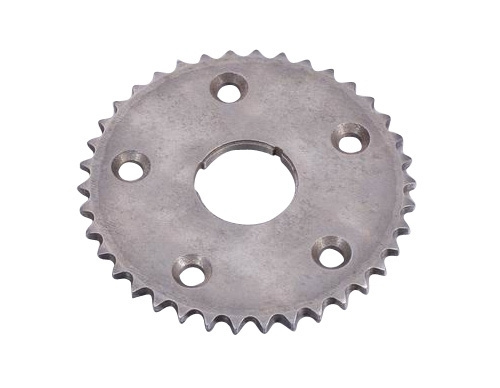
Fine blanked sprocket gear component for automotive transmission applications
Press Selection

HS-FINEB Press Recommendations

Selecting the appropriate fine blanking press for microalloyed steel requires matching press force capacity to part geometry and material strength.

🛡

HF-500 and HF-650 for Thick Gears

For automotive gear blanks in 16MnCr5 and 20CrMnTi with thicknesses of 5 to 8 mm, the HS-FINEB HF-500 (500 tons) and HF-650 (650 tons) provide required force capacity. These presses feature three independently controlled hydraulic cylinders for blanking force, V-ring impingement, and counter-pressure. The hydraulic system provides constant force throughout the stroke, advantageous for materials with high flow stress. The HF-650 processes gear blanks up to 300 mm diameter in 6 mm thickness at 15 to 25 strokes per minute.

HF-320 for Thin Gears

For thinner microalloyed steel components in the 2 to 4 mm range, such as synchronizer hubs and small pinion gears, the HF-320 (320 tons) provides optimal force matching. It achieves higher stroke rates of 25 to 40 strokes per minute for smaller parts, improving production economics. The press can be equipped with automatic coil feeding and ejection for fully automated production. For parts requiring heat treatment, the HF-320 can be integrated with in-line annealing furnaces.

HS-FINEB provides material-specific die design and process parameter recommendations for all microalloyed steel grades. Contact our application engineers with your gear blank drawings for processing evaluation including blanking force calculation, die material selection, and expected production rates.

Processing Microalloyed Steels?

HS-FINEB engineers will help you select the right press, die materials, and process parameters for 16MnCr5, 20CrMnTi, and other gear-grade microalloyed steels. Contact us for a detailed processing evaluation tailored to your automotive component requirements.

💬