💬 WhatsApp Chat

Fine Blanking Medical Implant Components: Precision & Cleanliness

Medical implants and surgical instruments demand burr-free edges, biocompatible materials, and validated manufacturing processes. Fine blanking produces clean shear surfaces that reduce bacterial adhesion, complex geometries in a single operation, and dimensional precision that supports the stringent requirements of ISO 13485 and FDA 21 CFR 820 quality systems.

Medical Applications

Medical Implant and Instrument Applications

Fine blanking serves a growing range of medical device applications. Orthopedic implants include bone plates with complex hole patterns for screw fixation, fracture fixation clips that secure bone fragments during healing, and spinal cage components requiring precise surface geometries for bone in-growth. These implants demand burr-free edges because any protrusion can irritate surrounding tissue, cause inflammation, or compromise the sterile barrier between implant and biological environment.

Dental implant components include abutment blanks that are fine-blanked to near-net shape before precision machining, and healing caps that protect implant sites during soft tissue healing. Surgical instruments benefit from fine blanking for scalpel handles with textured grip surfaces, forceps jaws with precisely positioned serrations, and clip applier components that require consistent spring performance and smooth edge transitions for reliable clinical operation.

Fine blanking offers three key advantages for medical applications. First, burr-free edges eliminate tissue irritation and reduce the risk of inflammation at implant sites. Second, the clean shear surface reduces bacterial adhesion compared to rough machined or stamped surfaces, supporting infection control. Third, complex geometries including multiple holes, notches, and profiles are produced in a single operation, reducing process variation and improving consistency across production lots.

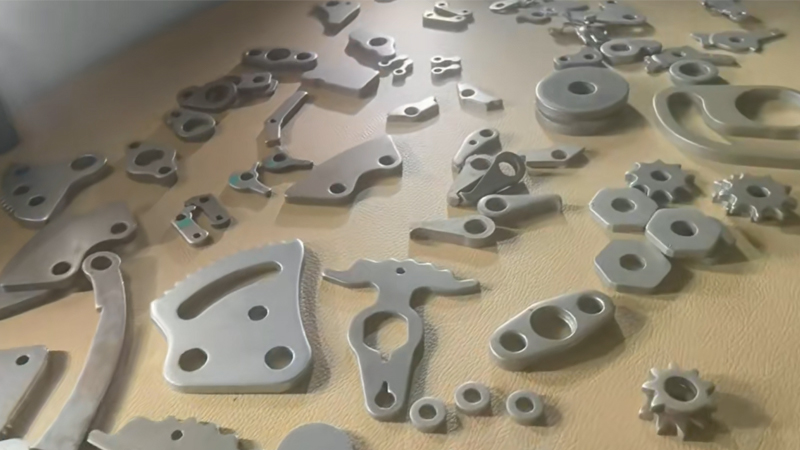
Fine blanked medical implant components showing burr-free clean edges
Biocompatible Materials

Material Selection for Medical Components

316L VM Stainless Steel

Vacuum-melted 316L stainless steel certified to ASTM F138 is the standard implant-grade material for bone plates, fracture fixation, and spinal components. Vacuum melting reduces non-metallic inclusions that could initiate fatigue cracks in the body. The low carbon content (0.03% maximum) minimizes sensitization during subsequent heat treatment, preserving corrosion resistance in the physiological environment. Fine blanking 316L VM requires careful die design due to the material work-hardening tendency.

CP Titanium Grade 2

Commercially pure titanium per ASTM F67 offers excellent biocompatibility, outstanding corrosion resistance in body fluids, and moderate strength. Grade 2 is used for dental implant components, surgical instrument parts, and non-load-bearing implant applications. Titanium fine blanks well with sharp tooling and appropriate lubrication, producing clean edges with minimal die roll. The material low elastic modulus requires higher counter-pressure to maintain flatness.

Ti-6Al-4V ELI

Extra-low-interstitial Ti-6Al-4V per ASTM F136 is the highest strength-to-weight implant material, used for load-bearing orthopedic applications including spinal cages and trauma plates. The ELI grade reduces oxygen and iron content for improved fracture toughness in the body. Fine blanking Ti-6Al-4V requires high press force due to the material strength, and carbide tooling is essential for sustained die life. The material springback necessitates tighter die clearance control.

17-7PH Stainless Steel

Precipitation hardening stainless per ASTM A693 is used for surgical instruments requiring high hardness and spring performance. 17-7PH in the TH1050 condition achieves 38 HRC with excellent fatigue properties, making it ideal for clip applier jaws, forceps mechanisms, and spring-loaded surgical tools. Fine blanking is performed in the annealed condition, with precipitation hardening applied after blanking to achieve final mechanical properties.

Biocompatibility Standards

Edge Quality for Biocompatibility

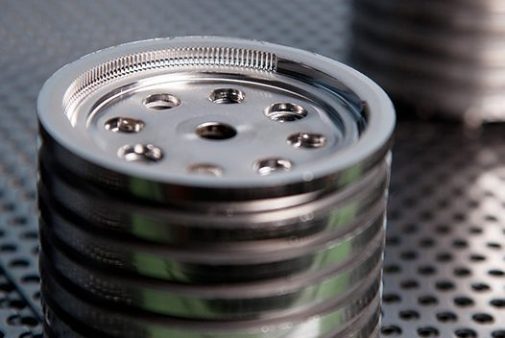
Fine blanked medical component edges showing clean shear surface quality

Burr-Free and Micro-Crack-Free Edges

Medical implant components must be completely burr-free. Any burr remaining on an implant surface could damage tissue during insertion, cause chronic inflammation, or harbor bacteria that lead to post-surgical infection. Burr height must be below 0.02mm or completely removed through deburring and passivation. Fine blanking produces edges with minimal burr, and subsequent vibratory deburring or electropolishing ensures complete burr elimination.

Surface finish on fine-blanked edges typically achieves Ra 0.4 to 0.8, which is then improved through electropolishing for implant surfaces. Electropolishing removes the work-hardened layer and creates a micro-smooth, chromium-enriched surface that enhances corrosion resistance and reduces bacterial adhesion. The fine-blanked edge provides an excellent starting point for electropolishing because it is already smooth and free of the deep striations that machining can produce.

No micro-cracks are permitted on implant component edges. The 100% clean shear zone produced by fine blanking is verified through metallographic cross-section inspection during process validation. Any tear zone or micro-cracking would be rejected. All implant components must be deburred and passivated per ASTM F86, which specifies the chemical surface treatment that removes free iron and creates a passive oxide layer for corrosion resistance in the body.

Cleanroom Manufacturing

Cleanroom and Contamination Control

Fine blanking of medical components requires controlled environments to prevent contamination that could compromise biocompatibility or cause adverse patient reactions. Surgical instrument components are typically fine-blanked in Class 100,000 cleanrooms, while implant surface components require Class 10,000 environments. These cleanroom classifications per ISO 14644 control airborne particulate levels, with HEPA filtration, positive pressure, and strict gowning protocols.

Post-blanking processing follows a validated cleaning sequence. Ultrasonic cleaning removes fine blanking lubricant and metallic fines from the component surface. Passivation per ASTM F967 or ASTM A967 removes free iron contamination and creates the passive oxide layer. Components are then packaged in cleanroom conditions, using medical-grade materials that maintain sterility and prevent recontamination during transport and storage.

Material segregation is critical in medical fine blanking. Carbon steel dust from other production must not contaminate titanium or stainless implant components, as this can cause galvanic corrosion in the body. Dedicated press setups, separate tooling, and segregated production areas prevent cross-contamination. Personnel follow cleanroom protocols per ISO 14644, including full gowning, gloving, and controlled access procedures. Environmental monitoring verifies that particulate counts remain within classification limits during production. Airborne particle counters positioned at critical workstations continuously verify that the cleanroom meets its classification, and any deviation triggers immediate production stoppage and investigation. Surface contact plates sampled from press beds, die surfaces, and handling equipment confirm that bioburden levels remain within validated limits. These controls are essential because microbial or particulate contamination on an implant surface can cause serious adverse patient reactions, including deep infection requiring revision surgery.

Regulatory Compliance

ISO 13485 Validation and Documentation

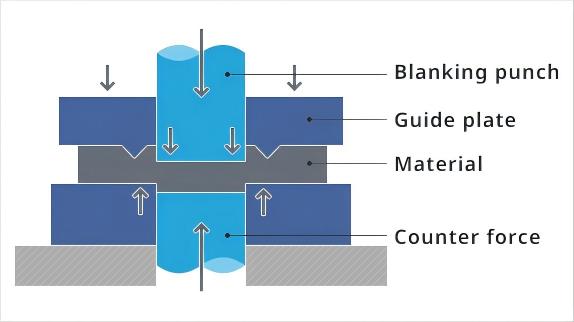
Fine blanking process for medical device component manufacturing

Validated Processes for Medical Devices

Medical device manufacturing under ISO 13485 and FDA 21 CFR 820 requires comprehensive design controls and process validation. The Design History File (DHF) documents design inputs, outputs, verification, and validation. The Device Master Record (DMR) defines the production process, and the Device History Record (DHR) documents each production lot conformance to the DMR.

Fine blanking process validation follows the IQ/OQ/PQ model: Installation Qualification verifies that the press, die, and auxiliary equipment are installed correctly; Operational Qualification confirms that the process operates within specified parameters; Performance Qualification demonstrates that the process consistently produces parts meeting all requirements under normal production conditions. Capability studies establish Cpk values above 1.33 on critical dimensions, with statistical sampling plans defined for ongoing production monitoring.

Traceability extends from the material lot number, through the fine blanking production lot, to the finished device. Material certificates, process records, inspection results, and nonconformance dispositions are retained per regulatory requirements, typically for the device life plus one year. Any modification to the fine blanking die requires change control evaluation and potential revalidation. HS-FINEB has experience with medical component fine blanking and understands the validation and documentation requirements of ISO 13485. Contact Helen at sales@fineblankingmachine.com to discuss medical device component development.

Develop Your Medical Device Components

HS-FINEB provides fine blanking presses and process engineering for medical implant and surgical instrument components. Contact Helen for material selection, cleanroom production configuration, and ISO 13485 process validation support.

💬