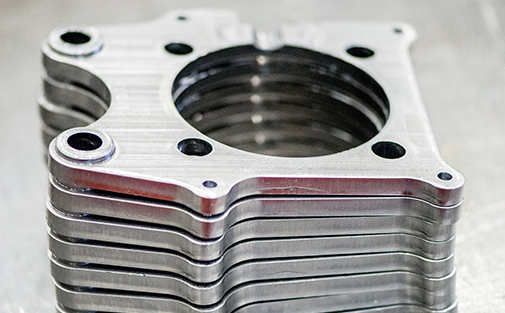
Hydraulic valve plates control fluid distribution in axial piston pumps and motors, where surface flatness and edge quality directly determine volumetric efficiency and leakage rates. Fine blanking achieves flatness below 0.05mm and 100% clean shear edges on port openings, eliminating the secondary machining that alternative processes require for sealing-grade surfaces.
Valve plates, also called port plates or manifolds, are the precision components that distribute hydraulic fluid between pump and motor chambers in axial piston pumps and motors. The plate sits between the rotating cylinder block and the stationary port housing, with machined or blanked ports that align with cylinder bores to direct fluid during the intake and discharge strokes. Any deviation in flatness or edge quality on these ports directly affects volumetric efficiency and internal leakage.
Typical valve plate thickness ranges from 3 to 8mm, depending on the pump displacement and operating pressure. Materials include carbon steel for standard hydraulic applications and hardened alloy steel for high-pressure mobile equipment. In some designs, cast iron is being replaced by fine-blanked steel plates that offer better dimensional consistency and surface quality.
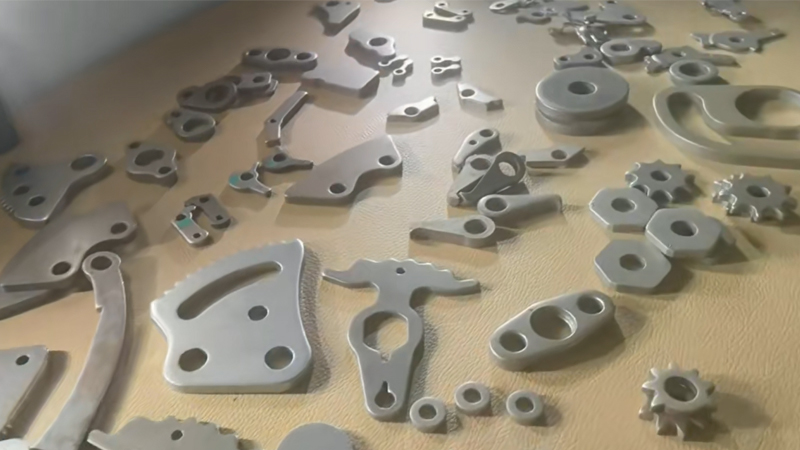
The critical requirements for valve plates are interrelated: flatness must be controlled to prevent leakage between the plate and cylinder block; edge quality on port openings must be clean to prevent flow disturbance and particulate generation; surface finish on sealing surfaces must support the lubricating film that separates the plate from the rotating cylinder block. Fine blanking addresses all three requirements in a single operation, which is why it has become the preferred manufacturing method for high-volume valve plate production.
Flatness across the full part must be controlled below 0.05mm to prevent leakage between the valve plate and the cylinder block. Fine blanking achieves 0.02 to 0.03mm flatness through counter-pressure control during the fracture phase. The counter-pressure (or ejector force) pushes the part flat as it separates from the sheet material, minimizing the warpage that conventional stamping cannot prevent.
Port edges must have 100% clean shear surface with no burrs that could flake off into the hydraulic system. A loose burr in a hydraulic circuit can damage precision valve components, clog orifices, and cause catastrophic system failure. Fine blanking produces burr-free edges on all port openings, eliminating the deburring operation that conventional stamping requires and the risk of burr reattachment after removal.
Sealing surfaces require Ra 0.8 or better to maintain the hydrodynamic lubricating film between the valve plate and cylinder block. Fine blanking produces this surface finish directly on the plate faces, and optional lapping can improve it to Ra 0.2 for high-pressure applications. The fine-blanked surface is work-hardened, which improves wear resistance against the rotating cylinder block.
Port alignment between the valve plate and the cylinder block requires hole position tolerance of ±0.03mm. Fine blanking die precision achieves this tolerance consistently, with the compound or progressive die producing all holes and profiles in a single stroke. This eliminates the accumulation of tolerance stack-up that occurs when holes are drilled or punched in separate operations.

Fine blanking completes the valve plate in one operation, producing clean edges, good flatness, and acceptable surface finish simultaneously. This makes it the lowest-cost method at production volumes above 10,000 parts per year. The process also generates the least material waste and requires the fewest secondary operations.
Stamping plus machining requires two operations: rough stamping to blank the profile, followed by machining to achieve flatness and edge quality. The stamped edges need deburring, adding a third operation. This multi-step approach increases cost, introduces tolerance stack-up between operations, and is slower than fine blanking at volume.
Laser cutting plus grinding produces accurate profiles but is slow and expensive. The thermal distortion from laser cutting compromises flatness, requiring grinding to restore the sealing surface. Water jet cutting is similarly slow and produces inconsistent edge quality that varies with material thickness and cutting speed. For production volumes above 10,000 per year, fine blanking offers the best combination of quality, speed, and cost.
The V-ring force is the primary control for flatness in valve plate fine blanking. Higher V-ring force reduces die roll but can cause distortion if excessive. The optimal range is 25 to 35% of the blanking force, which provides sufficient clamping for clean fracture without inducing residual stresses that warp the part after ejection. The V-ring position relative to the cutting edge is also critical: closer placement reduces die roll but increases the risk of V-ring indentation on the part surface.
Punch and die clearance is set at 0.5% of material thickness, tighter than the typical 1% used for general fine blanking. This tighter clearance reduces die roll and improves edge quality, which is essential for the sealing surfaces on port edges. The tighter clearance also increases die wear rate, making carbide tooling necessary for sustained production runs.
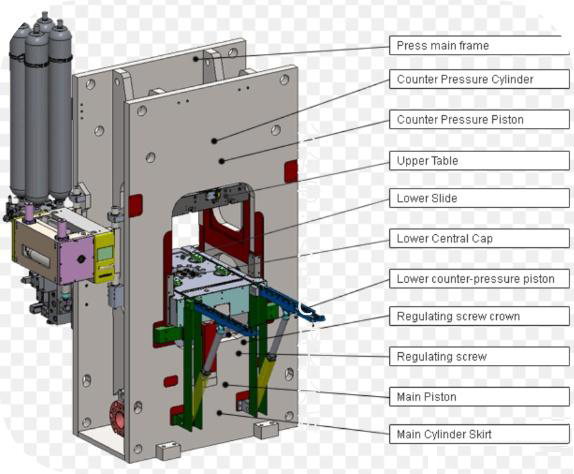
Counter-pressure is adjusted to minimize warpage during the fracture phase. The ejector force pushes the part flat against the die face as the material fractures, preventing the cupping or dishing that occurs when counter-pressure is insufficient. For valve plates with multiple ports, the counter-pressure distribution must account for the varying material thickness around port openings. Complex valve plates with multiple holes and profiles are produced using compound or progressive dies, which complete all features in a single press stroke.
Die material selection directly impacts valve plate quality and production economics. Tungsten carbide inserts at critical cutting edges maintain sharpness for 200,000 to 500,000 strokes, compared to 30,000 to 50,000 for tool steel. While carbide tooling requires higher initial investment, the extended die life and consistent edge quality it provides are essential for high-volume valve plate production. For complex valve plates with intricate port geometries, wire-EDM machining produces the die profiles with the precision and surface finish needed for optimal fine blanking performance.

For sealing surfaces requiring Ra 0.2 or better, a lapping station is added after fine blanking. Lapping removes the work-hardened surface layer and produces the mirror finish needed for high-pressure hydraulic applications. The fine-blanked surface provides an excellent starting point for lapping because it is already flat and smooth, reducing lapping time and material removal.
Surface treatment extends valve plate service life. Nitriding or carburizing hardens the sealing surface to 60 to 65 HRC equivalent, improving wear resistance against the rotating cylinder block. The fine-blanked surface accepts these treatments well because it is free of the surface defects that cause uneven hardening. Heat treatment options include through-hardening for maximum strength or induction hardening for localized surface hardness with a tough core.
HS-FINEB HF-320 to HF-800 presses are suitable for valve plate production, covering the force range needed for 3 to 8mm carbon and alloy steel plate. A complete production line includes the fine blanking press, coil feeding or strip feeding system, deburring station for any residual micro-burr, and surface treatment capability. Contact Helen at sales@fineblankingmachine.com or +86-13062870081 for hydraulic valve plate production line configuration, including press selection, die design, and secondary operation specification.
HS-FINEB provides complete fine blanking lines for hydraulic valve plate production, from press selection through secondary operations. Contact Helen for die design review, flatness optimization, and surface treatment specification tailored to your hydraulic component requirements.