💬 WhatsApp Chat

HB 250 Hardness in Fine Blanking: Material Hardness Limits

HB 250 (approximately 25 HRC) marks the practical upper hardness boundary for fine blanking. Beyond this threshold, tool wear accelerates, V-ring effectiveness diminishes, and the clean shear zone that defines fine blanking quality begins to fracture. Understanding this limit — and the heat treatment strategies that work around it — is essential for achieving consistent edge quality and maximizing die life.

Hardness Limit

What Is HB 250 and Why It Is the Boundary

Brinell hardness HB 250 (approximately 25 HRC) represents the critical threshold where tool steel dies begin to experience accelerated wear during fine blanking. Below this hardness level, the cutting edge maintains its sharpness for tens of thousands of strokes, producing consistent 100% clean shear zones with minimal die roll. At HB 250, several metallurgical mechanisms converge to degrade fine blanking performance.

First, the V-ring — the serrated impingement ring that creates compressive stress in the shear zone — becomes less effective because harder material resists plastic deformation. Instead of flowing smoothly around the cutting edge, the material begins to micro-fracture under the V-ring teeth. Second, the shear zone starts to show micro-tears rather than the smooth burnished surface that characterizes fine blanking. Third, die roll (the plastic deformation at the die entry edge) increases from the typical 5–10% of material thickness to 20–30%, eroding the dimensional accuracy that fine blanking is known for.

Above HB 250, the fine blanking advantage diminishes steadily. Edge quality approaches that of conventional stamping, where a significant tear zone replaces the clean shear. At HB 300 and above, the process is barely distinguishable from conventional blanking in terms of edge quality, though it still requires higher tonnage and more robust tooling.

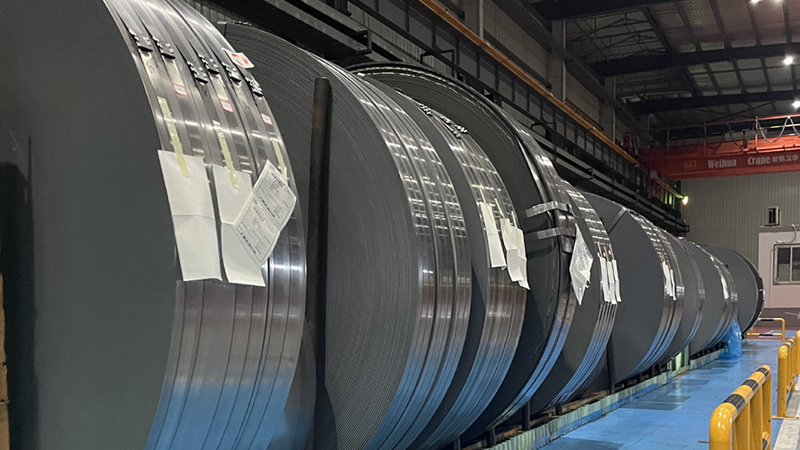
Fine blanking steel material sheet showing hardness effects on shear zone quality
Quantitative Effects

How Hardness Affects Fine Blanking Performance

Blanking Force Requirements

Blanking force increases linearly with material hardness. At HB 200, a standard fine blanking press operates at approximately 100% of its rated force for typical geometries. At HB 250, the same part requires 120–130% of rated force — meaning a 400-ton press is needed where a 320-ton press would suffice for softer material. At HB 300, the force requirement reaches 150% or more, often exceeding the practical capacity of the available press. This relationship means harder materials not only require larger presses but also place greater stress on dies, guide components, and frame structure.

🔋

Die Life and Tool Wear

Die life drops dramatically as hardness increases. At HB 200, a well-maintained carbide die can produce 20,000–30,000 strokes before requiring regrinding. At HB 250, this drops to 8,000–15,000 strokes — roughly half. At HB 300, die life falls to 3,000–6,000 strokes, making the process economically marginal for all but the highest-value parts. The wear mechanism shifts from abrasive wear (gradual edge rounding) to adhesive wear (galling and material transfer) at higher hardness, requiring specialized die coatings and lubricants to maintain acceptable tool life.

📊

Edge Quality and Shear Zone

Below HB 250, fine blanking produces a 100% clean shear zone — the entire cut surface is smooth and burnished, with no tear zone. Between HB 250 and HB 300, the clean shear portion drops to 80–90%, with micro-tears appearing near the die roll and break areas. Above HB 300, a visible tear zone replaces a significant portion of the shear surface, making the part indistinguishable from conventionally stamped parts. For applications requiring 100% clean shear — such as gearing, seating surfaces, and safety-critical components — staying below HB 250 is essential.

V-Ring Effectiveness

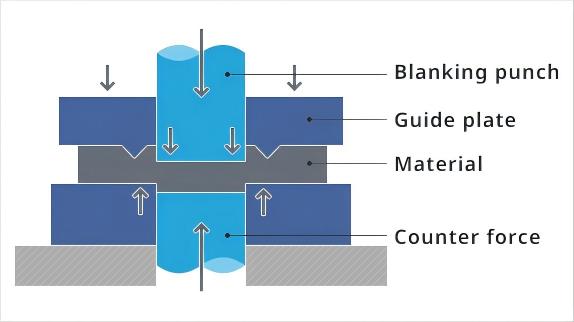
The V-ring creates compressive stress in the shear zone, preventing crack initiation and propagation. Below HB 250, the V-ring creates full compressive stress across the material thickness, enabling smooth plastic flow during shearing. Above HB 250, the harder material resists V-ring penetration, resulting in only partial compressive stress distribution. Die roll increases from 5–10% to 20–30% of material thickness, and the break zone becomes more irregular. Increasing V-ring force can partially compensate, but at the cost of higher tonnage and faster V-ring insert wear.

Process Optimization

Heat Treatment Strategies for Hard Materials

Fine blanking process showing heat treatment optimization for hard materials

Anneal Before Blanking

Reduce material hardness to HB 150–180 by spheroidize annealing, perform the blanking operation, then re-harden the part to its final specification. This adds two extra heat treatment operations but dramatically improves edge quality and die life. The approach is widely used for high-carbon steel parts that must achieve final hardness above HB 250.

Case Hardening After Blanking

Blank the material in its soft core condition, then carburize or nitride the surface to achieve a hard, wear-resistant case with a tough ductile core. This keeps the blanking operation easy while providing the wear resistance the application requires. Popular for gear teeth and sliding components.

Pre-Hardened Steel

Some steels are supplied in the 30–35 HRC (approximately HB 280–320) pre-hardened condition. While technically above the HB 250 limit, these materials have been successfully fine blanked with optimized tooling. Pre-hardened steel is popular for automotive structural components where moderate edge quality is acceptable.

Quench and Temper After Blanking

The most common strategy: blank at supply hardness (HB 180–220), then harden the finished part to its final specification. This approach separates the blanking operation from the final hardness requirement, allowing optimal blanking conditions while achieving the desired final properties through subsequent heat treatment.

Material Selection

Choosing Materials by Hardness Range

Material selection for fine blanking should begin with the hardness range that matches the application requirements. Low hardness (HB 80–150): Low carbon steel, copper, and aluminum are easy to fine blank, producing excellent edge quality with 100% clean shear and long die life of 30,000+ strokes. These materials are ideal for electrical connectors, decorative parts, and non-structural components. Medium hardness (HB 150–220): Medium carbon steel and low alloy steel represent the ideal range for fine blanking. This is the most common range for automotive, machinery, and consumer goods applications. Die life is typically 15,000–30,000 strokes with 100% clean shear and minimal die roll. High hardness (HB 220–250): High carbon steel and alloy steel can be fine blanked but with reduced die life (8,000–15,000 strokes). These materials require sharp dies, optimal V-ring force, and careful lubricant selection. Edge quality remains good (90–95% clean shear) but micro-tears may appear. Above HB 250: Tool steel and hardened stainless steel are not recommended for fine blanking. Consider alternative processes such as wire EDM, laser cutting, or conventional stamping with secondary machining. If fine blanking is mandatory, anneal the material first and harden after blanking.

Practical Experience

HS-FINEB Experience with Hard Materials

Over our 40 years of fine blanking machinery manufacturing, HS-FINEB has tested fine blanking on materials up to HB 280 with mixed results. At HB 280, edge quality achieved only 70–80% clean shear — acceptable for non-critical applications but insufficient for precision gearing or sealing surfaces. Based on this experience, we recommend annealing or using pre-hardened steel for best results when final hardness exceeds HB 250.

For customers processing harder materials, we recommend upgrading die material to powder metallurgy steel (PM30 or PM60) which offers superior wear resistance compared to conventional D2 or D3 tool steel. Additionally, V-ring force should be increased to 35–40% of blanking force for harder materials (compared to the standard 25–30% for medium hardness). This higher V-ring force helps maintain compressive stress in the shear zone, partially compensating for the material’s resistance to plastic deformation.

Our HF-320T through HF-1200T presses are equipped with independently adjustable V-ring and counter-pressure systems, allowing operators to optimize force distribution for different material hardness levels. Contact Helen at HS-FINEB for material-specific fine blanking recommendations tailored to your application requirements.

Processing Hard Materials?

HS-FINEB engineers will help you evaluate material hardness, recommend heat treatment strategies, and select the right press and tooling for your application. Contact us for material-specific fine blanking recommendations tailored to your production requirements.

💬