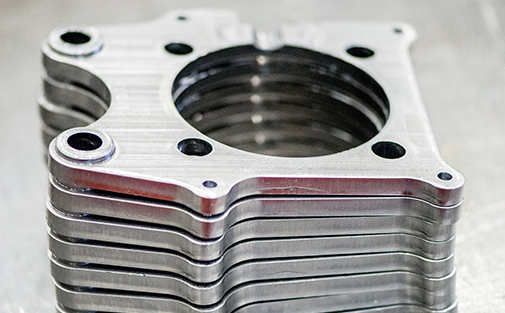
Electric vehicle production demands millions of precision busbars annually for battery modules, inverters, and charging systems. Fine blanking delivers burr-free edges, tight flatness, and clean shear surfaces essential for insulation integrity and stack assembly in high-voltage battery applications.
Electric vehicles use busbars extensively throughout their power systems. Battery module connectors link individual cells in series and parallel configurations, carrying currents from 200A to over 1000A in high-performance packs. Module-to-module busbars distribute power across the battery pack, requiring precise geometries that match mounting points within fractions of a millimeter. Inverter busbars serve as high-current DC links between the battery and motor controller, handling peak currents above 600A during acceleration. Motor winding connections and charging system busbars complete the power distribution network.
The EV market is driving demand for over 50 million busbars annually, with each vehicle using 30 to 80 busbars depending on architecture. Fine blanking offers critical advantages for this application: clean shear edges that do not pierce insulation film during wrapping, flatness within 0.05mm for stack assembly alignment, and zero burrs that could damage insulation or cause short circuits. Conventional stamping leaves tear zones and burrs that require secondary deburring, adding cost and process variability that EV manufacturers cannot tolerate at scale.
Tough-pitch copper offers 101% IACS conductivity, the benchmark for electrical busbar applications. The material is soft and ductile, requiring only 30 to 40% of the blanking force needed for steel of equivalent thickness. V-ring force drops to 10 to 20% of total blanking force. Copper tends to adhere to dull cutting edges, so sharp tooling with polished flanks and adequate lubrication is essential for consistent production.
Aluminum busbars achieve approximately 60% IACS conductivity at roughly one-third the weight of copper, making them attractive for weight-sensitive EV designs. T6 temper provides hardness higher than copper, requiring careful V-ring optimization. Aluminum demands 35 to 45% less blanking force than steel. The oxide layer on aluminum can accelerate die wear, necessitating coated tooling such as TiCN or DLC for sustained production runs.
Brass busbars serve primarily as terminal connectors and interface plates where moderate conductivity (28% IACS) is acceptable and corrosion resistance is valued. Brass fine blanks excellently, producing clean shear surfaces with minimal die roll. The material work-hardens during blanking, which can increase edge hardness and improve terminal contact pressure in bolted connections.
Composite busbars join copper and aluminum sections to optimize both weight and conductivity. Fine blanking can produce the transition geometry, though the dissimilar material interface requires specialized die design. The softer copper side controls V-ring penetration, while the harder aluminum side determines blanking force. These transition busbars reduce vehicle weight by 40 to 60% compared to all-copper designs.

EV busbars are wrapped in insulation film, typically polyester or polyimide, after blanking. Any burr or sharp protrusion on the edge can pierce this film during wrapping or in service under vibration, causing dielectric breakdown and potential short circuits. Fine blanking produces edges with burr height below 0.02mm, effectively eliminating this failure mode. The 100% clean shear zone means no tear zone exists where micro-burrs could initiate.
Surface finish on the fine-blanked edge typically achieves Ra 1.6 or better, providing a consistent substrate for insulation adhesion. Rough stamped edges create variable surface conditions that compromise adhesive bonding. Flatness is equally critical: busbars are stacked in battery modules with tight tolerances, and any warp exceeding 0.1mm causes assembly interference. Fine blanking holds flatness to 0.05mm or better through counter-pressure control during fracture.
The clean shear surface also delivers lower contact resistance than rough stamped edges. In high-current busbars, contact resistance at bolted joints generates heat, reducing efficiency and accelerating aging. Fine-blanked edges present a smooth, oxide-free surface that improves joint conductivity and long-term reliability under thermal cycling.
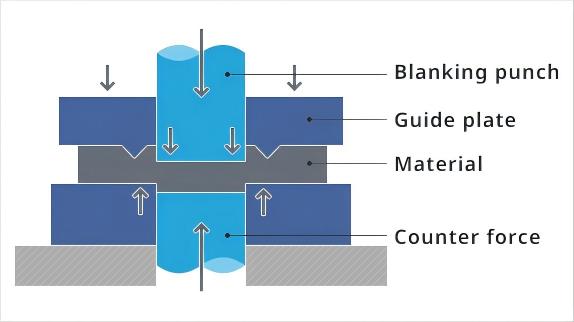
Fine blanking copper and aluminum requires significantly different force parameters compared to steel. Copper demands 30 to 40% less force than steel of the same thickness, while aluminum requires 35 to 45% less. This means an HF-320 press rated for 320 tons on steel can effectively process thicker or larger copper busbars at the same tonnage. The reduced force also extends die life and reduces press frame stress.
V-ring force must be reduced to 10 to 20% of the blanking force for soft materials, compared to 30 to 40% for steel. Excessive V-ring force on copper causes material flow into the die clearance, distorting the part. The V-ring geometry itself may be modified: a narrower, lower V-ring tooth is often used for copper to prevent excessive material displacement while still clamping the sheet firmly.
Die clearance is tightened to 0.5% of material thickness, compared to approximately 1% for steel. This tighter clearance is essential for achieving the clean shear surface and minimizing die roll on soft materials. Sharp cutting edges are absolutely critical: copper and aluminum tend to adhere to dull edges, causing galling, built-up edge formation, and deteriorating edge quality. Die surfaces should be polished and coated, with ongoing lubrication directed at the cutting zone to prevent adhesion.
Tool coating selection significantly impacts production stability for conductive materials. Titanium carbonitride (TiCN) and diamond-like carbon (DLC) coatings reduce the coefficient of friction between the copper or aluminum workpiece and the die surface, preventing material transfer and built-up edge formation. Coated tools can sustain 50,000 to 100,000 strokes between sharpening intervals, compared to 10,000 to 20,000 for uncoated tooling. Lubricant formulation is equally important: chlorinated or sulfurized oils provide the extreme-pressure protection needed for copper fine blanking but require post-processing removal for electrical applications. Water-soluble synthetic lubricants offer easier cleaning and are increasingly preferred for EV busbar production where surface cleanliness directly affects insulation adhesion.

EV busbar production volumes range from 100,000 to 1,000,000 parts per year per vehicle platform. At these volumes, fine blanking presses operating at 20 to 40 strokes per minute (SPM) match the throughput requirements while maintaining the edge quality and dimensional precision that battery applications demand. The SPM range balances speed against the force dwell time needed for complete fracture in copper and aluminum.
Automated feeding systems are essential for matching press throughput. Coil-fed systems supply strip directly to the press for progressive die configurations, while strip-fed systems deliver pre-cut blanks for compound die setups. Coil feeding reduces material handling and enables continuous production runs of 8 to 16 hours. Servo-feeders with precision roll mechanisms maintain feed accuracy within ±0.1mm, critical for multi-cavity busbar layouts.
HS-FINEB HF-200 to HF-500 presses are ideally suited for EV busbar production, offering the force range, speed, and control precision required for copper and aluminum materials. These presses feature adjustable V-ring force, counter-pressure control for flatness, and integrated lubrication systems that prevent copper adhesion. Contact Helen at sales@fineblankingmachine.com for a complete EV busbar production line configuration, including press selection, die design consultation, and auxiliary equipment specification.
HS-FINEB engineers specialize in copper and aluminum fine blanking for EV applications. Contact Helen for press selection, die design review, and complete production line configuration tailored to your busbar specifications and volume requirements.