In high-volume fine blanking production, every hour of press downtime for die resharpening or insert replacement directly costs $200–$500 in lost output. Quick-change die insert systems reduce changeover time from 3–4 hours to under 30 minutes — an 85–90% reduction that lifts press utilization from 70% to 88–92%. This guide covers cartridge design, changeover procedures, modular architecture, and implementation guidelines.
In fine blanking, die resharpening or insert replacement is a routine maintenance event that requires press downtime. The frequency depends on material type and part complexity — a die blanking 3 mm carbon steel may need resharpening every 15,000–30,000 strokes, while a die on 4 mm high-strength steel may require service every 5,000–10,000 strokes. At 30 strokes per minute, that is a resharpening cycle every 8–16 hours of production time for harder materials.
Conventional die change follows a laborious sequence: remove the upper die assembly from the press (1 hour), disassemble the die set (30 min), remove the worn insert (15 min), install the new or resharpened insert (15 min), reassemble the die set (30 min), reinstall in the press (30 min), and perform tryout with first-part inspection (30 min) — totaling approximately 3.5 hours. During this entire period, the press produces nothing, yet overhead costs (labor, facility, energy) continue to accrue.
Quick-change insert systems collapse this sequence: open the cartridge clamp (2 min), withdraw the used cartridge (5 min), insert a pre-set replacement cartridge (5 min), tighten the clamp (2 min), and perform first-part inspection (10 min) — totaling 24 minutes. The press utilization rate jumps from approximately 70% to 88–92%, which is critical for high-volume production where every hour of unplanned downtime costs $200–$500 in lost production output.

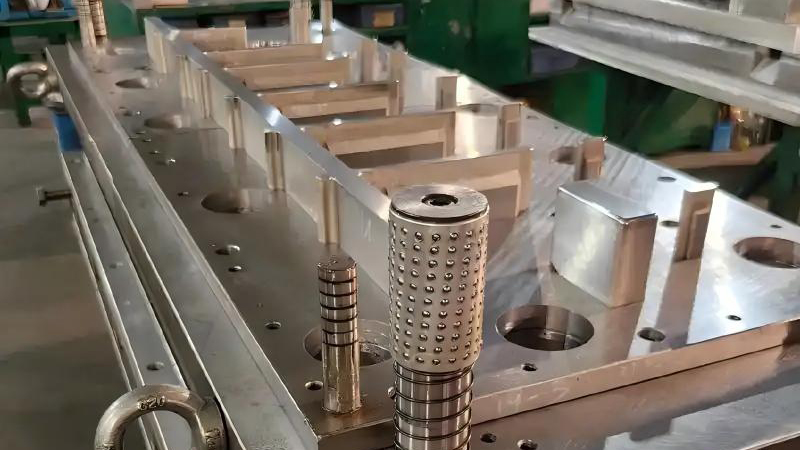
The insert fits into a precision-machined pocket in the die plate, located by two dowel pins and secured by high-strength screws. The cartridge format is standardized — same pocket dimensions, same dowel pin spacing, same screw pattern — so any cartridge of the same format is interchangeable between dies. This means a single spare cartridge can serve multiple die sets producing different parts, reducing the total spare insert inventory that must be maintained on the shop floor.
Each insert is pre-sharpened and pre-set to the correct position before it is installed in the press. The insert is mounted in the cartridge body in a toolroom setting, where a die maker uses a setting gauge or optical comparator to verify that the cutting edge is at the correct height and lateral position relative to the cartridge datum surfaces. When the cartridge is dropped into the die plate, the pre-set position transfers directly — no in-press adjustment is needed. The operator simply clamps the cartridge, runs one test part, and confirms quality.
The same cartridge format is used across different part dies within the same size class. If a production line switches from part A to part B (both using the same cartridge format), the operator swaps cartridges — the die plate, guide pillars, and stripper plate stay in the press. This is particularly valuable for job shops and tier-2 automotive suppliers who run multiple part numbers on the same press. The reduced setup time enables smaller batch sizes and more flexible production scheduling without sacrificing press utilization.
The cartridge body is manufactured from pre-hardened steel — typically P20M (28–34 HRC) or 4140 pre-hard (28–32 HRC). These materials provide sufficient toughness to withstand clamping forces and shock loading without cracking, while remaining machinable for pocket and dowel pin hole creation. The insert itself — the component that contacts the workpiece material — is made from powder metallurgy steel such as PM30 (60–62 HRC) or PM60 (62–64 HRC) for maximum wear resistance. The insert is heat-treated and ground to final dimensions before being set into the cartridge body.

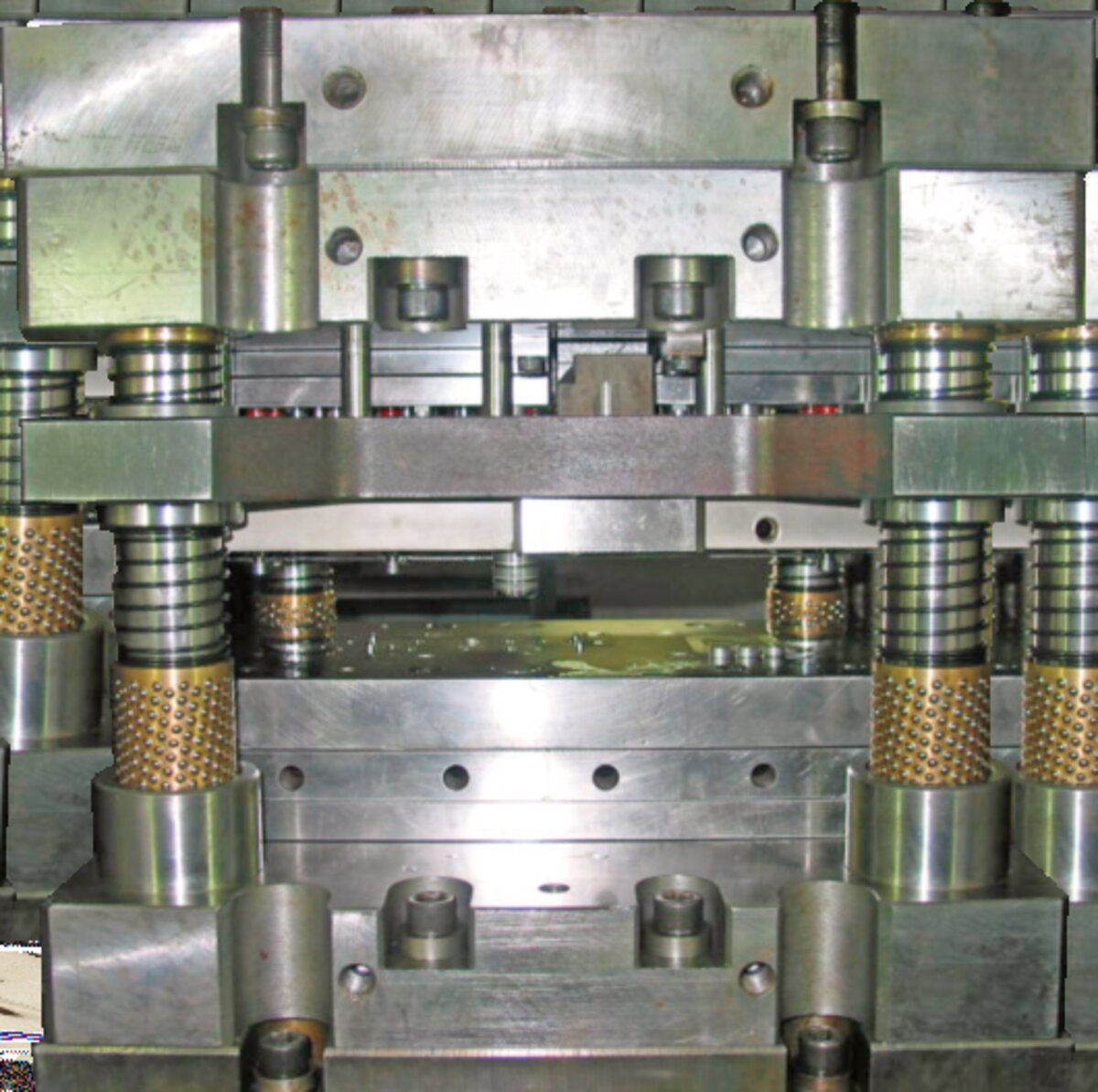
The conventional changeover requires removing the entire upper die from the press: breaking hydraulic and pneumatic connections, loosening clamping bolts, lifting the die set with a crane, and placing it on a workbench. Then the die is disassembled — stripper plate removed, punch bolts loosened, worn insert extracted. After replacing the insert, the entire process reverses. Each step requires a skilled die maker and crane access, creating a bottleneck when multiple presses need service.
The quick-change procedure requires no die removal, no disassembly, and no crane. The operator loosens the cartridge clamp bolts (2 min), slides the used cartridge out of the die plate pocket using a hand lever or extraction tool (5 min), inserts the pre-set replacement cartridge into the pocket (5 min), tightens the clamp bolts to specified torque (2 min), and runs a first test part for inspection (10 min). Total: 24 minutes, performed by a single operator without special lifting equipment. The die plate, guide system, and stripper plate remain undisturbed throughout.
The time savings are 85–90% compared to conventional changeover. Over a year of operation with 50 resharpening cycles, conventional changeover costs 175 hours of press downtime; quick-change costs 20 hours — a difference of 155 production hours. At $300/hour average production value, that is $46,500 per year in recovered production capacity from a single press.
Standard insert sizes reduce die design time because the designer works from a catalog of standard cartridge formats rather than designing each insert from scratch. The die plate pocket, dowel pin locations, and clamp geometry are already established — the designer only specifies the cutting profile. Standard insert blanks can be stocked, reducing lead time for new die construction or replacement.
Inventory management is simplified: maintain 2–3 sharpened insert sets per die, rotating them as they wear. When a set reaches its resharpening limit, it is sent to the toolroom while the next set is already in production. This rotation ensures a sharpened spare is always available, eliminating the waiting time that occurs when a single insert must be removed, resharpened, and reinstalled in sequence. The toolroom resharpening work is decoupled from press production time.
Consistent quality is achieved because pre-set inserts ensure the same dimensional accuracy at every changeover. The insert height, cutting edge position, and clearance are set in the controlled environment of a toolroom with precision gauges — not in the less controlled environment of the press floor with time pressure. Every cartridge delivers identical cutting geometry, which means part quality does not vary between changeovers. First-part reject rates drop by 60–80% compared to conventional changeovers where in-press adjustment introduces variability.
Predictive scheduling becomes possible when each insert has a stroke counter. The die tracks its stroke count, and when it reaches 80% of predicted life, the system flags the insert for scheduled changeover at the next production gap. This eliminates unplanned changeovers caused by sudden quality degradation — the maintenance team knows in advance when an insert will need replacement and can schedule the 24-minute changeover for a planned production break.
Cost: the quick-change system adds 20–30% to initial die cost due to the cartridge body, precision pocket machining, and dowel pin system. However, for high-volume production, this investment pays back within 6–12 months through recovered production hours. For low-volume production (under 10,000 parts per year per die), the payback period extends beyond 2 years and may not be justified.
When to invest: quick-change systems deliver ROI when production volume exceeds 50,000 parts per year per die, when the die requires resharpening more than 4 times per year, or when the press utilization target is above 85%. Below these thresholds, conventional die change may be more cost-effective. For operations running multiple part numbers on the same press with frequent changeovers, quick-change is justified even at lower volumes because the changeover frequency compounds the time savings.
Design considerations: the cartridge pocket in the die plate must be precision ground to ensure repeatable locating accuracy — pocket wall flatness of 0.005 mm and dowel pin hole position of ±0.01 mm are typical requirements. The dowel pin locations must be consistent across all cartridges in the same format family — any variation causes the insert cutting edge to shift position, negating the benefit of pre-setting. The clamp mechanism must apply consistent, repeatable clamping force to prevent the cartridge from shifting under blanking forces; hydraulic clamping is preferred over mechanical screw clamping for repeatability.
HS-FINEB offers quick-change die design as part of our die manufacturing service. We can also retrofit existing dies with a cartridge system — the die plate is machined to accept standard cartridge pockets, and new pre-set inserts are manufactured to match the existing part geometry. Contact Helen at sales@fineblankingmachine.com for a quick-change die consultation, and our engineers will evaluate your production volume, current changeover time, and die configuration to recommend the most cost-effective implementation path.
HS-FINEB designs and manufactures quick-change die insert systems tailored to your production volume and part geometry. Our engineers will assess your current die setup and recommend a cartridge solution that cuts changeover time by up to 90%.