Cold-rolled and hot-rolled steel differ significantly in surface finish, dimensional tolerance, grain structure, and mechanical properties — all of which directly affect fine blanking performance. For precision fine blanked parts, the choice between cold-rolled and hot-rolled material impacts die life, edge quality, dimensional accuracy, and overall production cost. This guide examines when to specify each type and why cold-rolled is the standard for fine blanking below 4 mm.
Hot-rolled steel begins as a slab heated above the recrystallization temperature (1100–1300°C), passed through rolling stands that reduce thickness to the specified gauge. The steel cools in air on the run-out table, forming a layer of iron oxide scale on the surface. This scale is characteristic of hot-rolled material and must be removed (by pickling) before most fine blanking applications. The rolling at high temperature produces recrystallized, equiaxed grain structure.
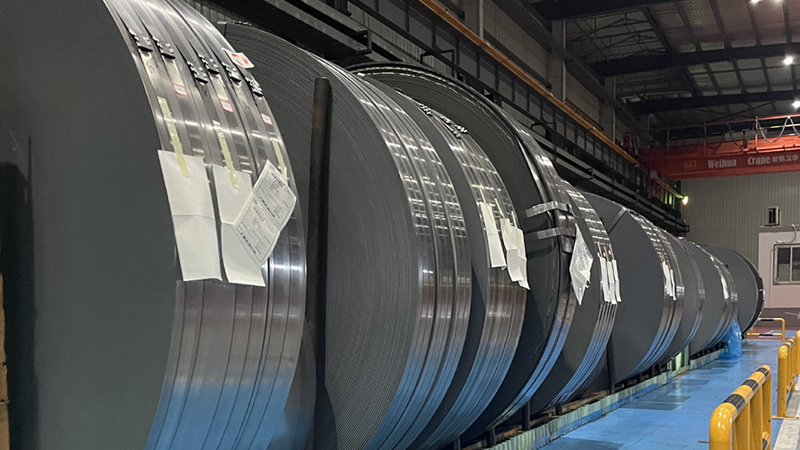
Cold-rolled steel starts as hot-rolled pickled steel that is further reduced at room temperature. The cold reduction work-hardens the surface, elongates the grains in the rolling direction, and produces a smooth, scale-free surface. Cold rolling reduction is typically 30–70% of the starting thickness. The result is tighter dimensional tolerances, better surface finish, and higher mechanical strength — all desirable properties for fine blanking.

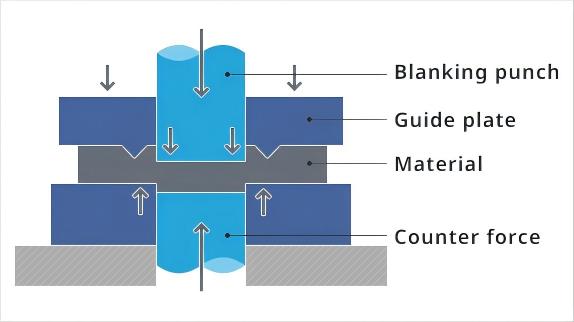
Cold-rolled steel has a smooth, uniform surface with Ra 0.4–0.8 µm, providing excellent die contact and consistent friction during blanking. Hot-rolled steel has a rough surface with Ra 1.6–6.3 µm, covered with iron oxide scale that must be removed before processing. The smooth cold-rolled surface ensures uniform V-ring engagement and consistent shear zone formation across the entire part.
Cold-rolled steel achieves thickness tolerances of ±0.05 mm or better, ensuring consistent V-ring engagement depth and uniform blanking force distribution. Hot-rolled steel has looser tolerances of ±0.15–0.30 mm, causing variation in V-ring engagement that leads to inconsistent die roll and edge quality. For tight-tolerance fine blanked parts, cold-rolled material is essential.
Cold-rolled steel has elongated, work-hardened grains from the rolling reduction, providing higher surface hardness and directional strength. Hot-rolled steel has equiaxed, recrystallized grains with uniform properties in all directions. The work-hardened cold-rolled surface can actually improve the wear resistance of the finished part, while the elongated grains contribute to smoother shear surfaces when properly oriented.
Cold-rolled steel has higher yield strength and tensile strength due to work hardening — typically 10–20% above the annealed condition. This means higher blanking force is required, but the finished part has better structural properties. Hot-rolled steel has lower strength but greater ductility, requiring less force to blank but producing parts with lower mechanical performance. The strength difference affects both processing parameters and end-use performance.

Cold-rolled steel is the standard choice for fine blanking below 4 mm. The smooth surface ensures uniform die contact and consistent V-ring engagement. The tight thickness tolerance means the V-ring penetrates to a consistent depth, producing uniform compressive stress and predictable die roll. The work-hardened surface can improve the wear resistance of the finished part. Tighter tolerances reduce the need for die adjustment between material lots.
Hot-rolled steel presents several challenges for fine blanking. The surface scale is abrasive and causes die wear 3–5 times faster than cold-rolled material. Inconsistent thickness affects V-ring engagement and force distribution, leading to variable die roll and edge quality. The rough surface causes dimensional variation in the blanked part. Pickling to remove scale adds a processing step and cost. Hot-rolled material is acceptable only for thick materials above 6 mm where cold-rolling is impractical, for non-critical applications, or after pickling and surface preparation.
For thick parts above 6 mm — such as structural brackets, heavy-duty gears, and machinery components — hot-rolled pickled steel is the practical and economical choice. After pickling removes the scale, the surface is clean enough for acceptable fine blanking quality. The looser thickness tolerance (±0.15–0.30 mm) requires a V-ring designed with sufficient depth range to accommodate variation. Die life will be shorter than with cold-rolled material, but the significantly lower material cost for thick gauges makes hot-rolled the rational choice for these applications.
Cold-rolled steel carries a 15–30% material cost premium over hot-rolled due to the additional cold reduction processing. However, this premium is often offset by lower total production cost. Available thickness ranges differ: cold-rolled is typically 0.3–4.0 mm, while hot-rolled starts at 1.5 mm and extends to 25 mm and above.
For fine blanking applications below 4 mm, cold-rolled is the standard material with wide availability. For 4–6 mm, cold-rolled is available but supply is more limited. Above 6 mm, hot-rolled pickled is the practical option, as cold-rolling such thicknesses becomes expensive and impractical.
The total cost comparison favors cold-rolled for most fine blanking applications. The material premium is offset by longer die life (no scale wear), better edge quality (fewer rejects), and fewer secondary operations (smoother surface requires less finishing). When evaluating material costs, consider the total cost of ownership including die maintenance, reject rates, and downstream processing — not just the per-kilogram material price.
A practical example illustrates the point: for a 3 mm thick automotive bracket produced at 100,000 parts per year, cold-rolled material costs approximately 20% more per kilogram than hot-rolled pickled. However, the cold-rolled die lasts 40,000 strokes versus 12,000 for hot-rolled, reducing annual die maintenance costs by 60%. The reject rate drops from 5% to under 1%, saving material and rework costs. The smoother surface eliminates a secondary deburring operation. The total cost per part, including all factors, is typically 10–15% lower with cold-rolled material despite the higher per-kilogram price.
Precision parts (tolerance ±0.02 mm): Specify cold-rolled steel with surface finish Ra 0.8 µm maximum. Require thickness tolerance within ±0.03 mm for consistent V-ring engagement. Structural parts (tolerance ±0.05 mm): Cold-rolled or hot-rolled pickled is acceptable. For hot-rolled, require pickled and oiled surface, scale-free. Thick parts (above 6 mm): Hot-rolled pickled is the practical option. Specify a scale-free, pickled surface and accept looser thickness tolerances. Adjust V-ring geometry to accommodate thickness variation.
Automotive applications: Specify cold-rolled steel per JIS G3141 or equivalent national standard. Specify the temper grade (1/8 hard to full hard) appropriate for the application. Stainless steel: Cold-rolled 2B finish is standard for fine blanking. The 2B finish provides a smooth, cold-rolled surface suitable for fine blanking without additional preparation.
HS-FINEB recommends always specifying the material condition (cold-rolled, hot-rolled pickled, annealed, etc.) on part drawings. Ambiguous material specifications lead to inconsistent quality and unexpected die wear. Contact Helen at HS-FINEB for material selection support and supplier recommendations for your fine blanking application.
When requesting quotes from material suppliers, include the fine blanking application context: specify the required edge quality percentage of clean shear, dimensional tolerance, and surface finish. This helps the supplier recommend the appropriate grade, temper, and condition. For high-volume automotive applications, consider establishing a direct supply agreement with a steel mill to ensure consistent grain structure and mechanical properties across production runs.
HS-FINEB engineers can help you specify the right steel type, condition, and tolerance for your fine blanking application. Contact us for material selection support and process optimization guidance.