💬 WhatsApp Chat

Fine Blanking Aerospace Seat Latches: Precision Safety Components

Aerospace seat latches secure passengers during normal flight and emergency landing conditions, requiring components with exceptional fatigue resistance, dimensional precision, and full material traceability. Fine blanking delivers 100% clean shear surfaces and tight tolerances that meet the rigorous demands of FAR/CS 25.561 safety requirements.

Safety-Critical Components

Seat Latch Function and Safety Requirements

Seat latches in commercial aircraft serve a critical safety function: they secure passenger seats against structural loads during normal flight turbulence and, more importantly, during emergency landing conditions. Federal Aviation Regulation FAR 25.561 and its European counterpart CS 25.561 mandate that seat attachments withstand a 16g forward load without failure. The latch mechanism must remain engaged and structurally intact throughout this dynamic event.

A typical seat latch assembly includes a cam that converts handle rotation into linear locking motion, a pawl that engages with the seat track, a locking plate that secures the pawl in the locked position, and a release lever for disengagement. Each of these components experiences cyclic loading during flight, with fatigue cycles accumulating over the aircraft service life of 60,000 to 90,000 flight hours.

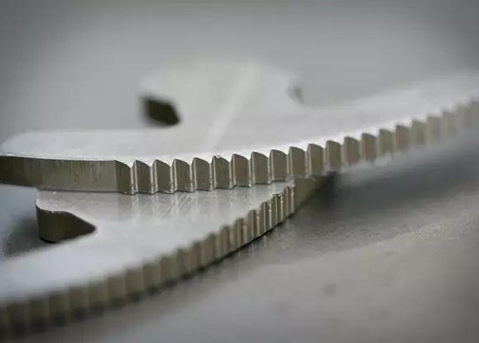
Fine blanking is the preferred manufacturing method for these components because it produces a 100% clean shear zone with no tear zone or micro-cracks that could propagate under fatigue loading. Tight dimensional tolerance of ±0.02mm on cam profiles ensures smooth locking engagement without backlash. Batch traceability from material certification through finished part supports the documentation requirements of aviation quality systems.

Precision fine blanked aerospace seat latch components showing clean shear surfaces
High-Strength Alloys

Material Selection for Safety-Critical Latches

17-4PH Stainless Steel

Precipitation hardening stainless steel in the H900 condition achieves approximately 40 HRC hardness with excellent fatigue strength and corrosion resistance. 17-4PH is the workhorse material for aerospace seat latch components, offering a tensile strength of 1,034 MPa and good fracture toughness. Fine blanking is performed in the solution-annealed condition (Condition A) at 31 HRC maximum, after which parts are aged to H900 for final properties.

15-5PH Stainless Steel

Similar to 17-4PH but with improved transverse toughness due to its refined microstructure. 15-5PH is preferred for the most critical latch components where crack propagation resistance in the transverse direction is essential. The material achieves comparable strength to 17-4PH in the H900 condition but provides better impact energy values, making it the choice for primary load path components in the latch assembly.

300M Alloy Steel

Ultra-high-strength alloy steel reaching 52 HRC and tensile strength above 1,860 MPa, 300M is used for the highest-stress components in the latch mechanism where space constraints demand maximum strength in minimum cross-section. Fine blanking 300M requires high press force and specialized die materials such as tungsten carbide punches. The material is blanked in the annealed condition and heat-treated after.

Material Certification per AMS

All aerospace materials require certification per AMS specifications. 17-4PH plate is certified to AMS 5604, 15-5PH to AMS 5659, and 300M to AMS 6419. Full heat treatment traceability per AMS 2759 ensures that the thermal processing of each lot is documented and controlled. Material certificates include heat number, chemistry, mechanical properties, and heat treatment records, maintained for the full service life of the aircraft.

Fatigue Performance

Edge Quality for Fatigue Resistance

Precision fine blanked components for safety-critical latch mechanisms

Clean Shear Zone Prevents Crack Initiation

The 100% clean shear zone produced by fine blanking is the primary reason the process is specified for fatigue-critical aerospace components. Unlike conventional stamping, which produces a tear zone with rough, micro-cracked surfaces, fine blanking creates a smooth shear surface across the entire material thickness. This eliminates the crack initiation sites that cause fatigue failure under cyclic loading.

Surface finish on the fine-blanked edge typically measures Ra 0.4 to 0.8, which is superior to many machined surfaces for fatigue performance. The work-hardened shear layer on the edge surface actually enhances fatigue resistance by introducing compressive residual stresses. Burr on critical surfaces is eliminated or controlled to less than 0.02mm, because burr acts as a stress concentration feature and crack initiator under cyclic load.

Die roll is controlled to a maximum of 10% of material thickness through V-ring optimization. Excessive die roll creates a radius transition that can reduce the effective shear area and introduce stress concentration. The V-ring geometry, force, and position are optimized for each material and thickness to minimize die roll while maintaining full clamping during fracture.

Quality Assurance

Certification and Traceability

Aerospace component manufacturing operates under AS9100 quality management system requirements, which extend beyond ISO 9001 to include additional focus on configuration management, risk assessment, and special process control. Fine blanking facilities producing seat latch components must maintain AS9100 certification with documented procedures for die qualification, first article inspection, and in-process controls.

Material traceability follows each component from mill to finished part. Heat number from the material certificate links to the production lot, which links to the fine blanking die setup record, process parameters, inspection results, and final packaging. First article inspection per AS9102 verifies that the fine blanking die produces parts meeting all dimensional, edge quality, and surface finish requirements. Statistical process control (SPC) monitors critical dimensions during production, with Cpk values above 1.33 required on safety-critical features.

All documentation, including material certificates, process records, inspection reports, and nonconformance dispositions, is retained for 10 years or more per aviation record retention requirements. This documentation supports fleet maintenance, investigation of in-service issues, and continued airworthiness demonstrations. Any modification to the fine blanking die triggers a delta first article inspection to verify that the change has not degraded part quality. Special process controls extend to heat treatment, where AMS 2759 pyrometry requirements mandate calibrated furnaces, thermocouple placement verification, and temperature uniformity surveys performed at defined intervals. Non-destructive testing such as fluorescent penetrant inspection per ASTM E1417 may be specified for finished components to detect surface indications that metallographic sampling alone cannot catch. These layered controls ensure that every fine-blanked seat latch component entering service meets the same quality standard verified during initial qualification.

HS-FINEB Capability

Aerospace Component Fine Blanking Experience

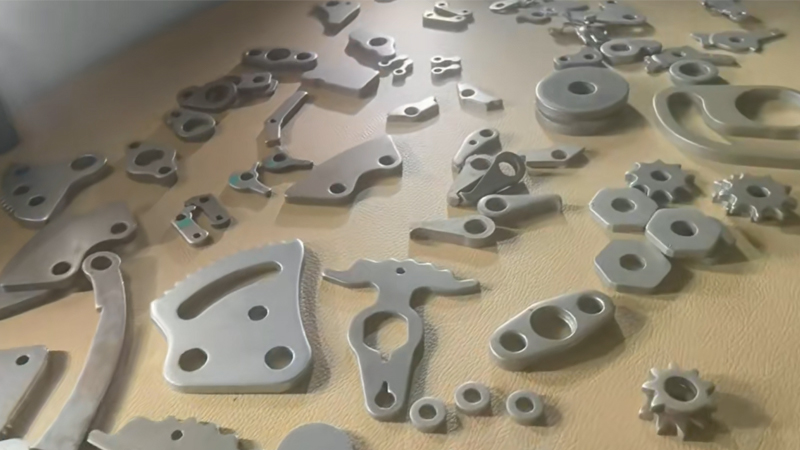
Fine blanked aerospace safety components showing clean edges and precise geometry

Press Capability and Die Engineering

HS-FINEB manufactures fine blanking presses up to 800 tons suitable for aerospace component production. The HF-800 press provides the force capacity needed for 17-4PH and 15-5PH stainless steel in the thickness range typical of seat latch components (2 to 6mm). Press features including adjustable V-ring force, counter-pressure control, and precision stroke adjustment support the tight tolerances and edge quality requirements of safety-critical parts.

Die design support includes Design for Fine Blanking (DfFB) review, which evaluates part geometry for manufacturability and identifies features that may compromise edge quality or die life. The DfFB process examines radii, hole positions, web thicknesses, and material selection to optimize the fine blanking process for fatigue-critical features. Clean shear capability has been verified on 17-4PH and 15-5PH materials, with metallographic inspection confirming 100% shear zone across the full material thickness.

The production traceability system at HS-FINEB maintains lot-level records of material certificates, die setup parameters, process measurements, and inspection results, supporting the documentation requirements of aerospace customers. Die life monitoring tracks stroke count and edge wear, triggering preventive resharpening before quality degrades. Contact Helen at sales@fineblankingmachine.com or +86-13062870081 to discuss aerospace component development, including material selection, die design, and production qualification for your seat latch and safety-critical component requirements.

Discuss Your Aerospace Component Requirements

HS-FINEB provides fine blanking presses and die engineering support for safety-critical aerospace components. Contact Helen for material selection guidance, DfFB review, and production traceability systems that meet AS9100 requirements.

💬