A comprehensive technical comparison of fine blanking against conventional stamping, laser cutting, progressive die stamping, and wire EDM across edge quality, dimensional tolerance, production speed, tooling investment, and volume suitability to guide your process selection.
Selecting the optimal metal forming process requires balancing part quality, production volume, tooling budget, and delivery timeline. Fine blanking delivers edge quality approaching wire EDM at production speeds competitive with stamping once tooling is amortized.
| Criteria | Fine Blanking | Conventional Stamping | Progressive Die | Laser Cutting | Wire EDM |
|---|---|---|---|---|---|
| Best Use Case | High volume precision parts with smooth edges | Low cost high speed simple shapes | Complex multi feature parts in coil strip | Prototypes low volume thick plate | Ultra precision low volume hard materials |
| Edge Quality | 90 to 100% smooth shear zone | 30 to 40% shear zone remainder torn | 30 to 40% shear zone per station | Heat affected zone rough dross edge | Perfect smooth no HAZ |
| Tolerance | IT6 to IT9 / plus or minus 0.01 to 0.05mm | IT12 to IT14 / plus or minus 0.1 to 0.3mm | IT10 to IT12 / plus or minus 0.05 to 0.15mm | Plus or minus 0.1 to 0.3mm positionally | Plus or minus 0.005mm achievable |
| Secondary Processing | Usually none required net shape | Often requires deburring machining | May require deburring or forming | Often requires deburring grinding | None edge quality is perfect |
| Tooling Investment | High 2 to 3x stamping die cost | Low to moderate | High complex multi station die | No tooling fixturing only | No tooling programming only |
| Production Volume | 10,000 to millions per year | 5,000 to millions per year | 50,000 to millions per year | 1 to 5,000 parts per year | 1 to 1,000 parts per year |
| Speed | 20 to 80 strokes per minute | 200 to 600 strokes per minute | 100 to 400 strokes per minute | Varies by thickness slow for precision | Very slow mm per minute cut rate |
Conventional stamping and fine blanking both use a punch and die to shear material, but differ fundamentally in process physics. Conventional stamping applies a single ram force. The material shears cleanly for approximately 30 to 40 percent of its thickness, then transitions to fracture and tears through the remainder, producing a ragged edge with burrs. The fracture surface is rough and mechanically weak compared to the sheared zone.
Fine blanking replaces the single force with three simultaneous forces: V-ring impingement constrains the material around the cutting line, counter-pressure prevents downward bulging, and the blanking punch produces clean shearing through 100 percent of material thickness. Die clearance in fine blanking is 0.5 percent of material thickness, compared to 5 to 10 percent in conventional stamping. This tight clearance, combined with material constraint, forces the metal to shear rather than tear.
Conventional stamping dies cost 50 to 70 percent less and run 3 to 10 times faster. However, stamped parts often require secondary machining, deburring, or grinding to achieve functional dimensions. Fine blanking produces net-shape parts with edges smooth enough for functional contact surfaces, gear teeth, and bearing seats without secondary operations. For volumes above approximately 10,000 parts per year where edge quality matters, fine blanking typically delivers lower total cost of ownership despite higher tooling investment.
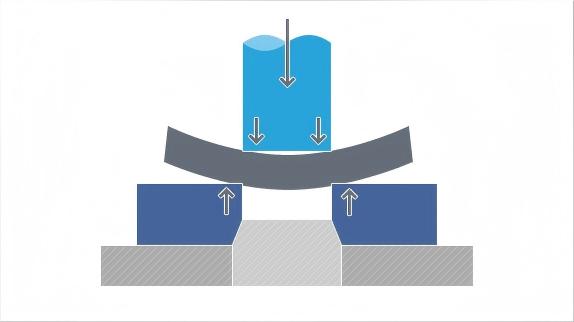
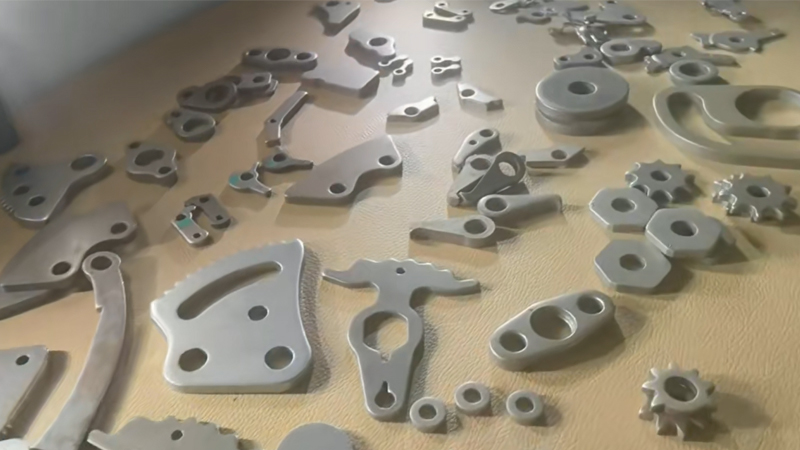
Laser cutting uses a focused high-energy beam to melt and vaporize material along a programmed path. It offers exceptional flexibility: no hard tooling is required, geometry changes are software-driven, and lead time from drawing to first part can be under one hour. For prototypes and low-volume production, laser cutting is often the most economical choice. Modern fiber lasers cut carbon steel up to 25mm thick at speeds exceeding meters per minute.
However, laser cutting introduces a heat-affected zone, or HAZ, along the cut edge. In carbon steels, this produces a hardened, brittle edge layer 0.1 to 0.5mm deep, creating stress concentrations and cracking risk under fatigue loading. In stainless steels, the HAZ can deplete chromium content, reducing corrosion resistance. Aluminum edges suffer from oxide formation and recast layer deposition. For functional edges experiencing contact or fatigue, the HAZ is a significant concern.
Fine blanking produces a cold-worked shear edge with no heat-affected zone. The material structure remains continuous with no recast, no oxide, and no metallurgical degradation. This makes fine blanking preferred for automotive safety components, medical devices, and aerospace parts where edge integrity affects performance. For volumes above 5,000 parts per year, fine blanking delivers lower per-part cost with superior edge quality and perpendicularity.
Progressive die stamping is a coil-fed process where material advances through multiple die stations, each performing one operation: piercing, blanking, forming, bending, or coining. By the final station, a complete complex part has been produced. Progressive dies are dominant for high-volume sheet metal parts with multiple features, such as electronics connectors and appliance brackets. Production speeds of 100 to 400 strokes per minute are common.
The critical distinction is that progressive stamping uses conventional stamping clearances and single-force shearing at each station. Each cut edge exhibits the same 30 to 40 percent shear zone and 60 to 70 percent fracture surface as conventional stamping. Parts requiring smooth functional edges, precise hole-to-profile positioning, or flatness within 0.05mm cannot be produced in a standard progressive die without secondary operations.
Fine blanking can be implemented in progressive configurations, known as progressive fine blanking or fine blanking transfer dies, where each station uses the triple-force architecture. HS-FINEB manufactures multi-station fine blanking presses for this application. However, process speed drops to 20 to 60 SPM due to longer dwell time for V-ring engagement. The decision between progressive fine blanking and conventional progressive stamping hinges on whether the part's functional requirements demand fine-blanked edge quality. For parts where every edge is functional, progressive fine blanking delivers the required quality within a coil-fed automated line. For parts where only some edges are functional, a conventional progressive die with selective secondary machining may be more economical.
Wire electrical discharge machining, or wire EDM, uses a thin brass or molybdenum wire to erode material through rapid electrical discharges. The wire never contacts the workpiece; material removal occurs through localized melting and vaporization. Wire EDM achieves the highest dimensional accuracy of any metal cutting process, with positioning tolerance of plus or minus 0.005mm and perfectly smooth edges with no burr, no HAZ, and no mechanical stress. It cuts any electrically conductive material regardless of hardness, including hardened tool steels and exotic alloys that cannot be mechanically sheared.
The limitation of wire EDM is speed. Cut rates range from 50 to 300 square millimeters per minute. An automotive gear blank that fine blanking produces in one 1.5-second stroke might require 20 to 60 minutes of wire EDM time. This makes wire EDM viable only for extremely low volumes, prototypes, or applications where no other process achieves the required precision. Tooling costs are zero, but per-hour machine cost is high and throughput is fundamentally limited by the physics of electrical discharge erosion.
Fine blanking offers a compelling middle ground: edge quality and dimensional accuracy approach wire EDM standards, while production speed is three to four orders of magnitude faster. A fine blanking press at 40 SPM manufactures 2,400 parts per hour versus one or two on wire EDM. For volumes above 100 parts, fine blanking tooling is rapidly amortized. For one prototype or ten validation parts, use wire EDM. For ten thousand or more parts with precision edges, fine blanking is the superior choice.
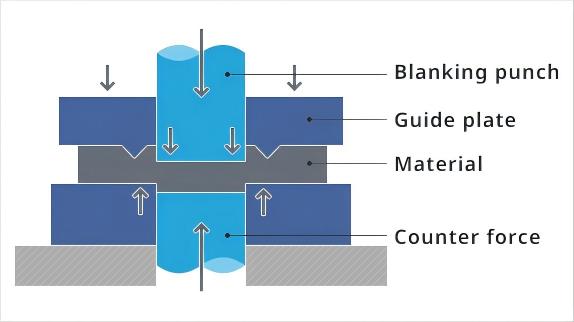
The following scenarios represent ideal conditions for selecting fine blanking. If your application matches three or more conditions, fine blanking will likely deliver the lowest total cost of ownership. HS-FINEB engineers provide free feasibility assessments against your drawings, material, and volume requirements.
Send us your part drawings, material specifications, and annual volume estimates. Our engineering team will analyze your requirements against this process comparison and recommend the most cost-effective manufacturing method, whether that is fine blanking on an HS-FINEB press or an alternative approach.