
Understanding Fine Blanking Technology
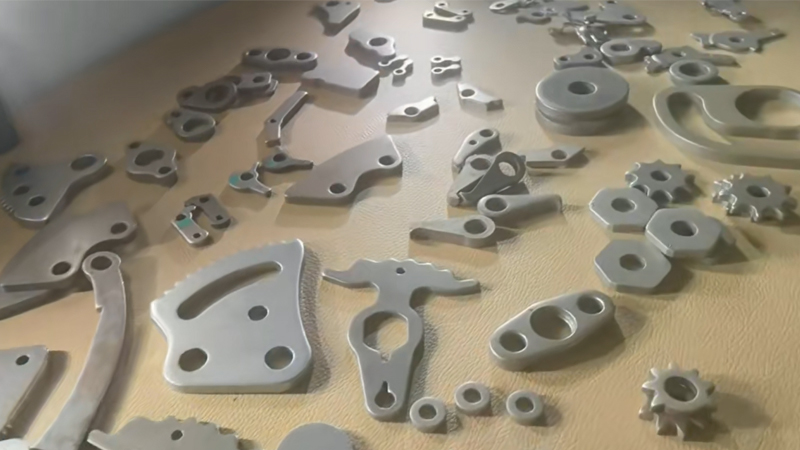
Fine blanking is a precision metal forming process that produces parts with clean sheared edges and exceptional dimensional accuracy in a single press stroke. Unlike conventional stamping, which leaves rough fractured edges and requires secondary operations, fine blanking delivers finished components ready for assembly or minimal post-processing.
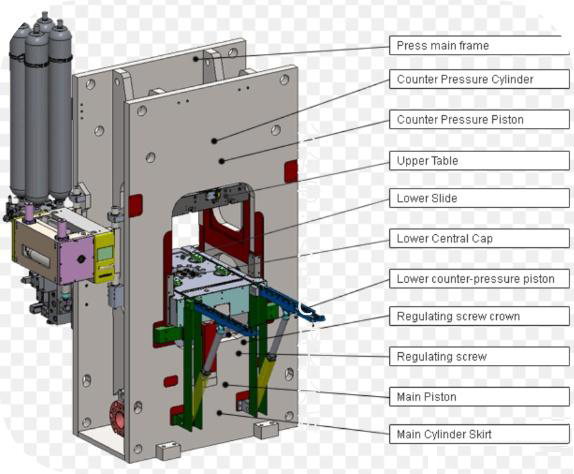
The process relies on three simultaneous force components: the main cutting force from the punch, the V-ring pressure that clamps material against the die face, and the counter-pressure that holds the part flat. This three-force system, combined with tight punch-to-die clearances, creates pure shearing action that produces smooth edges with minimal fracture zone.
HS-FINEB designs and manufactures the HF series hydraulic fine blanking presses from 200 tons to 1200 tons, supported by die design services, coil feeding systems, and automation integration. Our customers span automotive, aerospace, electronics, medical, and energy sectors worldwide.
Top 10 Fine Blanking Questions
Answers compiled by HS-FINEB senior application engineers with decades of combined experience in fine blanking process development and press manufacturing.
Q1 What is the main advantage of fine blanking over conventional stamping?
The primary advantage of fine blanking is producing parts with clean sheared edges, exceptional flatness, and tight dimensional tolerances in a single stroke, eliminating secondary machining. Where conventional stamping leaves rough edges with burr and deformation, fine blanking produces edges up to 100 percent sheared with minimal fracture zone.
This is achieved through a unique three-force system: a V-ring plate clamps material around the cutting perimeter, counter-pressure holds the part flat, and the punch cuts with extremely tight clearances. This produces positional tolerances of IT7 to IT8, straightness within 0.01 mm per 100 mm, and surface roughness Ra 0.8 to 3.2 micrometers on edges.
This translates to reduced labor, lower equipment investment, faster throughput, and improved consistency. Automotive and aerospace suppliers particularly benefit from eliminating milling, grinding, and deburring.
Q2 What materials can be fine blanked?
Fine blanking accommodates ferrous and non-ferrous materials including carbon steels (DC01, DC04, SPCC), alloy steels, stainless steels (304, 316, 430), copper alloys, brass, bronze, and aluminum alloys. Material thickness ranges from 0.5 mm to 16 mm depending on press tonnage and die complexity.
Softer materials with lower tensile strength produce cleaner edges and longer die life, while harder materials require higher forces and more maintenance. HS-FINEB HF series presses feature adjustable hydraulic pressure profiles to optimize V-ring and counter-pressure settings for each material grade.
Our engineering team provides detailed process parameter recommendations based on material test data and decades of global production experience.
Q3 What dimensional tolerances can fine blanking achieve?
Fine blanking achieves positional tolerances of IT7 to IT8, straightness within 0.01 mm per 100 mm, and surface roughness Ra 0.8 to 3.2 micrometers. These capabilities make it the preferred process for precision automotive, aerospace, and medical components.
Achievable tolerances depend on material consistency, die precision, press rigidity, and process control. HS-FINEB HF series presses with monoblock frames and precision guides help customers achieve the tighter end of the tolerance band.
For gear tooth profiles, bearing races, and mounting holes, fine blanking delivers accuracy rivaling machined components while maintaining stamping economics. Our QA team validates every press before shipment with certified measurement protocols.
Q4 How does press rigidity affect part quality?
Press frame rigidity controls elastic deflection under full cutting load. Even microscopic deflection can open punch-die clearance during cutting, causing edge defects, variation, and die wear.
A rigid monoblock frame minimizes deflection, maintaining consistent clearance throughout the stroke. HS-FINEB HF presses feature monoblock construction with optimized stress distribution, keeping deflection below tolerance thresholds at maximum tonnage.
Slide guidance accuracy is equally critical. HS-FINEB employs eight-point guided slides with adjustable gib strips to maintain guidance precision, directly improving part consistency and extending die life.
Q5 What is the relationship between tooling design and part accuracy?
Tooling design is the most critical factor for part accuracy. V-ring geometry must provide clamping without excessive marks. Punch-die clearances of 0.3 to 0.8 percent of material thickness must be uniform around the cutting perimeter.
Progressive dies require micron-level feeding accuracy with managed strip stress. Ejector forces must avoid distortion. Die material, heat treatment, and coatings influence edge quality and longevity.
HS-FINEB's die engineering team collaborates from concept through production, optimizing die geometry for each part using CAD and simulation software.
Q6 When should I choose fine blanking over laser cutting?
Fine blanking is the preferred choice over laser cutting when production volumes exceed approximately 10,000 parts per year, when edges must be perfectly perpendicular without secondary deburring, when part flatness is critical for downstream assembly, or when the material is reflective and difficult to process with laser technology.
For thick materials above 6 mm, laser cutting speed drops significantly and heat-affected zones become problematic, potentially altering material properties near the cut edge. Fine blanking maintains the original material metallurgy throughout the part because it is a cold-forming process with no thermal influence.
Laser cutting offers superior flexibility for prototype quantities and complex nesting without hard tooling investment. However, for medium to high volume production of precision parts, fine blanking delivers lower per-piece cost, better edge quality, tighter tolerances, and higher production rates. Many manufacturers use laser cutting for prototypes and fine blanking for production ramp-up.
Q7 Can complex 3D features be created through fine blanking?
Yes, through coining, embossing, bending, and shallow forming within progressive or compound dies. Features such as countersinks, half-shears, shallow draws, small bends, and locating holes can be produced in-line with blanking.
The constraint is that forming must occur within press stroke and die space. Deep draws and complex bends may require secondary operations or transfer press technology.
HS-FINEB multi-station presses provide additional forming stations, enabling complex geometries in a single automated line. Our die team evaluates manufacturability for each part.
Q8 What is the typical lifespan of a fine blanking die?
With proper material selection and maintenance, fine blanking dies achieve between 500,000 and 5,000,000 strokes before requiring re-sharpening, depending on material hardness, part complexity, and coating technology. Dies cutting soft carbon steels may last several million strokes, while dies processing stainless steels or thick materials require more frequent maintenance.
Premium tool steels such as ASP 23, Vanadis 4, or high-speed steel variants with advanced PVD coatings can extend die life substantially by reducing friction, galling, and abrasive wear. Regular inspection and scheduled re-sharpening, typically at 80 percent of predicted life, prevent catastrophic edge breakdown that could damage the entire die assembly.
HS-FINEB offers comprehensive die maintenance programs including inspection scheduling, re-sharpening services, coating refresh, and spare component management. Our service team can also train customer maintenance personnel in die care best practices to maximize tooling investment return.
Q9 How does fine blanking reduce total manufacturing cost?
Fine blanking reduces total manufacturing cost by eliminating milling, grinding, and deburring operations while producing net-shape or near-net-shape parts directly from coil stock. The process consolidates multiple operations into a single high-speed press stroke, reducing labor content, floor space requirements, work-in-process inventory, and quality inspection steps.
Material utilization is another significant cost driver. Advanced nesting algorithms and precision coil feeding systems achieve utilization rates of 70 to 85 percent, depending on part geometry, compared to 40 to 60 percent for machined parts from bar stock or plate. The scrap generated in fine blanking is clean sheet metal, readily recyclable at full value.
When evaluated on a total cost of ownership basis including capital depreciation, labor, floor space, energy, and quality assurance, fine blanking typically becomes cost-competitive with machining at annual volumes between 5,000 and 20,000 pieces, depending on part complexity. At volumes above 50,000 pieces annually, fine blanking is usually the dominant economic choice.
Q10 What tonnage press do I need for my part?
Required tonnage depends primarily on the perimeter to be cut, material thickness, and ultimate tensile strength. A practical calculation rule is approximately 60 to 80 percent of the total shear area multiplied by the material shear strength, with additional capacity for V-ring force and counter-pressure requirements.
As a rough guide: small precision parts under 100 mm cutting perimeter in 3 mm steel typically require 200 to 320 tons. Automotive transmission components with 300 to 500 mm perimeter in 4 to 6 mm steel need 500 to 650 tons. Large structural plates and heavy-duty parts may require 800 to 1200 tons.
HS-FINEB HF series spans from HF-200 for small precision electronics and medical parts to HF-1200 for large automotive structural components. Our application engineering team provides detailed tonnage calculations based on your part drawings, material specifications, and production requirements. We also offer die trial services on our reference presses to validate process feasibility before investment.
Still Have Questions?
Our application engineering team is available to answer specific questions about your part design, material selection, process feasibility, and press configuration. We offer free preliminary process evaluations based on part drawings and production requirements.
Contact us to schedule a technical consultation with one of our senior fine blanking specialists. We can review your drawings, recommend optimal press tonnage, die configuration, and auxiliary equipment, and provide budgetary quotations for the complete production solution.
HS-FINEB also welcomes visitors to our manufacturing facility in Hubei Province, China, where you can observe our HF series presses in operation, review die manufacturing processes, and discuss your application with our engineering team in person.
Get Expert Fine Blanking Advice
Speak with our engineering team about your specific application requirements. We provide free technical consultations and preliminary process evaluations.