CNC-controlled hydraulic fine blanking presses with HMI interface, servo systems, automated production line integration, and remote monitoring for intelligent manufacturing.
Smart fine blanking represents the convergence of traditional triple-force precision shearing technology with modern digital control systems, sensor networks, and data analytics. While the fundamental physics of fine blanking remain unchanged, the way the process is controlled, monitored, and optimized has been transformed by Industry 4.0 principles. A smart fine blanking press is no longer a standalone machine tool but an intelligent manufacturing node connected to production planning systems, quality databases, and maintenance platforms.
The core capability of smart fine blanking is real-time closed-loop control of the three critical forces. In a traditional hydraulic fine blanking press, the operator manually sets V-ring pressure, counter-pressure, and blanking speed using analog gauges and mechanical valves. In a smart press, proportional servo valves controlled by a CNC system adjust these parameters stroke by stroke, with feedback from pressure transducers, linear encoders, and force sensors. If the material thickness varies slightly from coil to coil, the controller automatically compensates by adjusting V-ring penetration depth and counter-pressure magnitude to maintain consistent part quality.
Data collection is equally important. Every stroke generates a force versus time profile, a position versus time profile, and quality measurements from in-line sensors. This data is stored in a local historian database and can be uploaded to a cloud manufacturing execution system. Over time, the accumulated data enables statistical process control, automatic parameter optimization, and predictive maintenance algorithms that anticipate component wear before it affects part quality.
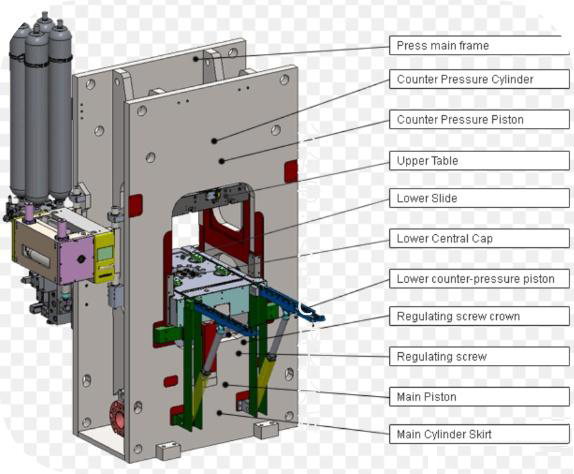
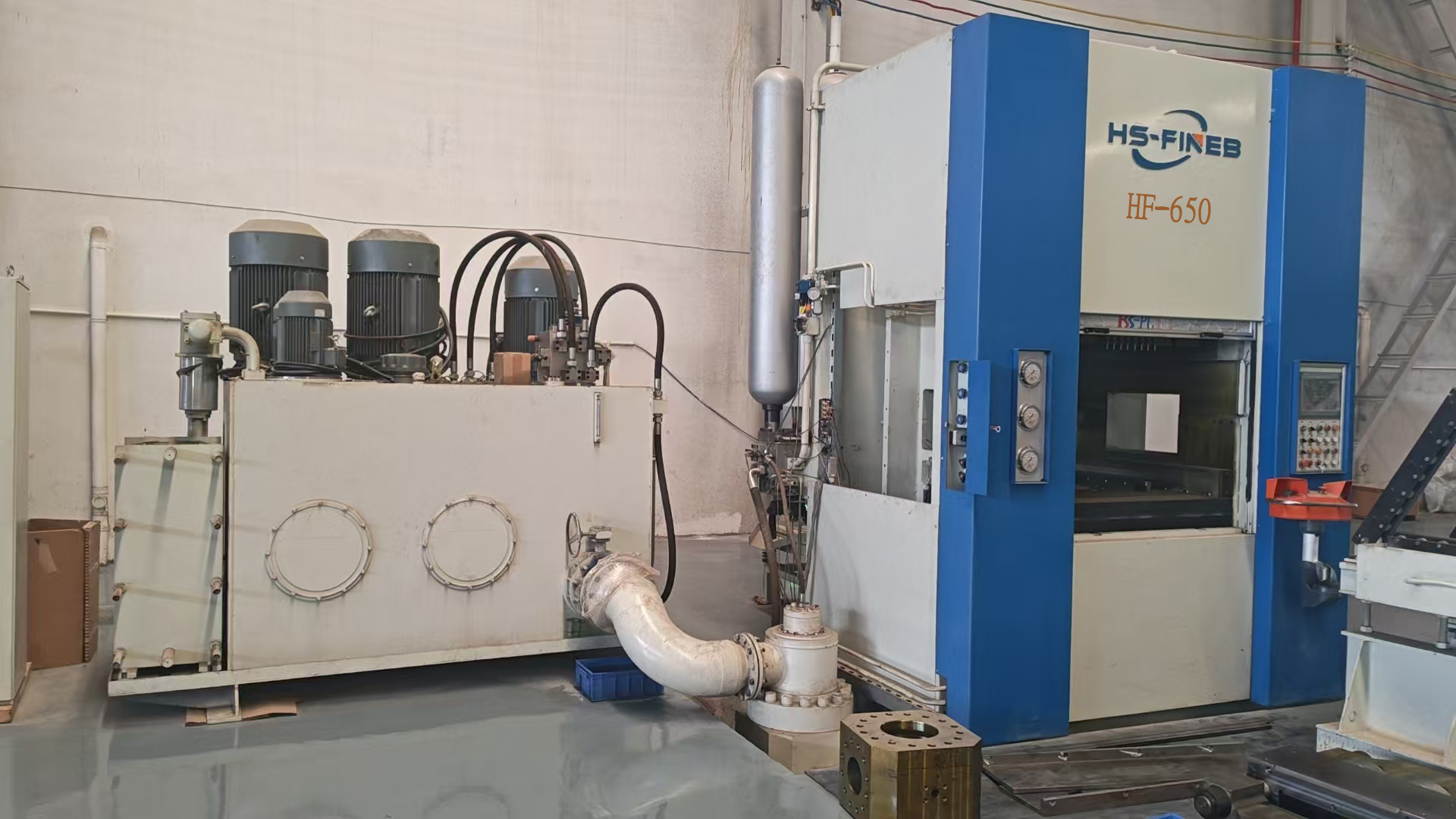
The HS-FINEB HF series features a high-resolution HMI touch screen panel mounted on a swing arm at the operator station. The interface displays real-time force curves for V-ring, counter-pressure, and blanking ram during each stroke. Operators can call up stored die recipes from the recipe database, each containing pre-calibrated force parameters, speed profiles, and safety limits for a specific die and material combination. Recipe switching between different production jobs takes less than thirty seconds, compared to manual valve adjustment that previously required fifteen to twenty minutes.
Every aspect of the pressing cycle is programmable through the CNC controller. The operator sets V-ring force as a percentage of blanking force, counter-pressure as a percentage of blanking force, approach speed, cutting speed, dwell time at bottom dead center, return speed, and stripper timing. Advanced users can program multi-stage speed profiles, where the ram slows down during the actual cutting phase for maximum edge quality, then accelerates during the return stroke to maximize overall cycle rate. These parameters are stored per die recipe and can be exported via USB or Ethernet for backup and replication across multiple presses.
Linear optical encoders on the main ram provide position feedback with 0.01 millimeter resolution. The controller compares actual ram position against the commanded position profile every millisecond and adjusts proportional valve response to eliminate following error. Force monitoring uses strain-gauge load cells integrated into the hydraulic cylinders, with sampling rates up to one kilohertz. If any force reading exceeds programmed safety limits, the press stops immediately and logs the event with timestamp and die identification for quality traceability.
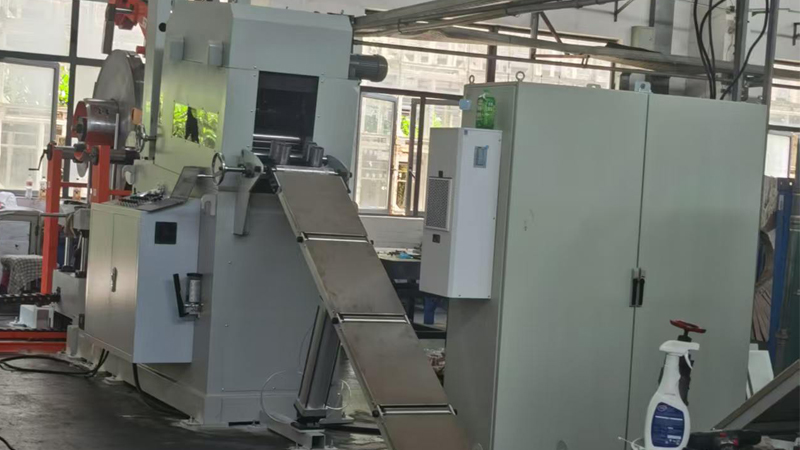
Hydraulic or motorized decoilers with tension control feed strip from master coil into the line at controlled speed and tension, preventing coil set and surface damage.
Precision roller levelers with eleven to twenty-one rolls remove coil curvature and internal stress, delivering flat strip to the feeder with residual curl below 0.5 millimeter per meter.
The HF series press performs the precision shearing operation with CNC-controlled triple forces, producing net-shape parts with smooth edges and tight tolerances in a single stroke.
Continuous vibratory or brush deburring systems remove the minimal die-roll and micro-burr from fine-blanked edges, preparing parts for assembly or coating without manual handling.
In-line vision inspection systems with high-resolution cameras check critical dimensions, edge quality, and presence of all features on every part, rejecting outliers automatically.
Robotic or pneumatic stacking systems sort parts by quality grade, count them into programmable batches, and place them directly into shipping containers or tote pans.
The complete production line is controlled by a master programmable logic controller that coordinates timing between all stations. When the press completes a stroke, the feeder advances, the parts conveyor moves, and the stacking system updates, all synchronized within milliseconds. Changeover between different part numbers is managed at the master controller level, with each station automatically loading its recipe parameters from the central database. This integration reduces labor requirements from three operators per shift to one supervisor and eliminates the quality variation that occurs when parts are manually transported between operations.
Die changeover time directly impacts overall equipment effectiveness because every minute spent changing dies is a minute of lost production. In traditional fine blanking operations, die changeover requires crane-assisted removal of the upper and lower die sets, manual disconnection of hydraulic couplings for V-ring and counter-pressure cylinders, recalibration of the feeder alignment, and trial-and-error adjustment of force parameters until part quality is acceptable. This process typically consumes two to four hours.
The HS-FINEB quick die change system reduces this to under thirty minutes through a combination of mechanical, hydraulic, and electronic innovations. Die clamping uses hydraulic quick-clamp fixtures on both the upper and lower platens, activated by a single button press. The hydraulic couplings for V-ring and counter-pressure circuits use self-sealing quick-connect fittings that maintain system pressure without leakage. Die transfer carts with precision rollers allow the operator to roll the complete die set out of the press and roll the new die set in, with mechanical centering guides that achieve automatic alignment within 0.05 millimeter.
Electronic parameter transfer completes the changeover. Each die carries a radio-frequency identification tag or a barcode that the operator scans. The CNC controller immediately loads the complete parameter recipe for that die, including V-ring force, counter-pressure, blanking speed, feeder advance length, strip width limits, and safety envelopes. The first part produced after changeover is typically within specification, because the parameters are pre-calibrated rather than adjusted by trial and error. This predictability increases overall equipment effectiveness from seventy percent to over ninety percent in mixed-model production environments where changeovers occur multiple times per shift.
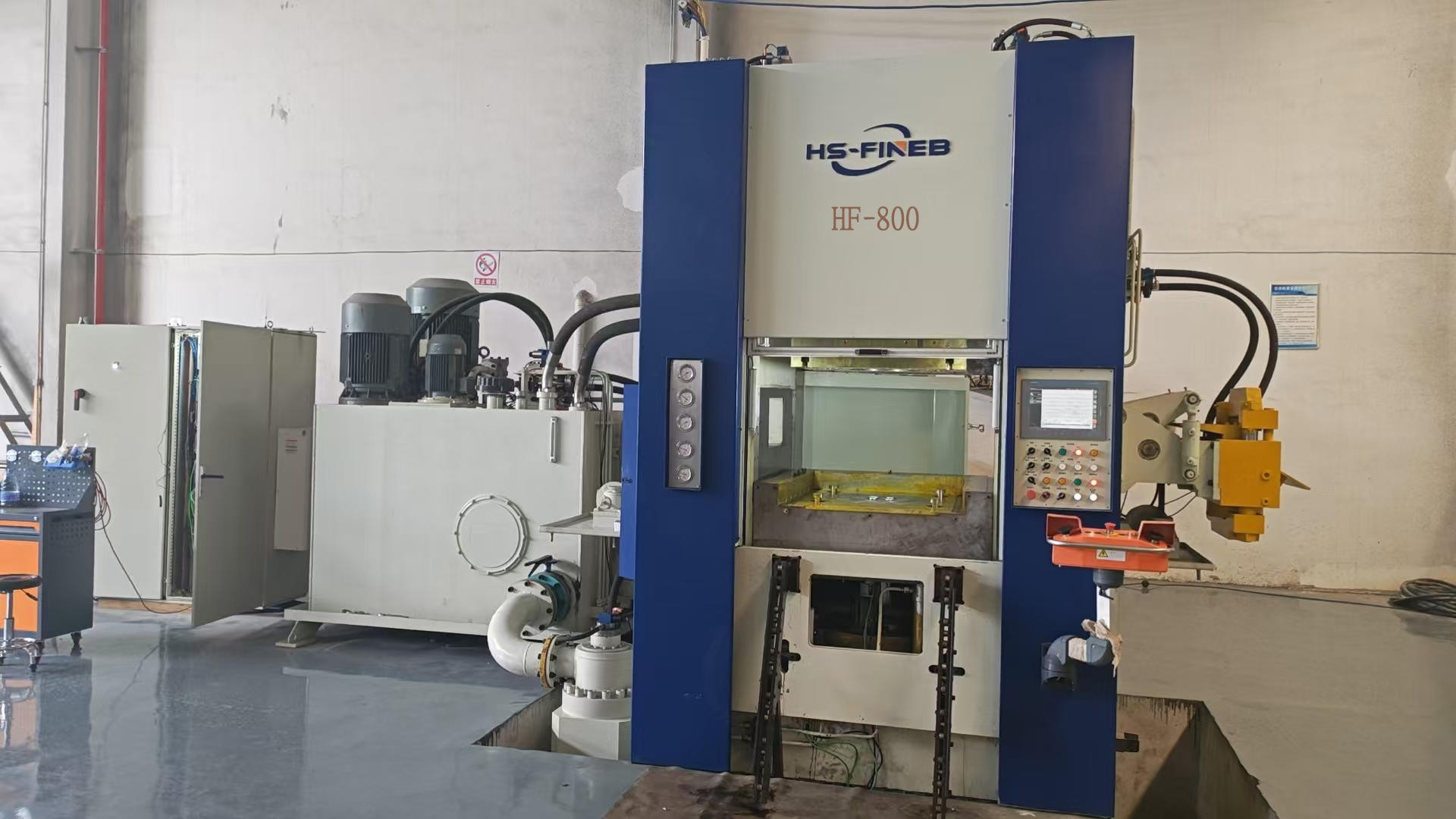
Every HF series press is equipped with a comprehensive sensor network that monitors machine health and process quality in real time. Pressure transducers on all hydraulic circuits report V-ring pressure, counter-pressure, system pressure, and accumulator pressure. Temperature sensors on the hydraulic oil reservoir, pump casings, and cylinder glands detect overheating conditions before they cause seal failure. Vibration sensors on the main motor, pump, and frame detect mechanical anomalies such as bearing wear, coupling misalignment, or loose mounting bolts. Oil cleanliness sensors report particle count and water contamination level in the hydraulic fluid, alerting maintenance when filter replacement is needed.
Sensor data is transmitted via Ethernet or cellular connection to a secure cloud manufacturing platform accessible from any web browser or mobile application. Plant managers can view real-time equipment status, production counters, and efficiency metrics for every press in their fleet, whether located in one factory or distributed across multiple sites. Automatic alert rules notify maintenance personnel when any parameter exceeds defined thresholds. For example, if hydraulic oil temperature rises above sixty degrees Celsius, an alert is sent immediately. If V-ring pressure deviates by more than five percent from recipe setpoint for three consecutive strokes, production is paused and the operator is notified to inspect the die or material.
The accumulated historical data enables predictive maintenance that replaces scheduled interval maintenance with condition-based intervention. Machine learning models analyze trends in oil temperature, pressure leakage rates, vibration spectra, and force curve shape changes to predict when specific components will require service. A gradual increase in hydraulic pump case drain flow indicates internal wear that will lead to catastrophic failure in approximately three hundred operating hours. Detecting this trend early allows planned replacement during a scheduled changeover rather than unexpected breakdown during production. Similarly, subtle changes in the force versus position curve can indicate die wear, punch chipping, or material property changes before they produce out-of-tolerance parts. This predictive capability transforms maintenance from a cost center into a competitive advantage, maximizing uptime while minimizing both repair costs and quality defects.
| Parameter | Traditional Manual Press | Smart CNC Fine Blanking |
|---|---|---|
| Productivity (OEE) | 55% - 70% | 85% - 93% |
| Die Changeover Time | 120 - 240 minutes | 20 - 30 minutes |
| First Part Quality | Requires 10 - 50 trial strokes | Recipe loaded, first part good |
| Part Consistency (Cpk) | 1.0 - 1.33 | 1.67 - 2.0 |
| Labor Cost per Shift | 3 operators + 1 supervisor | 1 operator + 1 supervisor |
| Process Documentation | Paper log sheets | Digital stroke-by-stroke trace |
| Defect Detection | Visual or periodic sampling | 100% in-line vision inspection |
| Maintenance Strategy | Scheduled preventive | Predictive condition-based |
| Energy Efficiency | Fixed pump displacement | Variable servo pump, 30% savings |
| Remote Support | None | Real-time cloud diagnostics |
The performance gap between traditional and smart fine blanking is substantial and measurable across every dimension of manufacturing excellence. Overall equipment effectiveness improves by twenty to thirty percentage points primarily through faster changeovers, reduced trial scrap, and fewer unplanned stops. Part quality consistency, measured by process capability index, increases from marginal to excellent. Labor cost per part drops by fifty to sixty percent because one operator can manage an entire automated line. Most importantly, the digital traceability of every stroke creates a quality record that satisfies automotive and medical industry auditing requirements without additional paperwork or manual data entry.
HS-FINEB engineers will evaluate your current production line and design a smart fine blanking upgrade path. From retrofit CNC packages for existing hydraulic presses to complete automated production lines, we provide the technology and integration expertise for intelligent manufacturing.