Precision fine blanking of 316L stainless steel and titanium bipolar plates for PEM fuel cells with flow channel depth plus or minus 0.02mm and flatness less than or equal to 0.05mm.
The global transition toward decarbonized energy has positioned hydrogen fuel cells as a critical technology for transportation and stationary power. Proton exchange membrane fuel cells require bipolar plates as their most numerous component. Each stack contains hundreds of plates, accounting for about sixty percent of stack weight and forty-five percent of cost.
Market projections from 2026 to 2030 indicate sustained high growth for bipolar plate manufacturing. The automotive sector is the primary demand driver, with heavy-duty trucks, buses, and passenger vehicles transitioning to hydrogen fuel cell powertrains. Stationary power including data center backup power are creating additional demand. The total addressable market is expected to expand by twenty-five to thirty percent annually through 2030.
This growth creates both opportunity and challenge for manufacturers. Production volume requirements are enormous, each fuel cell vehicle contains roughly four hundred bipolar plates, and projected volumes imply billions of plates per year. Simultaneously, precision requirements are demanding. Flow channels must maintain exact depth and width tolerances to ensure uniform gas distribution across the membrane electrode assembly. Plate flatness must be maintained under clamping loads to prevent gas leakage. These requirements of high volume and extreme precision make fine blanking ideal for bipolar plate production.
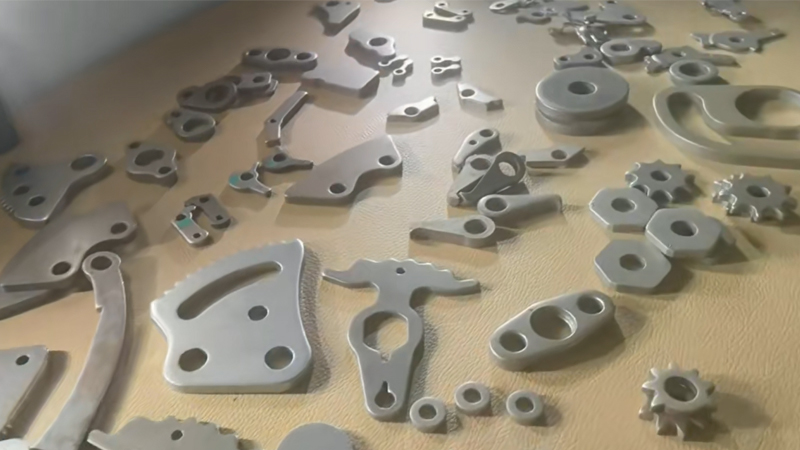
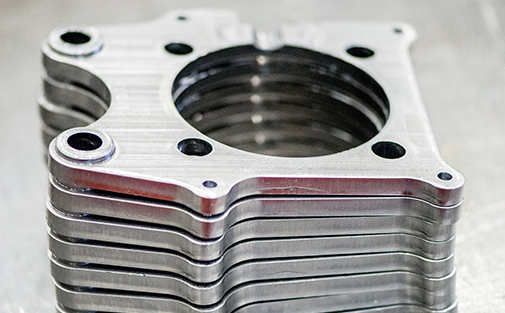
Bipolar plates perform three critical functions in a fuel cell stack. They distribute hydrogen and oxygen across the membrane electrode assembly through flow channels. They conduct electrical current between adjacent cells. They remove waste heat from the electrochemical reaction. Each function imposes geometric and surface quality requirements that fine blanking can satisfy.
Flow channel geometry is the most demanding feature. Channels are typically 0.5 to 1.5 millimeter wide and 0.1 to 0.5 millimeter deep, with serpentine or parallel patterns covering the active area. Fine blanking provides superior edge quality compared to conventional stamping, where channel edges contain a fracture zone with microcracks that cause dimension variation. Fine blanking produces a smooth shear edge through the full material thickness, maintaining consistent channel geometry.
The sealing surface around the plate perimeter must mate with an elastomer gasket to prevent gas leakage between cells. A fracture zone creates microscopic leak paths that compromise stack performance. Fine blanking eliminates this risk by producing a clean shear edge on the sealing groove, providing better gasket seating and extending gasket life.
Electrical conductivity depends on the flatness of contact areas between plates. Fine blanking maintains excellent flatness because counter-pressure prevents material bulging during shearing. The resulting flat plate achieves 0.05 millimeter flatness or better across the active area, ensuring uniform electrical contact resistance when compressed in the stack.
Austenitic stainless steel 316L is the most widely used material for fine-blanked bipolar plates due to excellent corrosion resistance in the acidic fuel cell environment and moderate cost. The low carbon content minimizes intergranular corrosion during coating processes. For fine blanking, annealed 316L with hardness between 85 and 95 HRB is preferred because it shears cleanly without excessive tool wear. Material thickness ranges from 0.1 millimeter for lightweight automotive designs to 0.2 millimeter for stationary power applications. The incoming coil thickness tolerance must be controlled within plus or minus 0.005 millimeter to ensure consistent channel depth after forming.
Titanium offers superior corrosion resistance with lower density for aerospace and high-performance automotive applications. Commercially pure titanium Grade 1, with oxygen content below 0.18 percent, is suitable for fine blanking in the annealed condition. The material's tendency to gall requires die design with polished surfaces and appropriate lubrication. After blanking, titanium plates receive protective coatings such as gold or platinum to enhance conductivity. The fine blanked surface must be free of burr and residual lubricant to ensure coating adhesion. Surface roughness in the range of Ra 0.2 to 0.8 micrometer provides optimal coating anchoring without stress risers.
Material surface quality before blanking directly impacts final plate performance. Incoming coil must be free of scale and rolling defects that could translate into channel geometry errors. Lubrication selection is critical for fine blanking thin stainless steel and titanium. HS-FINEB provides guidance on lubricant selection and application methods as part of the press commissioning and process development service for bipolar plate manufacturers.
Channel depth is the most tightly controlled dimension on a bipolar plate because it determines gas flow distribution across the membrane electrode assembly. Depth variation exceeding 0.02 millimeter causes flow maldistribution, membrane dry-out, and flooding. Fine blanking achieves this tolerance through die clearance of 0.5 percent of material thickness, precision guide pillars with less than 0.01 millimeter alignment, and counter-pressure that prevents material bulging. For 0.15 millimeter material, total die clearance is only 0.00075 millimeter, forcing the material to conform exactly to the punch geometry.
Stack flatness ensures uniform electrical contact resistance and gas sealing. When plates deviate from flatness, clamping force concentrates on high points, increasing resistance and leakage risk. Fine blanking produces inherently flat parts because counter-pressure supports the material from below during shearing, preventing the downward bulging that occurs in conventional stamping. Post-blanking stress relief annealing may be applied to remove residual stresses and maintain flatness during coating and assembly.
The sealing groove perimeter must maintain consistent width and depth for gasket compression within the elastic design range. Groove width variation causes insufficient compression and leakage, or over-compression and gasket creep. Fine blanking produces smooth, perpendicular groove walls with precise dimensional control. Surface roughness is controlled to Ra 0.4 to 1.6 micrometer, smooth enough for gasket sealing yet textured enough for coating adhesion. The absence of fracture-zone microcracks prevents crevice corrosion initiation in the aggressive fuel cell environment.
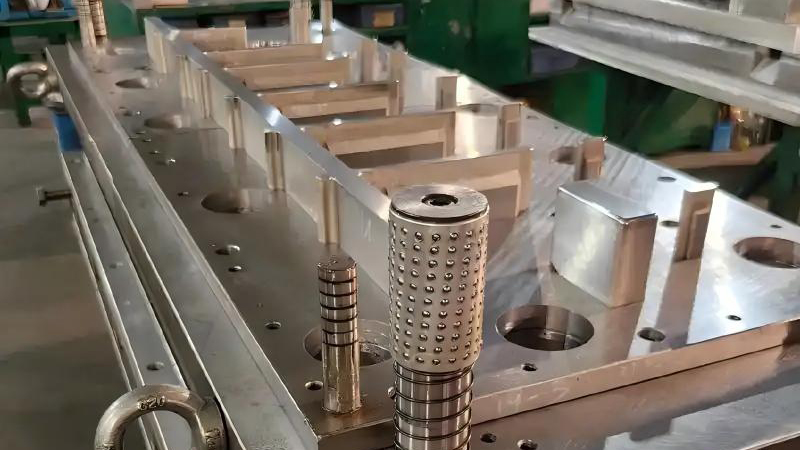
Bipolar plate fine blanking requires press parameters optimized for thin, corrosion-resistant materials. The HS-FINEB HF-320T and HF-400T presses are well-suited because their force range provides adequate capacity for bipolar plate sizes while maintaining precision for high-volume production.
For 316L stainless steel 0.1 to 0.2 millimeter thick, blanking force for a typical 300 by 150 millimeter plate is 80 to 150 tons. V-ring force is set to 25 to 35 percent of blanking force because thin sheet requires aggressive edge constraint to prevent buckling. Counter-pressure is 15 to 20 percent to maintain flatness without distorting the thin material. Cutting speed is reduced to 3 to 8 millimeter per second because thin sheet shears more cleanly at reduced speed.
Bipolar plate dies require precision ground punch and die inserts with surface roughness Ra 0.05 micrometer. Punch and die are manufactured from high-grade tool steel, vacuum heat treated to 60 to 62 HRC. Die clearance is 0.5 percent of material thickness per side, which for 0.15 millimeter material means only 0.00075 millimeter clearance. The V-ring geometry for thin material features reduced penetration depth of 15 to 20 percent of material thickness, preventing excessive thinning and cracking.
Coil feeding for thin bipolar plate material requires precision handling because 0.1 to 0.2 millimeter sheet is easily deformed. The HS-FINEB precision roll feeder uses small-diameter hardened feed rolls with diamond-knurled surfaces that grip without slippage. Feeding accuracy is plus or minus 0.02 millimeter per advance through servo motor control with encoder feedback. A precision straightener with eleven to fifteen rolls removes coil set before feeding. Lubrication is applied by precision roller coaters that deposit controlled synthetic blanking lubricant on both surfaces before the die.
Strip width must be controlled to plus or minus 0.1 millimeter because flow channels extend close to strip edges. Guide rails maintain lateral position within 0.05 millimeter. Scrap handling uses vacuum ejection to prevent thin material from clinging to the die face due to static electricity.
| Process | Cost per Part | Production Speed | Channel Precision | Suitable Volume | Material Range |
|---|---|---|---|---|---|
| Fine Blanking | Low to moderate | 30 to 60 strokes per minute | Plus or minus 0.02 millimeter | 10,000 to millions | 0.1 to 0.5 millimeter sheet |
| Chemical Etching | High | Batch process, slow | Plus or minus 0.05 millimeter | Low to moderate | 0.05 to 0.3 millimeter sheet |
| Conventional Stamping | Low | 100 to 200 strokes per minute | Plus or minus 0.1 millimeter | High | 0.1 to 0.5 millimeter sheet |
| Hydroforming | Moderate to high | 10 to 20 parts per minute | Plus or minus 0.03 millimeter | Moderate | 0.2 to 1.0 millimeter sheet |
Chemical etching uses photoresist masking and acid dissolution to create channel patterns. While capable of very fine features, the process involves multiple wet chemistry steps, generates hazardous waste, and achieves lower production rates than mechanical forming. The cost per part is high due to chemical consumption and batch processing. Etching is most suitable for prototyping and low-volume production where tooling investment cannot be justified.
Conventional stamping offers lower tooling cost and higher stroke rates but sacrifices edge quality and dimensional precision. The fracture zone on stamped channel walls creates microcracks that become corrosion initiation sites. For applications where corrosion resistance is critical, the additional tooling investment for fine blanking is recovered through improved stack life and reduced warranty claims. As volumes increase into millions of plates annually, the per-part cost advantage of fine blanking tooling amortization becomes decisive.
Hydroforming uses pressurized fluid to form channels against a die cavity, achieving good precision and minimal springback. However, the process is slower than fine blanking, requires more complex tooling with sealed pressure chambers, and is limited to materials with sufficient formability. Hydroforming is advantageous for very deep channels or complex three-dimensional geometries, but for the straight-sided channels typical of most bipolar plates, fine blanking offers a superior combination of speed, precision, and cost.
Contact HS-FINEB engineers for a feasibility assessment of fine blanking for your hydrogen fuel cell bipolar plate production. We will evaluate your channel geometry, material specification, and volume requirements to recommend the optimal press configuration, die design, and process parameters.